Aveline Kirana
The Royal Opera House has once again staged Vincenzo Bellini’s formidable opera, I Puritani, a work that has long been a benchmark for vocal virtuosity and a rarity on the operatic calendar. Bellini’s final opera, completed in 1835, tragically just months before his own premature death at the age of 33, presents a vocal Everest for its performers. This revival, absent from Covent Garden for 35 years, underscores the opera’s enduring, albeit demanding, legacy. The decision to revive I Puritani is invariably linked to the availability of a cast capable of navigating its treacherous vocal demands, a testament to the exacting standards set by Bellini and his celebrated tenor, Giovanni Battista Rubini.
The Vocal Gauntlet: Bellini’s Demanding Score
I Puritani is notorious for its extraordinarily challenging score, a defining characteristic that contributes to its infrequent performances. The opera demands singers with exceptional agility, unparalleled breath control, and the ability to sustain exceptionally high notes with seemingly effortless grace. The role of Arturo, the tenor, is particularly taxing, characterized by a "punishingly high tessitura." Elvira, the soprano, requires pinpoint accurate coloratura, while the bass and baritone roles also present significant hurdles. This extreme vocal athleticism is not merely a stylistic choice but an intrinsic element of Bellini’s bel canto aesthetic, pushing the boundaries of human vocal capability. The opera’s revival is thus a strategic undertaking, requiring meticulous casting and extensive preparation.
Libretto Dilemmas: A Tale of Nationalism and Confusion
While the musical demands are universally acknowledged, the libretto, penned by Carlo Pepoli, often draws criticism for its perceived incoherence and puerility. Pepoli, a poet, journalist, and politician, was not Bellini’s regular librettist. For I Puritani, he crafted a narrative set against the backdrop of the English Civil War, viewed through an Italian lens and infused with his own revolutionary nationalist sentiments. This combination results in a story that can appear disjointed and nonsensical, posing significant interpretive challenges for directors. The synopsis provided in the program, according to initial reports, bears little resemblance to the narrative enacted on stage, suggesting a deliberate departure from a literal interpretation of Pepoli’s text.
Director’s Vision: Embracing Abstraction and Modification
Director Richard Jones appears to have adopted a pragmatic approach to the libretto’s shortcomings, opting to "run with it" while introducing "perturbing modifications." While specific details of these changes remain undisclosed to avoid spoilers, the overall staging suggests a move away from strict historical accuracy towards a more abstract and symbolic representation. This directorial choice, coupled with Jones’s characteristic preference for minimalist staging and bleak backdrops, aims to maintain a sharp focus on the performers and their vocal artistry.
Minimalist Staging: A Canvas for Vocal Brilliance
The production’s visual design, by set designer Hyemi Shin, complements Jones’s minimalist aesthetic. A stark, slate-grey wall serves as a recurring backdrop, occasionally animated with projected "written script" symbolizing the characters’ internal monologues and correspondence. The main stage is dominated by a sandbag-lined stronghold, a setting that lends itself to the opera’s Civil War context. The inclusion of a cannon, assembled and maneuvered on stage in a seemingly arbitrary fashion, adds a surreal and disorienting element. A mobile "pop-up" display box ingeniously transforms to represent various locations, including private quarters, a chapel, a crypt, and a prison cell. A large spotlight on wheels underscores the feeling of pursuit and entrapment in later scenes. The chorus’s repetitive, almost comically stylized marches across the stage further contribute to a sense of theatrical artifice, at times evoking a pantomime.
Wardrobe Choices: Eclectic and Historically Ambiguous
Costume designer Nicky Gillibrand’s approach to the wardrobe appears equally unconventional, with outfits seemingly drawn from various eras and sources. The military attire, in particular, defies historical categorization, with some soldiers sporting flak jackets and helmets, while others exhibit a more Wild West aesthetic. The protagonist Arturo is notably dressed in candy-striped trousers and a maroon waistcoat, a costume choice that evokes a circus performer rather than a nobleman, further blurring historical and thematic lines.
The Music Reigns Supreme: Bellini’s Enduring Score and Frizza’s Direction
Despite the conceptual and visual complexities of the production, the fundamental strength of I Puritani lies in its music. The article’s author reiterates a frequently held conviction: that opera’s primary focus should be its music and singing. This revival, fortunately, delivers on this front. Bellini’s score is described as exquisite, a testament to his compositional genius, even with its demanding vocal requirements. Conductor Riccardo Frizza is lauded for his superb direction, eliciting beautiful sounds from the orchestra and expertly guiding the cast through the opera’s intricate musical landscape. His stewardship is crucial in balancing the operatic drama with the sheer vocal pyrotechnics required.
A Stellar Cast: The Heart of the Performance
The scarcity of I Puritani performances is directly linked to the difficulty of assembling a cast capable of meeting its rigorous vocal demands. This production, however, is presented as a resounding success in this regard, featuring a stellar group of artists who rise to the occasion.
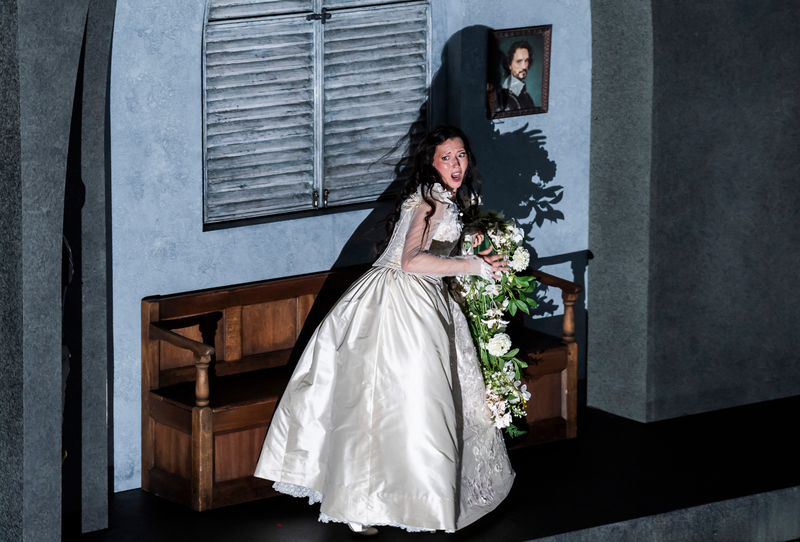
Lisette Oropesa: A Tour de Force as Elvira
Soprano Lisette Oropesa, renowned for her acclaimed performances of Elvira in Paris and at the Metropolitan Opera, reprises the role with undeniable brilliance. Her portrayal is described as indisputable evidence of her status as the preeminent lyric coloratura soprano of her generation. Her flawless technique, characterized by rapid trills, fluid runs, and exquisite vocal ornamentation, is a spectacle in itself. Her upper register is robust and secure, and her top notes are crystalline in their precision. Her rendition of "Son vergin vezzosa" in the first act, capturing Elvira’s joy at Arturo’s arrival, is noteworthy. The duet "Sai com’arde in petto mio" is imbued with profound emotion, conveying Elvira’s despair at being forced into an unwanted marriage.
The opera’s famous "Mad Scene," a sequence of arias rather than a single piece, serves as Elvira’s ultimate showpiece. Oropesa’s performance of "Qui la voce sua soave" and "Vien, diletto, è in ciel la luna" is described as "sublime," offering some of the most divine bel canto singing ever heard. Beyond her astonishing vocal capabilities, Oropesa is recognized as a consummate actress. Her descent into madness is portrayed with remarkable conviction, transitioning from bright optimism to visible distress, betrayal, and a complete detachment from reality. Her wide-eyed, frantic, and frenetic performance, marked by hallucinatory conversations and utter mental turmoil, is compelling. A particular scene alluding to Elvira’s molestation by the villain Riccardo is singled out for its disturbing intensity, leaving the reviewer feeling a need for a trigger warning. Oropesa’s performance is hailed as that of a supreme artist, fulfilling her own assessment that Elvira represents the "absolute peak of a career."
Francesco Demuro: Navigating the Tenor’s High Wire Act
The role of Lord Arturo Talbo is equally famous for its demanding tenor part, including an optional but celebrated high F (F5) in the aria "Credeasi, misera." This note, written by Bellini for the exceptional vocal abilities of Rubini, is often transposed or omitted by tenors. Sardinian tenor Francesco Demuro bravely tackled the high F, a vocal accomplishment that, while perhaps not conventionally "pretty" to the reviewer’s ear due to its inherent force, was an "astonishing vocal accomplishment" and part of a superbly sung aria. His C sharp in the famous love aria and quartet "A te, o cara" was superb, as was his performance of this taxing piece, an ambitious undertaking for an opening aria. Demuro’s finest work, however, is reserved for the later acts, particularly "La mia canzon d’amore!", sung with "fine, expansive emotion and feeling" upon his escape and return to his homeland. He is described as possessing a "sound, limpid, bright tenor with a wonderful bel canto line."
Andrzej Filończyk: A Menacing and Expressive Baritone
As the villain Sir Riccardo Forth, Polish baritone Andrzej Filończyk commands the stage with a potent mix of superciliousness and menace. His singing is characterized by a "stunningly rich and expressive instrument." His Act I romanza, "Ah! per sempre io ti perde," lamenting the impending loss of Elvira to his rival Arturo, is rendered with genuine poignancy. The Act II duet with Giorgio, "Il rival salvar tu déi," discussing Arturo’s fate, is delivered with a "rousingly stentorian" yet passionate quality.
Ildebrando D’Arcangelo: Richness and Empathy from the Bass-Baritone
Ildebrando D’Arcangelo portrays Sir Giorgio Valton, Elvira’s uncle, with a voice of "sublime quality." His vocal instrument is described as "treacle rich throughout the registers with opulent timbre and velvety resonance." His Act I interaction with Elvira, "Odi! Qual suon si desta?", where he reassures her of her father’s consent to her marriage to Arturo, is endearing. However, his most significant contribution is in the Act II aria "Cinta di fiori," where he sings of his niece’s distress and descent into madness. D’Arcangelo infuses the piece with "almost tangible empathy," his mellifluous tone caressing each word.
Supporting Roles and Chorus
Marcela Rahal, as Enrichetta di Francia, the deposed Queen, delivers a splendid duet with Arturo, "Sulla verginea testa," leaving the audience wanting to hear more of her "fine, luxurious mezzo." Blaise Malaba, as Lord Gualtiero Valton, Elvira’s father, makes brief but impactful appearances, showcasing his magnetic stage presence and a deep, resonant bass. The Royal Opera Chorus is, as expected, magnificent. Their combined majestic voices are a cornerstone of operatic performance, and their efforts here are highly commendable. However, their stage actions, choreographed by movement director Sarah Fahie, are described as somewhat superfluous and perfunctory.
Implications and the Enduring Appeal of I Puritani
The revival of I Puritani at Covent Garden serves as a potent reminder of the opera’s enduring power and its unique place in the repertoire. Its rarity is a direct consequence of its extreme vocal demands, making each performance a significant event. The production’s conceptual choices, while perhaps divisive, highlight a modern approach to staging classic works, prioritizing thematic resonance and artistic interpretation over strict adherence to historical context.
The success of this production hinges on its vocal prowess, with Lisette Oropesa’s Elvira being a particular standout. Her performance reinforces the notion that I Puritani is a work best experienced when a cast of exceptional caliber is available. For opera enthusiasts and lovers of beautiful music, this revival offers a rare opportunity to witness Bellini’s masterful score brought to life by world-class artists. The underlying message remains clear: go for the music, and if you are fortunate enough to witness Oropesa’s portrayal, the peculiarities of the plot will undoubtedly fade into insignificance. The opera’s infrequency ensures that such an opportunity should not be missed.