
 Indra Aziz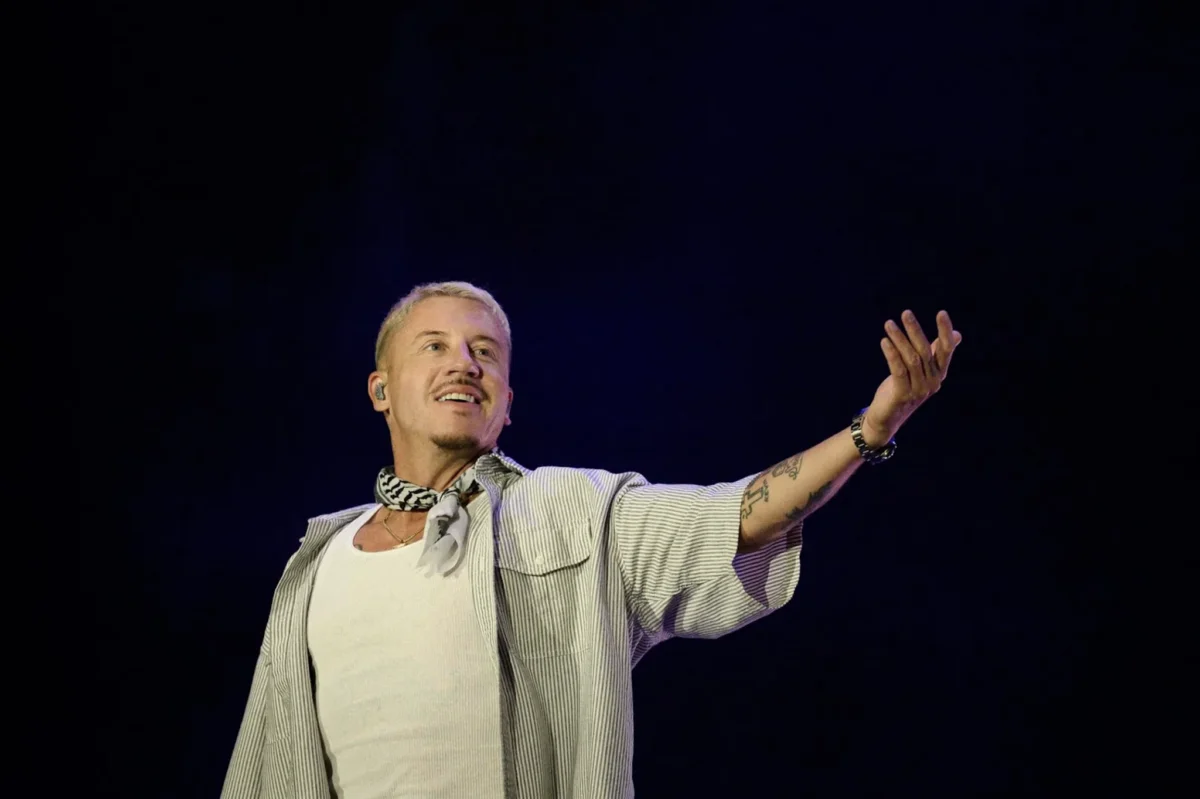
American rapper Macklemore has been officially dropped as the opening act for Ed Sheeran’s upcoming U.S. Loop Tour, following widespread controversy surrounding an impassioned pro-Palestinian speech he delivered during a concert earlier this month. The decision, announced by the tour’s promoters, highlights the increasingly delicate intersection of mainstream popular music, massive commercial concert venues, and geopolitical activism.
The controversy centers on an event that took place on September 4th at the MetLife Stadium in New Jersey, where Macklemore—born Ben Haggerty—took to the stage and addressed tens of thousands of concertgoers. For the Seattle-born artist, the moment was framed as an intentional platform to amplify humanitarian concerns regarding the ongoing conflict in Gaza and the West Bank, a cause he has vocally supported for several years.
However, the subsequent fallout has led to high-stakes commercial repercussions, resulting in his removal from eight of the remaining ten dates of Sheeran’s high-profile tour.
The Catalyst: The MetLife Stadium Performance
On September 4th, during his opening set at the MetLife Stadium, Macklemore addressed the audience directly, articulating his stance on the humanitarian crisis in the Middle East.
"A big part of the reason why I wanted to do this tour in the first place is so I could stand up in stadiums like this and say two words that are very near and dear to my heart: ‘Free Palestine,’" Macklemore told the packed stadium. "I said, ‘Free Palestine!’ I want those words to be loud and clear, so that people all the way in Gaza to the occupied West Bank know that we have not forgotten about them."
Following his speech, Macklemore launched into a live performance of his politically charged track “Hind’s Hall,” a song specifically written to protest the military actions in Gaza and university crackdowns on student demonstrations. As he performed, graphic and sobering images documenting the destruction in Gaza were projected onto the massive stadium screens behind him, leaving a profound and polarized impression on the audience.
While a significant portion of the crowd responded with vocal approval, the performance quickly triggered intense repercussions within the political and entertainment spheres. Pro-Israel organizations in the United States mobilized quickly against the rapper. The watchdog group StopAntisemitism published a sharply worded critique on Instagram, accusing the artist of projecting what they termed “anti-Israel propaganda.” This post gained significantly broader visibility after being amplified by pop singer Pink, drawing mainstream media attention to the brewing culture-war flashpoint.
Promoter Statement and Tour Logistics
The commercial fallout materialized swiftly. Messina Touring Group, the promoter responsible for the U.S. leg of Ed Sheeran’s Loop Tour, issued an exclusive statement to Rolling Stone detailing the rationale behind the rapper’s abrupt removal from the remainder of the concert dates.
"As the concert promoter for Ed Sheeran’s U.S. Loop Tour, we have been notified by venues on the upcoming U.S. tour dates that they will not allow a concert to take place with Macklemore on the lineup, which would result in the cancellation of the tour and impact hundreds of thousands of fans," the promoter stated. "After discussions with stakeholders, Macklemore will not be performing on the remaining support dates."
Prior to his dismissal, Macklemore was scheduled to provide direct support for Ed Sheeran at eight out of ten remaining shows on the tour itinerary, which is slated to resume on September 19th in Philadelphia. The logistical hurdles cited by Messina Touring Group—namely, venue pushback and the threat of total tour cancellations—underscore the immense financial and organizational stakes involved in staging stadium-scale events, where multiple corporate entities, local municipalities, and venue owners hold leverage over the touring lineup.
Macklemore Responds via Social Media
In the wake of the announcement, Macklemore took to Instagram to issue a comprehensive and reflective statement regarding his removal from the tour, contextualizing the event within a broader pattern of censorship and political discomfort within the entertainment industry.
"What I said at MetLife I have been saying on stages around the world for almost three years. So why is it an issue now?" Macklemore wrote. "Because now I’m sharing the stage with one of the biggest artists in the world, in some of the biggest stadiums in America. At a certain level of exposure, ‘Free Palestine’ becomes too much of a risk. If I kept doing the shows, saying Free Palestine, with Ed implicitly supporting it, the crowd getting loud and showing undeniable support for Palestinian liberation, what artist might speak out next? The stage becomes resistance. Maybe that’s why this time it became so important to silence me."
The rapper’s public remarks point directly to the tension between corporate entertainment interests and individual artistic expression. By linking his removal to the immense scale of Ed Sheeran’s platform, Macklemore suggested that mainstream institutional gatekeepers are willing to tolerate political speech only when it occurs on smaller, independent stages where it lacks the commercial amplification to disrupt the status quo.
Broader Industry Silence and Stakeholder Stances
As of the reporting of this development, representatives for Ed Sheeran—who has not personally commented on the matter—as well as the management teams for the various venues involved, have largely maintained silence. This widespread reluctance to issue public statements reflects the profound polarization surrounding the Israeli-Palestinian conflict and the commercial risks prominent artists face when dragged into geopolitical controversies.
The incident also highlights a growing trend of ideological clashes within the live music industry. In recent months, numerous musicians, actors, and cultural figures have faced career disruptions, canceled contracts, or intense public scrutiny over their public statements regarding the conflict in the Middle East. Conversely, artists who remain silent or issue neutral statements frequently face criticism from fans and activist organizations demanding moral accountability.
Implications for Live Entertainment and Freedom of Expression
The removal of Macklemore from Ed Sheeran’s tour serves as a significant case study regarding the boundaries of free speech in commercial spaces. Stadium-sized tours involve complex ecosystems of private venue operators, corporate sponsors, insurance providers, and major booking agencies. While artists retain the legal right to express political opinions, private venues and promoters similarly retain the contractual authority to alter lineups to protect their financial interests, avoid liability, or prevent logistical disruptions.
Legal and industry analysts note that while outright government censorship is barred by constitutional protections in the United States, private-sector curation of entertainment spaces operates under different rules. Venues and promoters routinely enforce codes of conduct or clauses concerning public safety and public disruption. However, critics of Macklemore’s removal argue that using venue access as a lever to suppress political discourse sets a dangerous precedent for artists seeking to use their platforms to address global humanitarian crises.
Looking Ahead: The Tour Resumes Without Its Opener
Ed Sheeran’s U.S. Loop Tour will proceed as planned, resuming on September 19th in Philadelphia, though it will do so without Macklemore on the bill. Whether the promoters will announce a replacement opening act or how concertgoers will respond to the altered lineup remains to be seen.
For Macklemore, the episode is unlikely to temper his activism. Having built a career on socially conscious hip-hop—exemplified by past hits addressing income inequality, LGBTQ+ rights, and systemic racism—the rapper has signaled that his commitment to the Palestinian cause remains absolute, regardless of the commercial fallout. Nevertheless, the incident vividly illustrates the steep price artists may pay when their personal convictions collide with the corporate machinery of the global music industry.

![Watch Carl Cox spotlight his favourite disco records ahead of Louie Vega b2b set at [UNVRS] Ibiza](https://empire-music.net/wp-content/uploads/2026/09/watch-carl-cox-spotlight-his-favourite-disco-records-ahead-of-louie-vega-b2b-set-at-unvrs-ibiza.webp)
