Nayara Elvina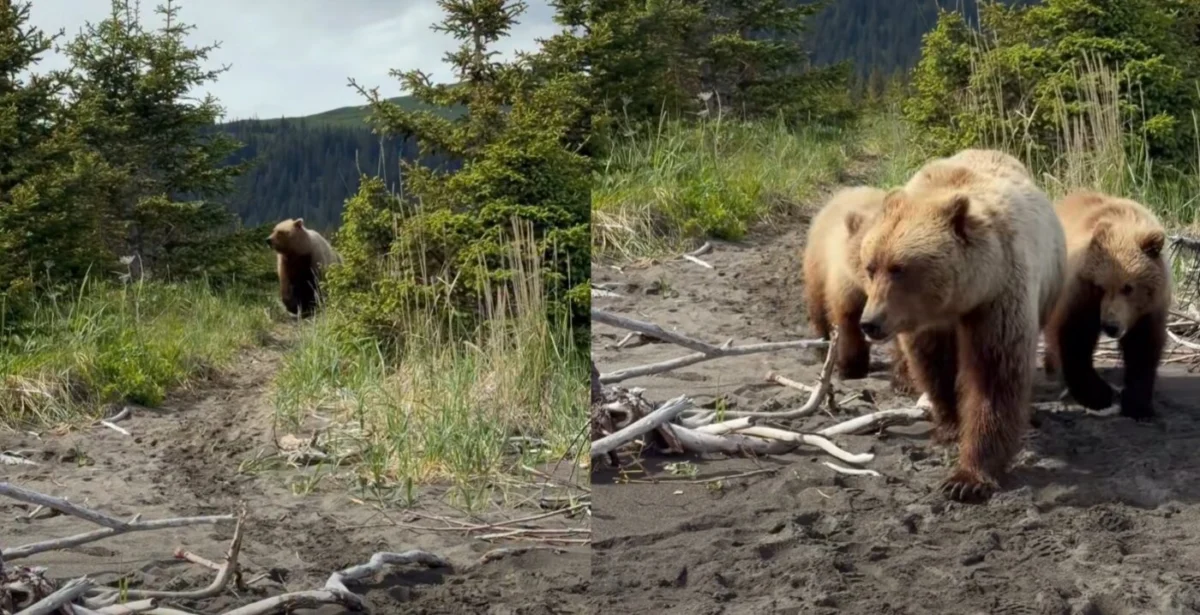
The vast wilderness of Alaska offers some of the most breathtaking landscapes on the North American continent, yet it simultaneously serves as the untamed domain of Earth’s most formidable apex predators. For professional wildlife guides and recreational outdoor enthusiasts alike, venturing into the backcountry requires a constant state of situational awareness, profound respect for local fauna, and an understanding of animal behavior. This delicate coexistence was recently underscored when professional wildlife and Alaska bear guide Brooke Bartleson found herself in a high-stakes scenario, coming face-to-face with a grizzly bear sow and her two sizable offspring on a narrow mountain trail.
While running into a single grizzly bear during a backcountry excursion is widely considered a worst-case scenario for the average hiker, encountering an entire family unit elevates the risk profile exponentially. However, for professionals whose careers are dedicated to wildlife navigation, such incidents serve as a potent reminder of the unpredictability inherent in wild environments. The encounter, which was successfully managed through adherence to established wildlife protocol and subsequently documented on video, highlights the vital intersection between human recreation, animal migration patterns, and safety preparedness in prime grizzly territory.
Main Facts of the Encounter
The incident unfolded along an unnamed Alaskan trail as Bartleson and a group of hiking companions prepared to ascend a section of the path. According to accounts shared by the guide, the tranquility of the wilderness was abruptly interrupted when a female grizzly bear, accompanied by two younger bears, came barreling down the trail directly toward their location.
Rather than panicking, fleeing, or resorting to aggressive defensive displays, Bartleson and her group executed textbook wildlife encounter protocols. The group immediately stepped off the trail, backing up as far as the dense surrounding terrain would permit to maximize the distance between themselves and the approaching animals. By remaining completely still, maintaining a collective calm, and offering the family unit an unhindered path of travel, the humans successfully avoided provoking a defensive or predatory response from the apex predators.
The grizzly family maintained their momentum, passing by the stationary group with minimal hesitation and appearing to pay remarkably little attention to the humans standing just feet away in the brush. Despite the heart-pounding nature of the event, the outcome was entirely peaceful, resulting in no injuries to either the humans or the bears. Bartleson managed to capture the entire sequence on camera, later utilizing social media platforms to educate the public on the realities of backcountry travel and the critical importance of maintaining composure under extreme pressure.
Chronology of Events in Backcountry Bear Encounters
Understanding how wildlife encounters progress from initial surprise to resolution is essential for analyzing backcountry safety. While every wild animal interaction is unique, incidents involving fast-moving predators typically follow a compressed timeline that leaves little room for hesitation.
The sequence of events during the encounter on the Alaskan trail can be broken down into distinct phases:
- Pre-Encounter Preparation: Bartleson and her group were at the base of a trail section, preparing to ascend. At this stage, standard backcountry protocols—such as carrying bear spray in an accessible location and maintaining a baseline level of auditory awareness—were already established.
- The Detection Phase: The grizzly family appeared suddenly, moving rapidly down the trail toward the hikers. The element of surprise was mutual, as the bears were moving with purpose and the humans were positioned near the trailhead.
- The Assessment and Reaction Phase: Recognizing the immediate proximity of a sow with offspring, Bartleson and her companions instantly assessed the danger. Rejecting the instinctual urge to run—which can trigger a predator’s chase response—the group moved backward off the trail and assumed a stationary, non-threatening posture.
- The Passage Phase: The grizzly sow and her two sub-adult cubs swept past the stationary group, utilizing the path of least resistance. The bears remained focused on their trajectory rather than the human observers.
- De-escalation and Reflection: Once the bear family cleared the immediate area and moved out of sight, the group allowed a safety buffer of time before assessing the situation, confirming the safety of all participants, and documenting the event for educational purposes.
Supporting Data: Grizzly Bear Demographics and Habitat Overlap
To contextualize the frequency and potential hazards of human-wildlife interactions in Alaska, it is necessary to examine population estimates and ecological data regarding Ursus arctos horribilis, commonly known as the grizzly bear.
Alaska supports a robust and thriving population of grizzly bears, with biologists estimating that approximately 30,000 individuals inhabit the state. This represents one of the highest concentrations of grizzly bears in North America, sustained by the region’s abundant salmon runs, expansive wilderness tracts, and rich foraging opportunities. Because humans and bears frequently utilize the same geographical features to navigate the rugged terrain, spatial overlap is statistically inevitable.
Research in wildlife ecology consistently demonstrates that both wildlife and human recreationists heavily favor pre-existing linear corridors. Mountain trails, old logging roads, game paths, and valley floors offer surfaces of least resistance. For a massive mammal weighing several hundred pounds, navigating a cleared trail requires significantly less caloric expenditure and physical exertion than forcing a path through dense underbrush, windfall, and thick timber.
Consequently, trails function as shared highways within ecosystems. When a human hiker rounds a blind corner or ascends a rise on a trail, they are utilizing the exact same infrastructural pathway that bears, wolves, moose, and other large mammals rely on for daily travel and foraging. This underlying reality is the primary driver behind the vast majority of surprise bear encounters in North America.
Official Responses and Expert Safety Guidelines
Wildlife management agencies, including the Alaska Department of Fish and Game (ADF&G) and the National Park Service (NPS), continuously issue comprehensive guidelines for recreating in bear country. These protocols are formulated based on decades of behavioral research and historical incident data, designed specifically to minimize negative outcomes for both people and bears.
When evaluating the actions taken by Bartleson during her recent encounter, wildlife professionals universally validate her response as the gold standard of backcountry safety. Key directives emphasized by safety experts include:
- Never Run: Running triggers the predatory chase instinct in bears, even species that are primarily herbivorous or omnivorous. A grizzly bear can easily outrun a human over any distance, achieving speeds of up to 35 miles per hour.
- Stand Your Ground and Stay Calm: Panic generates erratic movements and high-pitched vocalizations that can startle or provoke an animal. Remaining stationary allows the bear to assess the human as a non-threatening, non-prey entity.
- Yield the Right of Way: As demonstrated in this encounter, forcing a confrontation over trail space is counterproductive. Stepping off the trail and giving the animal ample room to move past reduces defensive aggression, particularly for a mother bear protecting her young.
- Avoid Eye Contact, but Keep the Bear in Sight: Direct, prolonged eye contact can be interpreted by a grizzly as a challenge or a threat. Conversely, looking away entirely surrenders situational awareness. Observers should watch the animal with averted or lowered glances while tracking its movements.
- Carry and Know How to Use Deterrents: While the specific details of this encounter did not necessitate the discharge of a deterrent, regulatory bodies strongly mandate the carriage of EPA-approved bear spray within arm’s reach during any backcountry excursion.
Broader Impact and Implications for Outdoor Recreation
The viral dissemination of Brooke Bartleson’s trail encounter serves a dual purpose within the broader conservation and outdoor recreation communities. On one hand, it provides a gripping narrative that captures the imagination of the public regarding the raw power of Alaska’s wilderness. On the other hand, it functions as a vital educational tool that demystifies predator behavior and counters sensationalized myths surrounding grizzly bears.
As ecotourism and recreational hiking continue to surge in popularity across North America, the number of inexperienced individuals venturing into remote habitats increases proportionally. This demographic shift often correlates with a rise in preventable human-wildlife conflicts. Educational outreach from certified guides, wildlife biologists, and outdoor media outlets is essential for fostering a culture of preparedness.
Furthermore, the incident highlights the ecological necessity of viewing trails not merely as human recreational assets, but as dynamic shared ecosystems. Respecting wildlife requires acknowledging that humans are guests in these environments. When an animal utilizes a trail, the onus rests upon the human visitor to yield space, exercise patience, and prioritize the natural behaviors of native species.
Ultimately, Bartleson’s experience reinforces the reality that coexistence with apex predators is entirely achievable through education, emotional control, and deep respect for the natural world. By adhering to proven safety measures and remaining calm when faced with the unexpected, outdoor enthusiasts can navigate the challenges of bear country while preserving the wild integrity of habitats across Alaska and beyond.