Nayara Elvina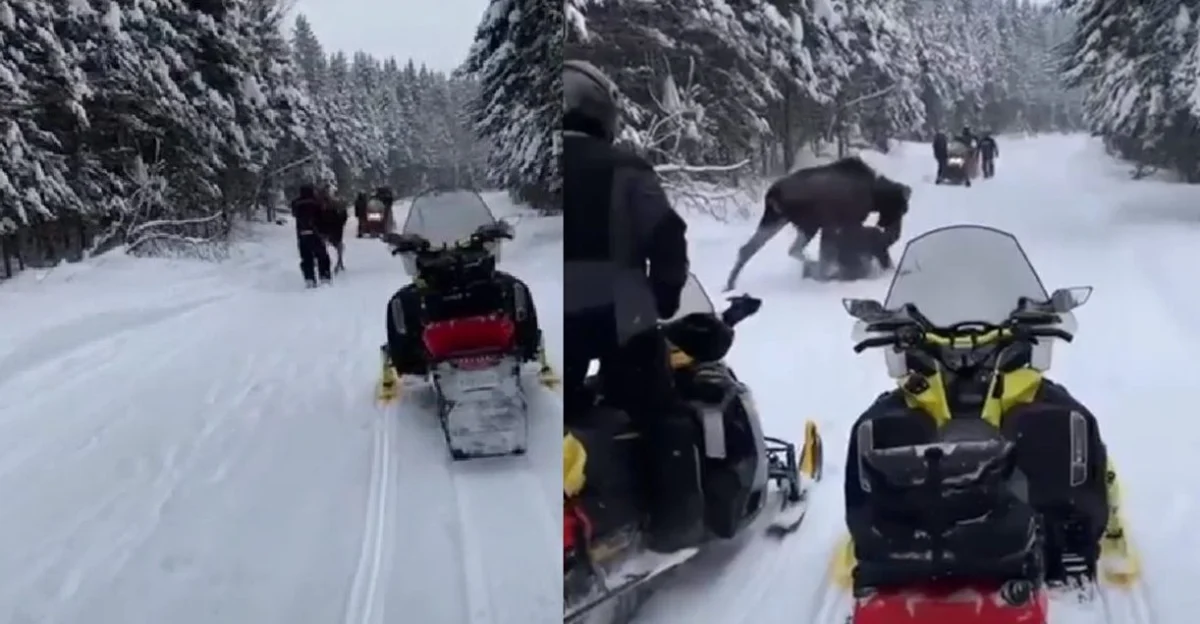
The northern wilderness of North America presents a deceptive illusion of tranquility during the winter months. Blanketed in deep snow and silent pines, regions across Canada and the northern United States transform into playgrounds for winter sports enthusiasts, particularly snowmobilers. However, beneath the serene landscape lies an unforgiving ecosystem governed by wildlife whose survival instincts are finely tuned to harsh seasonal demands. Among these inhabitants is Alces alces, the North American moose. While commonly romanticized as gentle giants of the forest, these massive herbivores command respect and caution that many casual visitors fail to comprehend. A viral video originating from the Canadian wilderness has once again thrust the complex and frequently dangerous dynamics of human-wildlife encounters into the global spotlight, illustrating the catastrophic consequences of misjudging wild animals in their natural habitat.
Main Facts of the Incident
The recorded incident, which rapidly circulated across social media platforms including X (formerly Twitter) in January 2024, captures a harrowing escalation between a group of snowmobilers and an adult moose. According to visual evidence and witness observations from the footage, the encounter began when several recreational riders crossed paths with a moose occupying a groomed snowmobile trail. Rather than maintaining a safe distance or allowing the animal the right-of-way, one individual dismounted from his vehicle and advanced toward the towering mammal, seemingly attempting to interact with or approach the creature.
The moose, interpreting the human’s forward movement as a direct threat within its personal space, immediately shifted from a posture of cautious observation to aggressive self-defense. In a matter of seconds, the animal charged the dismounted rider, knocking him forcefully onto the snow-covered ground. Despite the man’s frantic attempts to crawl away and escape the onslaught, the moose delivered a series of devastating kicks using its powerful hind legs. The confrontation culminated in a severe physical injury when the animal targeted the victim’s lower extremity, resulting in a visible fracture around the knee area before the camera operator abruptly averted the lens. The video sparked widespread commentary regarding wilderness safety, the ethics of human interference with wildlife, and the predictable outcomes of ignoring basic outdoor protocols.
Chronology of the Encounter
Understanding how a recreational winter excursion rapidly deteriorates into a medical emergency requires examining the sequence of events typical of such winter wildlife interactions. While the complete, unedited timeline of the January 2024 Canadian incident is defined primarily by the viral video clip, the progression of the confrontation follows a well-documented behavioral pattern familiar to wildlife officers and conservation authorities.
Phase One: Convergence on the Trail. The snowmobile party was navigating a recognized, hard-packed winter trail network. Due to the extreme depth of the surrounding snowpack—frequently exceeding four feet in northern backcountry areas—wildlife naturally gravitates toward packed routes to conserve vital energy reserves. The riders rounded a bend or section of the trail to find a moose standing squarely in their path.
Phase Two: The Approach. Standard outdoor safety protocol mandates halting snowmobiles at a considerable distance, turning off or idling engines, and either waiting for the animal to move or slowly retreating to give the creature space. In this specific instance, the protocol was severely violated. One rider dismounted and initiated a direct approach on foot toward the large herbivore, fundamentally misinterpreting the animal’s temperament and physical capabilities.
Phase Three: Defensive Escalation. Sensing it had no viable avenue of escape—surrounded by deep, energy-draining powder on either side—the moose perceived the approaching human as an imminent predatory threat. True to its biological defense mechanisms, the animal eliminated the perceived danger by charging. The victim was instantaneously floored by the sheer impact of the charge.
Phase Four: The Attack and Injury. Pinned in the snow, the victim attempted to scramble away while companions shouted futilely from a distance. The moose utilized its most effective close-range defense weapon: rapid, heavy-impact stomping and kicking with its sharp-hoofed rear legs. During this phase, the victim sustained a severe structural injury to the knee area before the recording was abruptly terminated.
Supporting Data: The Biology and Statistics of Moose Conflicts
To contextualize the severity of the Canadian incident, one must examine the physiological attributes of the moose and the statistical reality of human-wildlife conflicts in northern regions. Adult moose are the largest extant members of the deer family (Cervidae). Mature bulls routinely weigh between 1,200 and 1,500 pounds, while large cows generally range from 800 to 1,000 pounds. Standing up to seven feet tall at the shoulder, their immense bulk is propelled by long, muscular legs capable of carrying them through deep snow and across lakes at speeds reaching 35 miles per hour.
Despite their classification as herbivores whose diets consist of willow twigs, bark, leaves, and aquatic vegetation, moose inflict more injuries on humans in North America annually than bears and wolves combined. Wildlife management agencies in states like Alaska, Maine, Wyoming, and Canadian provinces such as Ontario, Alberta, and British Columbia consistently log hundreds of aggressive moose encounters each year.
These confrontations spike during two distinct seasonal windows:
- The Autumn Rut (September–October): Bull moose experience surges in testosterone, rendering them highly territorial, erratic, and prone to charging inanimate objects, vehicles, or humans.
- The Winter and Spring Thaw (January–May): Deep snowpacks restrict movement and force moose onto plowed roads and snowmobile trails. During spring, pregnant cows (cows carrying calves or nursing newborns) exhibit extreme maternal aggression, readily stomping any perceived threat—including dogs, livestock, and humans—into submission.
Furthermore, moose possess notoriously poor eyesight. Rather than pausing to evaluate an unfamiliar object or shape, their instinctual response to uncertainty is often a preemptive charge. When combined with the physical mechanics of a kick capable of fracturing human bones and a propensity to use their hooves to stomp adversaries on the ground, a close-range encounter without protective barriers is exceptionally hazardous.
The Winter Trail Dilemma: Snowmobiles Versus Wildlife
The intersection of motorized recreation and winter wildlife habitat creates persistent management challenges for conservation officers. Snowmobilers traversing remote backcountry trails frequently underestimate how their presence impacts animals struggling through the lean winter months.
When a snowmobile approaches a moose on a narrow, packed trail, the animal faces a physiological crisis. Plunging off the trail into chest-deep or waist-deep powder requires an expenditure of energy that a winter-stressed moose can ill afford. Consequently, the animal often stands its ground, feeling cornered and anxious.
A common error made by motorized recreationists is the belief that revving the snowmobile engine will intimidate the animal into fleeing. In behavioral terms, the high-pitched whine and deep rumble of a two-stroke or four-stroke snowmobile engine do not register as a sign of human dominance; instead, they mimic the aggressive vocalizations or territorial challenges of a rival animal. This auditory trigger frequently pushes a hesitant moose across the threshold from passive defensiveness into active aggression.
Official Responses and Wilderness Safety Protocols
Following the widespread dissemination of the January 2024 video, wildlife conservation agencies, park rangers, and outdoor safety organizations reiterated standard guidelines for safely managing wildlife encounters in deep-snow environments. Authorities emphasize that wild animals are not domestic pets and must never be approached, fed, or cornered, regardless of how docile or stationary they appear.
Conservation officers outline several non-negotiable rules for snowmobilers operating in moose territory:
- Maintain Distance: Upon spotting a moose on or near a trail, immediately cut the throttle and bring the snowmobile to a complete stop at a distance of at least 50 to 100 yards.
- Silence the Machine: Shut off the engine if safe to do so, or allow it to idle quietly without revving or making sudden, loud noises that could provoke an aggressive reaction.
- Observe Body Language: Watch for warning signs of agitation, including flattened ears, raised hair along the neck and shoulders (hackles), lip-licking, grunting, or lowering the head. These indicators signal that the animal is preparing to charge.
- Yield the Trail: Never attempt to herd, push, or drive a moose off a trail. Back up slowly and safely, providing the animal ample time and unobstructed space to move away on its own terms. If the moose refuses to move, recreationists must be prepared to turn around and find an alternate route.
- Avoid Dismounting: Never step off the machine to take photographs, record close-up videos, or attempt physical contact. A snowmobile serves as a vital physical barrier and means of rapid escape; removing oneself from that shelter exposes the individual to catastrophic physical trauma.
Broader Impact and Implications
The intense public reaction to the viral Canadian snowmobile incident—reflected in online discussions referencing concepts like natural selection and Darwin Awards—highlights a broader cultural disconnect between modern populations and the realities of wild ecosystems. As outdoor recreation participation grows and backcountry access expands via high-performance snowmobiles, all-terrain vehicles, and winter utility vehicles, human-wildlife interfaces are increasingly frequent.
Sociologically and ecologically, these events carry significant implications. For the individual involved, a momentary lapse in judgment resulted in permanent physical consequences, serving as a visceral reminder of the fragility of the human body when pitted against a 1,000-pound wild mammal. For the broader community of winter sports enthusiasts, the incident underscores the urgent need for enhanced outdoor education regarding wildlife ethics. Conservation groups continually advocate for mandatory safety briefings and stricter trail etiquette regulations to prevent avoidable injuries to humans and unnecessary stress—or lethal management interventions—for local wildlife populations.
Ultimately, the northern wilderness remains an untamed domain operating under ancient biological laws. As long as humans venture into deep snow country on mechanized transport, mutual respect for the landscape and its formidable inhabitants will remain the single greatest determinant of survival.