Aveline Kirana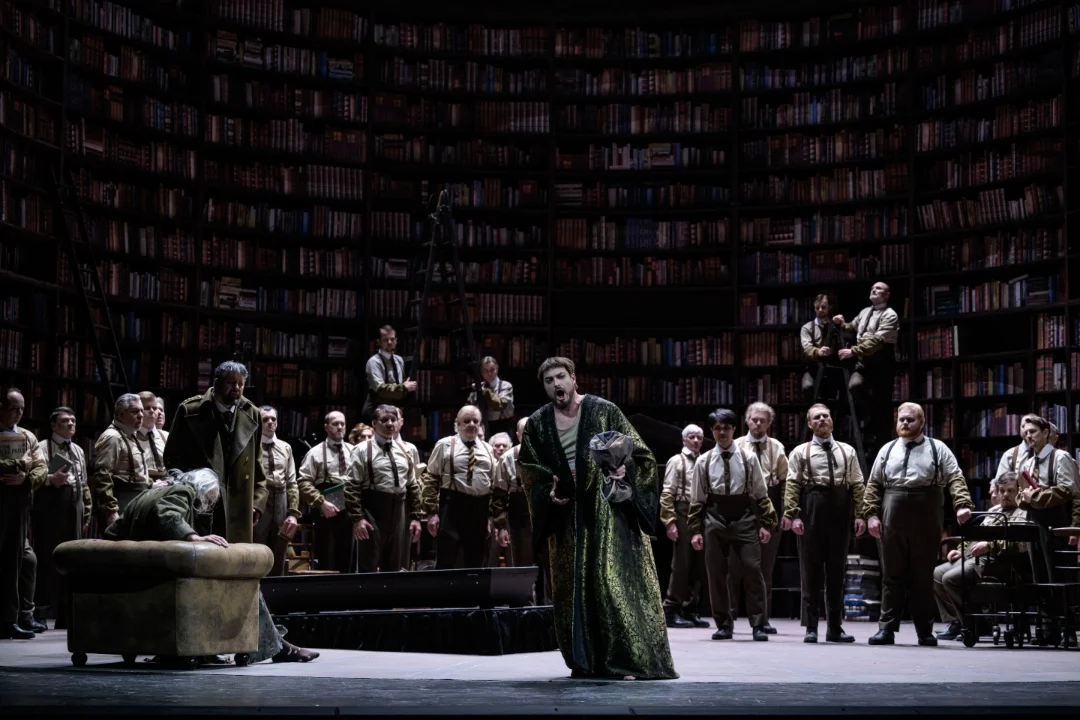
A week before Good Friday, the National Theatre in Prague unveiled its highly anticipated production of Richard Wagner’s Parsifal, a work often described as a "Bühnenweihfestspiel" or "stage consecration festival play." Premiering on [Insert Date – e.g., March 22, 2026], this staging, under the direction of Andreas Homoki, transcended a mere interpretation of inherited faith, instead embarking on a profound and unsettling inquiry into the very architecture of knowledge, meaning, and human longing. Wagner’s final opera, a complex distillation of philosophical thought into a seemingly simple narrative, finds new resonance in Homoki’s vision, which draws inspiration not from traditional operatic interpretations but from the labyrinthine, bureaucratic worlds depicted by Franz Kafka.
A Narrative of Spiritual Crisis and Intellectual Architecture
Wagner’s Parsifal centers on a naive young man who stumbles into the cloistered world of the Grail knights. Their king, Amfortas, suffers from an incurable wound, a physical manifestation of desire and moral failure. Guided by the elder Gurnemanz, Parsifal gradually unravels the community’s spiritual crisis, encountering the enigmatic Kundry, a figure who embodies the dualities of temptation and penitence, and the restless currents of human yearning. The opera’s traditional arc suggests that redemption is not found in dogma or ritual, but in compassion forged through profound personal experience and self-awakening. Parsifal’s journey culminates in his transformation and his ability to heal Amfortas, ultimately assuming leadership.
However, Andreas Homoki’s direction fundamentally reconfigures this narrative. In his hands, Parsifal becomes a paradoxically more human and more disquieting experience, akin to a closed, Kafkaesque system where meaning is meticulously archived, administered, and, by implication, potentially suffocated. The production eschews the hallowed traditions of Bayreuth, instead grounding its conceptual framework in the writings of the Czech author Franz Kafka.
The Bureaucracy of the Grail: An Archive of Illusion?
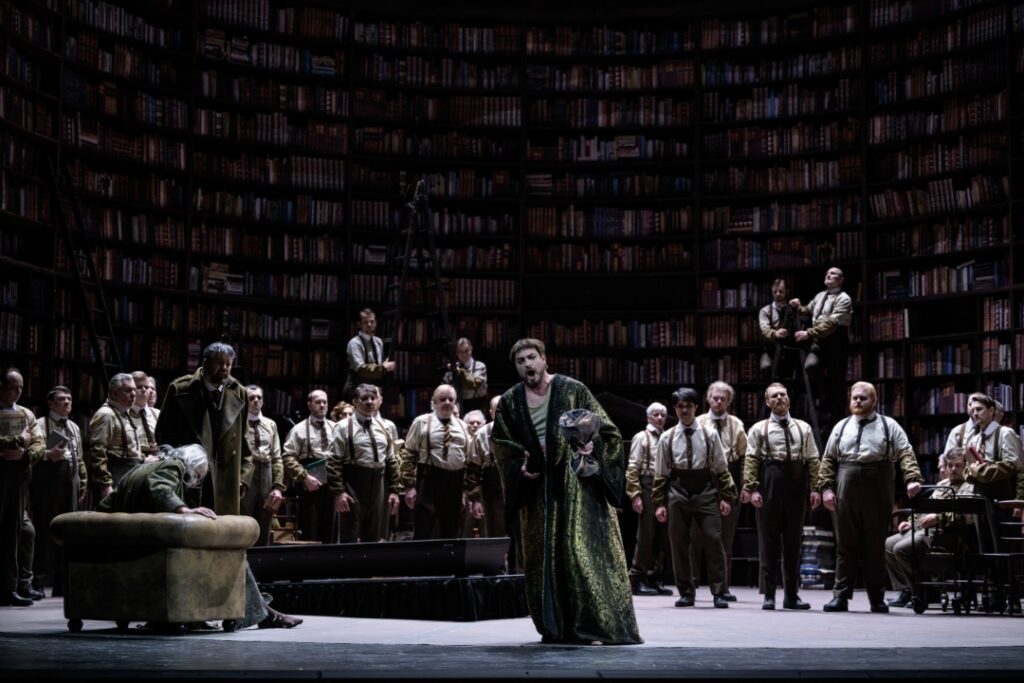
In this Prague production, the hallowed ranks of the Grail knights are reimagined as diligent bureaucrats, the custodians of an immense and impressive library. This vast repository, visually rendered by set designer Frank Philipp Schloessmann, is not merely a physical space but a symbolic construct. The revolving set itself takes the form of a conical vessel, a multifaceted metaphor simultaneously representing the Grail, an archive, and a containment unit. Its geometric design dictates the entire dramaturgy.
The visual language of the set emphasizes a stark dichotomy: private encounters are relegated to the exposed periphery, close to the edge of the stage, suggesting vulnerability and direct engagement. In contrast, communal rituals are drawn inward, retreating into the heart of this bureaucratic sanctum. This potent visual metaphor underscores Homoki’s central thesis: enlightenment, in this context, is not a sudden revelation but a process of administration. This is particularly evident in the first and third acts, where the weight of knowledge and its management becomes palpable.
Act II: A Grotesque Divertissement of Mechanized Desire
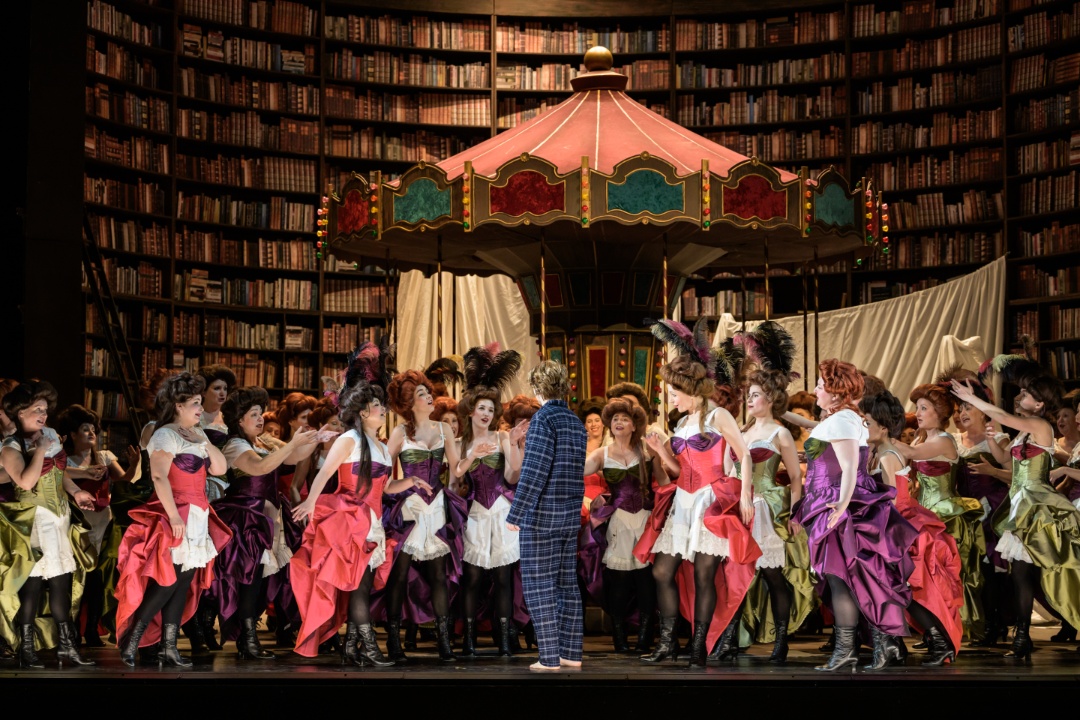
The second act of Homoki’s Parsifal offers a stark departure, transforming into a grotesque divertissement. This act unfolds as a colorful, almost nightmarish carousel that also functions as a brothel, where illusion is mechanized and desire is put on stark, unsettling display. Martin Bárta, as the sorcerer Klingsor, presides over this gaudy menagerie. The flower maidens, styled as Gibson-girl figures, descend and circle Parsifal in choreographed waves of seductive allure.
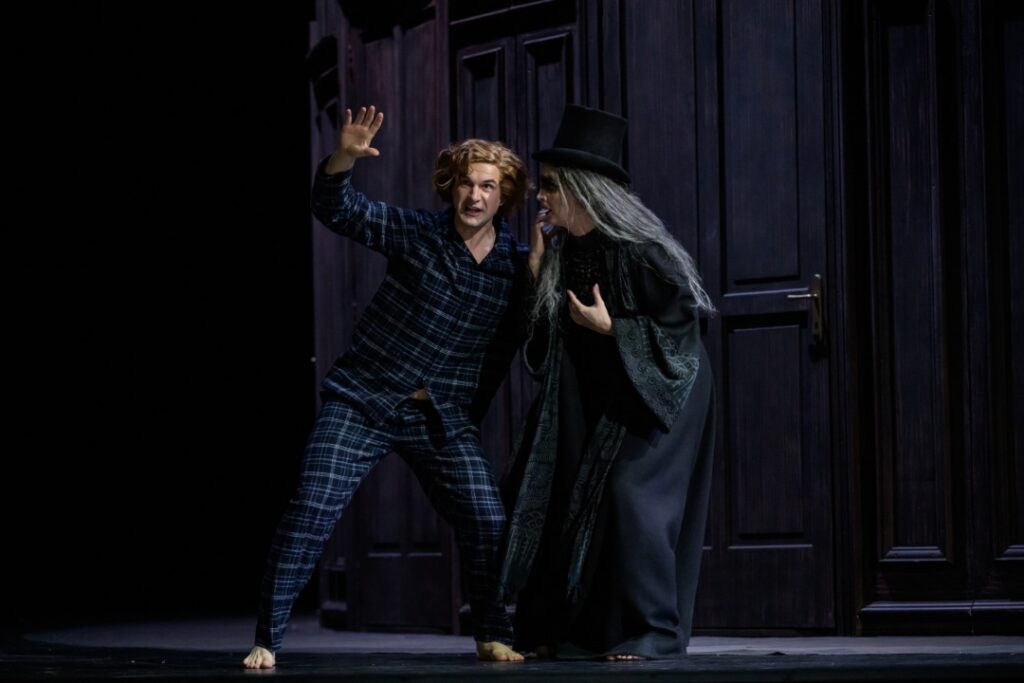
Matthew Newlin, in the titular role, provides a crucial anchor of stillness amidst this swirling spectacle. His stoic presence at the center of the act generates significant tension, as he resists the centrifugal pull of the surrounding sensuality. The dramatic axis shifts decisively with the entrance of Ester Páleníková as Kundry. Páleníková cuts through the superficial artifice with a darker, more focused energy, her presence immediately disrupting the choreographed seduction. Her intervention disperses the flower maidens almost violently, collapsing the carousel’s ephemeral allure into a single, charged confrontation. In this pivotal moment, seduction briefly morphs into revelation, and the drama finds its fleeting, visceral emotional core.
Philosophical Underpinnings: Schopenhauer and Buddhist Renunciation
Homoki’s interpretation, while distinctly modern and intellectual, surprisingly aligns with the philosophical underpinnings of Wagner’s original conception. Wagner himself was deeply influenced by Arthur Schopenhauer’s pessimism and a generalized, Westernized interpretation of Buddhist renunciation. In this production, Amfortas’s wound transcends a mere theological curse, becoming instead a symptom of systemic exhaustion. It represents desire without transcendence, and ritual devoid of genuine renewal. Parsifal, the archetypal "pure fool," enters this hermetically sealed order as an anomaly, an unclassified variable whose very presence challenges the established equilibrium.
Orchestral Illumination Under Markus Poschner
In the pit, the State Opera Orchestra, under the baton of Markus Poschner, mirrored the dramatic arc of the staging, progressing from initial opacity to eventual illumination. The opening notes exhibited a degree of uncertainty, with textures that felt slightly unsettled and balances not yet fully calibrated. However, Poschner’s masterful long-range sense of structure gradually asserted itself. By the third act, the performance had achieved a remarkable lucidity and depth. Phrases breathed with organic life, harmonic tensions resolved with an almost natural inevitability, and the orchestral fabric glowed with a quiet, profound emotional authority. In these final stretches, the orchestra’s performance seemed to achieve what the staging only tentatively suggested: a credible, resonant vision of redemption.
Vocal Performances: Anchors and Anomalies
The vocal cast delivered performances that navigated the complexities of Homoki’s vision with notable skill. American tenor Matthew Newlin approached the title role with a lyric instrument of appealing warmth. His Parsifal was that of a young man audibly grappling with the nascent burden of self-recognition, a portrayal subtly underscored by his attire – a pair of checkered Pendleton pajamas that offered a disarming touch of domesticity within the operatic grandeur. Newlin’s voice carried well, and he shaped the crucial central transformation scene with an increasing inwardness that successfully avoided grandiosity.
Finnish bass Timo Riihonen served as the evening’s moral anchor as Gurnemanz. His delivery was characterized by vocal steadiness and excellent diction, allowing Wagner’s often dense narration to unfold with admirable clarity. Czech baritone Jiří Hájek, as Amfortas, was vocally firm, projecting his anguish in broad, emphatic strokes. In Homoki’s staging, Amfortas is granted a significant divergence from traditional readings: he is offered death as a release, a final gesture of closure that provides a poignant resolution for the character.
Czech bass Ivo Hrachovec made a striking, albeit brief, impression as Titurel, emerging from his coffin with ritualistic gravity, embodying a chilling sense of the living dead. Czech baritone Martin Bárta, as Klingsor, presided over the second act’s descent into the grotesque. While Bárta’s timbre was agreeable, it lacked the darker grain that can imbue the character with true menace. Consequently, the act’s impact relied more on its visual excesses and conceptual daring than on vocal threat.
Ester Páleníková’s Kundry: The Emotional Core
It was left to Czech mezzo-soprano Ester Páleníková, the sole female lead and making her role debut as Kundry, to provide the evening’s most compellingly dramatic through-line. Páleníková’s performance was notable for its profound physical commitment – barefoot, restless, and oscillating between feral agitation and poised seduction. More significantly, however, it was distinguished by its psychological coherence. Her Kundry is not simply a figure suffering under an ancient curse but a self-aware individual driven by a lucid desperation for release.
In the second act, her narration of Parsifal’s past unfolded with an intimacy that cut through the surrounding spectacle. The palpable erotic charge of the scene, amplified by Parsifal’s resolute refusal, generated a moment of genuine theatrical suspense. Though largely silent throughout the third act, Páleníková remained a central, magnetic presence. Homoki’s decision to have Amfortas die in her arms is a powerful directorial choice, compressing an entire history of longing and shared suffering into a fleeting, emotionally charged tableau. A significant departure from tradition, Kundry does not perish in this production. Instead, Parsifal’s final gesture of absolution, rather than annihilation, is offered. This subtle but significant shift tilts the opera, often accused of terminal solemnity, toward a cautiously affirmative, even hopeful, conclusion.
Implications and Future Resonance
Homoki’s interpretation, while challenging traditional notions of Parsifal, leaves ample room for a contemplation of a "happy ending." The community of knights may regain their will to organize and understand the world’s knowledge, Parsifal finds his identity and purpose, Kundry achieves a semblance of peace, and Amfortas experiences a redeemed death. Coupled with the sublime realization of the third act by Markus Poschner and the orchestra, the premiere evening was met with a warm and sustained applause from the Prague audience.
The production’s engagement with themes of knowledge, bureaucracy, and the nature of redemption offers a timely commentary on contemporary society. In an era saturated with information and increasingly mediated by systems of administration, Homoki’s Parsifal serves as a potent reminder of the human cost of intellectualization and the enduring power of hard-won compassion. The National Theatre’s bold staging invites audiences to question not only the nature of faith and ritual but also the very structures of knowledge that shape our understanding of ourselves and the world. This production is poised to spark considerable discussion within the opera world and beyond, offering a fresh and intellectually rigorous perspective on one of opera’s most enduring and enigmatic masterpieces.