Nayara Elvina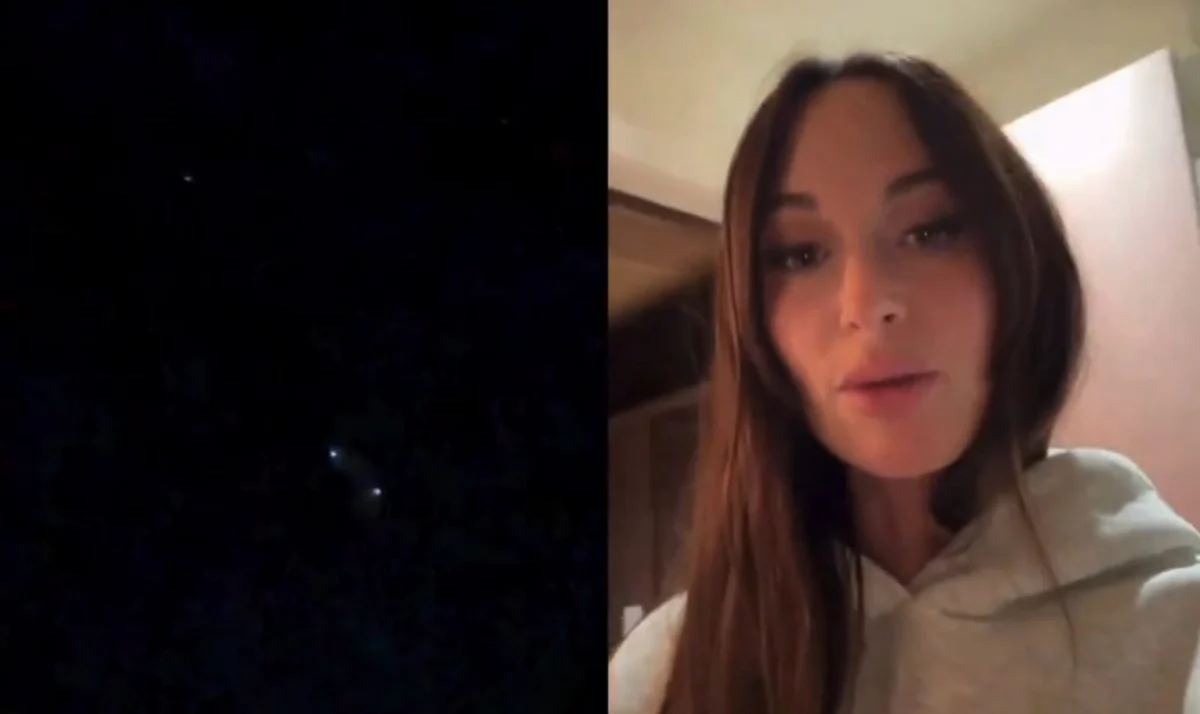
Seven-time Grammy Award-winning artist Kacey Musgraves has become the latest high-profile individual to report a sighting of Unidentified Aerial Phenomena (UAP) during a commercial flight. The incident, which occurred during a transit from Fort Worth, Texas, to Nashville, Tennessee, involved the observation of three luminous "orbs" that appeared to follow the aircraft for a significant portion of the journey. While the footage shared by Musgraves on social media has sparked widespread public interest, aerospace analysts and digital forensics experts have pointed to a more terrestrial explanation: the optical phenomenon known as Starlink horizon flares.
Detailed Account of the Aerial Sighting
The event took place in April 2026, while Musgraves was traveling over the south-central United States. According to the singer-songwriter’s testimony, she was preparing to rest when her attention was drawn to unusual lights outside the cabin window. Musgraves described the objects as three distinct orbs that appeared to be trailing the aircraft at an altitude she estimated to be approximately 50,000 feet.
The behavior of the objects, as described by Musgraves, did not conform to standard aeronautical movements. She noted that the orbs were intermittently appearing and disappearing, often shifting their relative positions to form triangular patterns. The color of the phenomena was described as a deep orange, though the intensity of the light varied significantly throughout the encounter. At certain intervals, the orbs reportedly increased in size and brightness, changing color before fading entirely from view, only to reappear moments later.
The sighting was not limited to the passenger cabin. Musgraves reported that upon inquiring with the flight crew, both pilots confirmed they were observing the same lights. Furthermore, the pilots indicated that such sightings had become a recurring element of their nocturnal flights across the United States. One pilot reportedly noted seeing similar objects while flying over New York the previous evening, while the other cited a similar experience over Dallas. This anecdotal evidence from professional aviators suggests a widespread and frequent occurrence of these specific aerial signatures within the commercial aviation corridors.
Chronology of the Encounter and Flight Path Analysis
The timeline of the sighting provides critical context for identifying the phenomena. Musgraves first noted the presence of the orbs as the aircraft passed near Little Rock, Arkansas. The objects remained visible and seemingly in proximity to the plane for approximately 45 minutes, persisting until the flight reached the airspace near its destination in Nashville.
Analysis of the flight trajectory from Fort Worth to Nashville places the aircraft within a specific geographical and temporal window where sunlight can still reach objects in Low Earth Orbit (LEO), even when the surface of the Earth is in darkness. This period, shortly after sunset or before sunrise, is the primary window for observing satellite reflections. Digital analysts tracking the flight’s coordinates noted that the entire duration of the encounter occurred within the "Starlink flare band," a region where the geometry between the sun, the observer, and Elon Musk’s SpaceX satellite constellation is optimized for high-intensity reflections.
The Science of Starlink Horizon Flares
While the visual characteristics described by Musgraves—erratic movement, changing luminosity, and formation flying—may initially seem extraterrestrial or technologically advanced, they align closely with the known physics of satellite flaring. The All-domain Anomaly Resolution Office (AARO), a specialized division within the U.S. Department of Defense tasked with investigating UAPs, has released technical papers specifically addressing this phenomenon.
A satellite flare occurs when sunlight reflects off the flat, highly reflective surfaces of a satellite, such as its solar arrays or chassis. Because Starlink satellites operate in "mega-constellations" consisting of thousands of units in coordinated orbits, it is common for multiple satellites to pass through the same reflective window in quick succession.
The "triangular patterns" and "erratic movement" described by witnesses are often an optical illusion resulting from the orbital mechanics of the Starlink constellation. The satellites follow criss-crossing orbital planes. When one satellite moves out of the optimal angle for reflection and "disappears," another satellite entering the same window may "appear" at a different point in the sky. To a moving observer on an airplane, this sequence of appearing and disappearing lights can create the impression of a single group of objects maneuvering in formation or following the aircraft.
Furthermore, the perceived altitude of 50,000 feet is a common misestimation in aerial sightings. Human depth perception is notoriously unreliable when viewing bright lights against a featureless night sky. While the satellites are actually positioned approximately 340 miles (over 1.7 million feet) above the Earth’s surface, their brightness and movement relative to the aircraft’s horizon can make them appear much closer to the observer’s altitude.
Official Responses and the AARO Perspective
The Department of Defense, through AARO, has increased its public transparency regarding satellite-related UAP reports. In a formal information paper, AARO stated that the advent of satellite communication mega-constellations has significantly increased the number of reported UAPs. The office noted that there are currently thousands of artificial satellites in LEO, with plans for tens of thousands more in the coming decade.
AARO’s research indicates that satellite flaring is an optical phenomenon that can be predicted with high accuracy based on the known positions of satellites and the observer. The agency has emphasized that while these sightings are "unexplained" to the casual observer or even to experienced pilots in the moment, they do not represent a threat to national security or evidence of non-human intelligence. The office continues to work with the Federal Aviation Administration (FAA) to educate pilots on these visual phenomena to reduce the number of official UAP reports that can be attributed to commercial satellite activity.
Broader Impact on Astronomy and Aviation
The incident reported by Kacey Musgraves highlights a growing tension between the expansion of global satellite internet infrastructure and the preservation of the night sky. The proliferation of Starlink and similar constellations has drawn significant criticism from the global astronomical community.
Astronomers argue that the high reflectivity of these satellites interferes with deep-space observations and increases "light pollution" in the upper atmosphere. The "flaring" phenomenon witnessed by Musgraves is a visible manifestation of this interference. As more companies, including Amazon and OneWeb, launch their own constellations, the frequency of these sightings is expected to rise.
From an aviation safety perspective, the recurring nature of these sightings poses a unique challenge. While the satellites are far above the flight paths of commercial jets, the visual distraction to pilots is a concern. The fact that the pilots on Musgraves’ flight were already familiar with the orbs suggests that the aviation community is self-adjusting to this new reality, categorizing these lights as a routine part of modern night flying rather than an emergency or an encounter with the unknown.
Public Perception and the Modern Space Age
The timing of Musgraves’ report coincides with a period of heightened public interest in space exploration and the search for extraterrestrial life. With the ongoing Artemis II mission—the first crewed mission to orbit the Moon in over half a century—public attention is fixed on the skies. This cultural backdrop often leads to a "pro-extraterrestrial" bias in the interpretation of unexplained aerial sightings.
Musgraves herself expressed an openness to the idea that the orbs were not of this world, noting that she has witnessed several unexplainable events over the years. This sentiment is echoed by a significant portion of the public who remain skeptical of government or corporate explanations for UAPs. The discrepancy between the scientific explanation (satellite flares) and the witness experience (maneuvering orbs) continues to fuel a robust debate in the digital age.
Fact-Based Analysis of the Implications
The Kacey Musgraves sighting serves as a case study in the intersection of celebrity influence, social media, and scientific literacy. When a high-profile individual shares compelling video evidence of a "UFO," it reaches millions of people instantaneously, often before a technical analysis can be performed.
However, the corroborating data—the flight path, the timing of the sun’s position, and the technical characteristics of Starlink satellites—points toward a definitive, man-made cause. As the orbital environment becomes increasingly crowded, the distinction between "unidentified" and "misidentified" becomes crucial. For the scientific and defense communities, the priority remains the accurate identification of all objects in the national airspace. For the public, the incident remains a reminder of the rapidly changing nature of our skies in the 21st century, where the line between science fiction and orbital logistics is increasingly blurred.
While Musgraves’ experience was undoubtedly profound and visually striking, the evidence suggests that the "three orbs" were not visitors from another world, but rather the reflective glint of the massive infrastructure currently being built in the heavens to connect the world below. As more satellites reach orbit, these celestial "triangle patterns" are likely to become a permanent, if controversial, fixture of the human experience of the night sky.