Johan Budi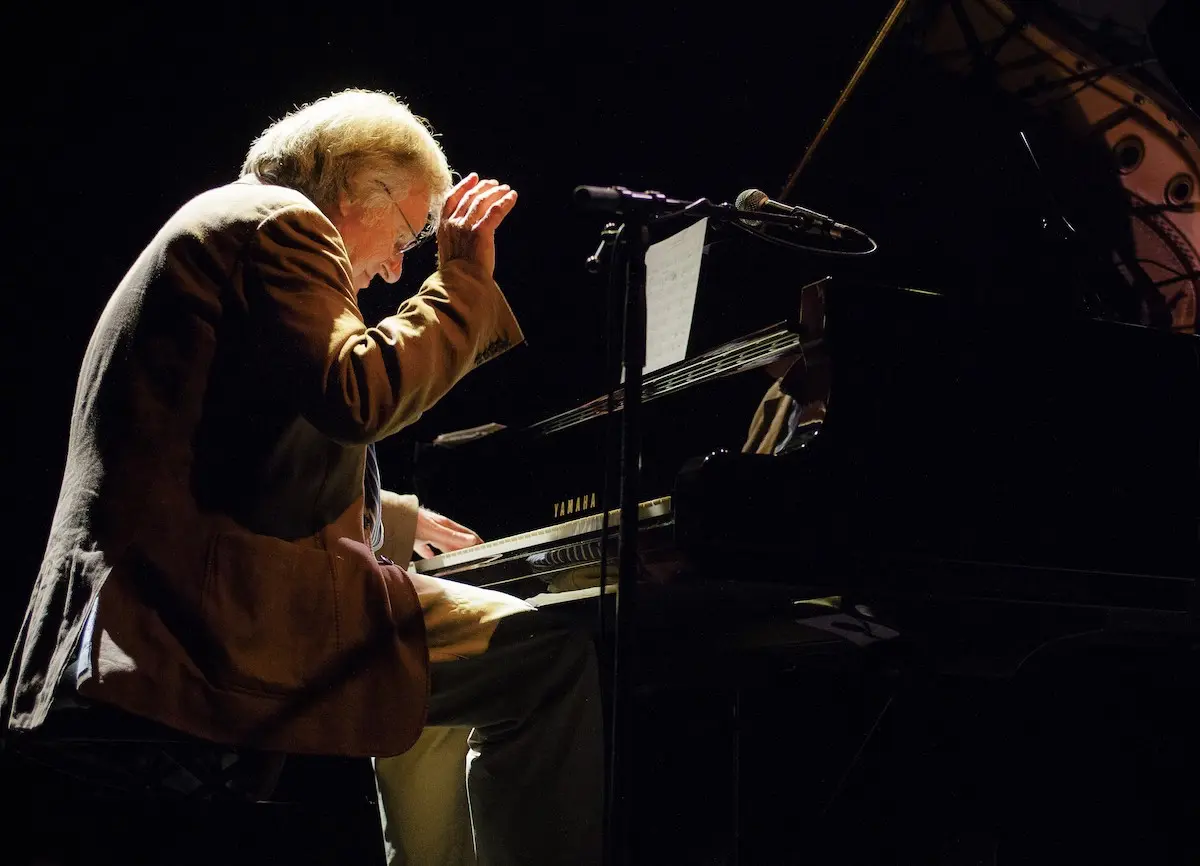
The international jazz community is mourning the loss of Mike Westbrook OBE, the visionary English pianist, composer, and bandleader who redefined the boundaries of orchestral jazz over a career spanning more than six decades. Westbrook passed away peacefully on April 11, 2026, at the Royal Devon and Exeter Hospital, according to an official statement released by his long-time manager, Peter Conway. He was 90 years old.
Westbrook is survived by his wife and primary artistic collaborator, Kate Westbrook, his children Guy and Joanna, and his step-children Josie, Clio, and Jason Barnard. His death marks the end of an era for British music, as he was widely considered one of the most significant figures in the development of a distinctly European jazz identity, independent of American stylistic hegemony.
A Legacy of Innovation in European Jazz
Born in High Wycombe on March 21, 1936, Mike Westbrook’s journey into the vanguard of modern music began not in a conservatory, but in the multidisciplinary environment of Plymouth Art School. It was here in the late 1950s that he formed his first workshops, laying the groundwork for a philosophy that treated music as a visual and theatrical medium as much as an auditory one.
His importance to the continent’s cultural landscape was perhaps best articulated by the German musicologist and festival director Bert Noglik, who noted that Westbrook did more than simply lead bands; he provided European jazz with its own unique voice. Noglik observed that Westbrook possessed an unparalleled ability to absorb the foundational "essence" of American jazz pioneers—most notably Duke Ellington—while simultaneously reflecting European high culture, poetry, and social history.
Through his collaboration with his wife, Kate, Westbrook created a body of work that often defied categorization, blending elements of cabaret, avant-garde improvisation, and classical structure. This "Westbrook genre" became a staple of the European festival circuit, proving that jazz could be a vehicle for interpreting the works of William Blake, the melodies of Gioachino Rossini, or the socio-political complexities of the 20th century.
Chronology of a Transformative Career
Westbrook’s professional ascent began in earnest in 1962 when he moved to London. He quickly became a focal point for a generation of young, ambitious musicians who were eager to push jazz beyond the constraints of bebop. His early ensembles included future luminaries such as John Surman, Mike Osborne, and Malcolm Griffiths.
The late 1960s saw the release of seminal recordings like Celebration (1967) and the sprawling, anti-war suite Marching Song (1969). These records established Westbrook as a master of the "jazz orchestra," a role he would inhabit for the rest of his life. Unlike many of his contemporaries, Westbrook’s big bands were never merely about power or volume; they were about texture, narrative, and the individual voices of the soloists within the collective.
In the 1970s, Westbrook expanded his scope even further. His 1971 album Metropolis remains a high-water mark of British jazz-rock and orchestral fusion, capturing the frantic energy of urban life. This period also saw the beginning of his deep exploration into "jazz-theatre," influenced by his marriage to Kate Westbrook, a trained painter and singer. Together, they formed the Westbrook Trio and various iterations of the Westbrook Brass Band, taking their music to street corners, theaters, and grand concert halls across Europe.
The 1980s were characterized by monumental tributes and literary adaptations. The Westbrook Blake (1980), which set the poetry of William Blake to music, is frequently cited as one of the most important British jazz recordings of all time. Later in the decade, he released On Duke’s Birthday (1985), a sophisticated homage to Duke Ellington that demonstrated his ability to honor the tradition while moving resolutely forward.
In the 21st century, Westbrook remained remarkably prolific. He founded the Uncommon Orchestra, a big band based in the West Country of England, which brought together professional jazz musicians, classical players, and blues performers. His ability to maintain a high level of creative output into his late 80s was evidenced by the "Band of Bands" project, which toured as recently as late 2025.
Data and Artistic Impact
Quantitative measures of Westbrook’s career highlight his immense productivity. He released over 50 albums as a leader and composed hundreds of original works, ranging from short songs to multi-hour suites. His influence is also measured by the caliber of musicians who passed through his ranks. More than 100 professional musicians have, at various times, been members of a Westbrook ensemble, many of whom went on to become major figures in the global jazz scene.
His contribution to the arts was formally recognized in 1988 when he was appointed an Officer of the Order of the British Empire (OBE) for his services to music. Additionally, he was the recipient of numerous awards from the Jazz Centre (UK), the Parliamentary Jazz Awards, and various European cultural institutions.
Westbrook’s work was also notable for its geographical defiance. While many of his peers felt compelled to remain in London or move to New York to sustain a career, Westbrook spent much of his later life based in Devon. This relocation did not signal a retreat but rather a refocusing. He became a cornerstone of the South West’s cultural life, proving that world-class avant-garde music could flourish outside of major metropolitan hubs.
Industry Reactions and Tributes
The announcement of Westbrook’s passing has prompted a wave of tributes from the global music community. Fellow musicians and critics have highlighted not just his technical skill as a pianist, but his "riveting" presence as a conductor and his kindness as a mentor.
Barry Witherden, reviewing a performance of the "Band of Bands" in Torquay in December 2025, described the then 89-year-old Westbrook’s music as "often intense and always riveting." This sentiment has been echoed in the hours following the news of his death. Critics have noted that Westbrook never "retired" in the traditional sense; his music continued to evolve, incorporating new technologies and younger performers until the very end.
Colleagues in the European jazz circuit have emphasized his role as a bridge-builder. By frequently touring France, Germany, Italy, and Scandinavia, Westbrook helped create a continental network for improvised music that bypassed the traditional gatekeepers of the American recording industry. His work was a testament to the idea that jazz was a universal language that could be adapted to local dialects and histories.
Analysis of Implications for British Music
The passing of Mike Westbrook leaves a significant void in the British cultural landscape. He was one of the last remaining links to the "Golden Age" of British jazz in the 1960s, a period that saw the UK emerge as a creative powerhouse in the genre. However, unlike many of his peers who remained rooted in the sounds of that era, Westbrook’s legacy is one of constant reinvention.
One of the primary implications of his death will be the preservation and curation of his massive archive. Given the breadth of his work—incorporating scores, visual art, recordings, and theatrical scripts—there is expected to be significant interest from academic institutions and museums. His estate, managed in conjunction with Kate Westbrook, holds a treasure trove of unreleased material and documentation of the British underground music scene from the 1960s through the 2020s.
Furthermore, Westbrook’s death highlights the importance of state and private support for large-scale jazz composition. Westbrook often spoke about the logistical and financial difficulties of maintaining a big band in the modern era. His success in doing so for over half a century is a testament to his tenacity and the loyal audience he cultivated across Europe.
As the music world reflects on his life, Mike Westbrook will be remembered not only for the notes he wrote but for the space he created for others to play. He treated the orchestra as a living, breathing organism, and his compositions provided a framework within which individual expression could thrive. His belief that jazz was an inclusive, multidisciplinary art form remains his most enduring contribution to the world of music.
Funeral arrangements and a public memorial service are expected to be announced by the family in the coming weeks. For now, the sounds of the Westbrook Concert Band, the Uncommon Orchestra, and the many iterations of his musical vision remain as a permanent monument to a life dedicated to the pursuit of the "new" in music. May he rest in peace.