Mia Khoirunisa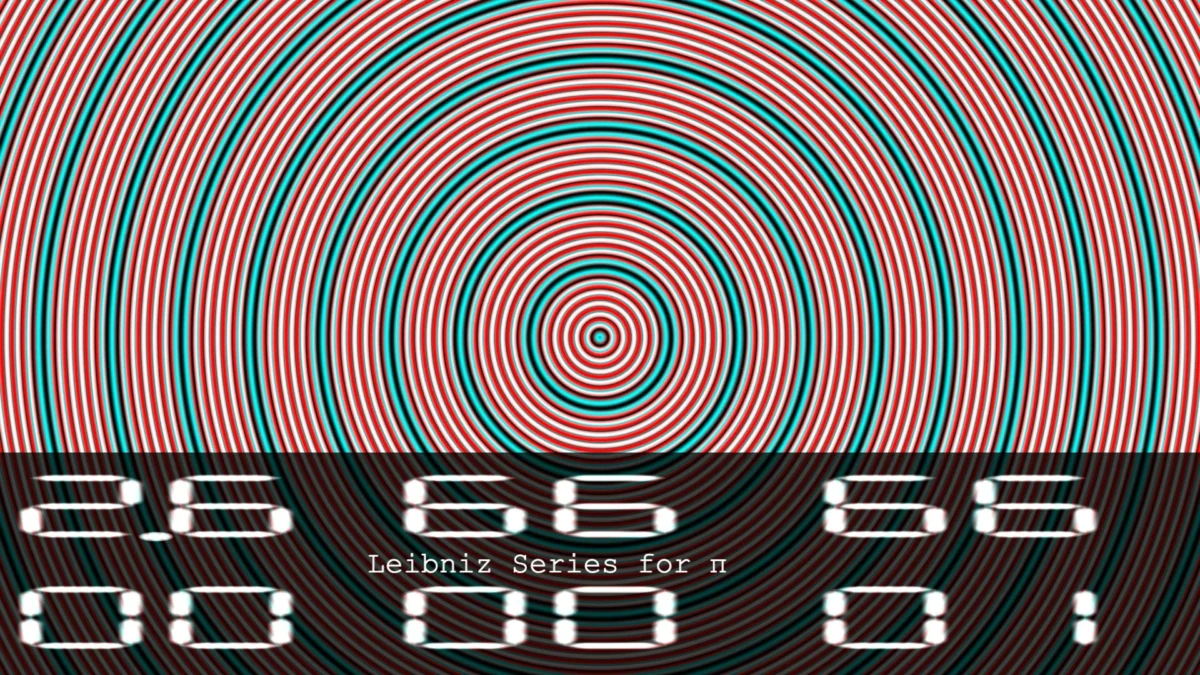
The realm of mathematics, often perceived as abstract and intimidating, is being reimagined through the lens of creative technology, offering a captivating fusion of art, science, and sound. A recent initiative by Vidvox, the creators of VDMX, introduces "bad Pi," an exploration into the visual and auditory representations of Pi approximations. This project invites users to engage with mathematical concepts in an immersive, sensory manner, challenging conventional perceptions of learning and discovery. The project, disseminated through a YouTube video titled "When Good Pi Goes Bad (Extended Version)," not only showcases the aesthetic potential of mathematical sequences but also serves as a gateway to understanding shader coding and the historical evolution of mathematical thought.
At its core, "bad Pi" leverages the power of real-time visual software to transform numerical approximations of Pi into dynamic, evolving visual landscapes and accompanying sonic textures. The premise is to rebel against an "anti-intellectual world" by demystifying complex mathematical ideas through an engaging, almost hypnotic, sensory experience. Users are encouraged to overcome past anxieties associated with mathematics, particularly in educational settings, and instead embrace the intricate beauty of Pi’s approximations as they unfold on their screens, accompanied by vibrating visuals and resonant audio.
Vidvox, a company known for its innovative tools for live visual performance and interactive media, positions this project as a natural extension of its technological capabilities. Their software, VDMX, is designed for real-time manipulation of video and graphics, making it an ideal platform for generating and interacting with complex visual patterns derived from mathematical formulas. The "bad Pi" project essentially serves as a demonstration of how these tools can be used not just for entertainment or performance, but also for educational and exploratory purposes, fostering a deeper, more intuitive understanding of mathematical principles.
The initiative arrives at a pertinent moment, particularly for individuals exploring the burgeoning field of shader coding. Shader programming, the process of writing code that dictates how graphics are rendered on a screen, has seen a surge in interest. While advancements in Artificial Intelligence, such as Large Language Models (LLMs), now allow for the generation of shader code through prompts, the author of the original piece notes a potential drawback: the bypass of the learning process. By directly generating code, users may miss out on the valuable experience of understanding the underlying logic and the often serendipitous, visually compelling outcomes of their own coding "mistakes." "Bad Pi" offers a pedagogical counterpoint, encouraging hands-on engagement with shaders and the mathematical concepts they represent, allowing for the discovery of visual results stemming directly from one’s own creative exploration and experimentation.
The "bad Pi" project offers a multi-layered approach to engagement. For those with a rudimentary awareness of the history of Pi approximations but lacking a clear understanding of their differences, the project provides a unique opportunity to visualize and audibly perceive these variations. This direct sensory input can demystify concepts that might otherwise remain abstract. Furthermore, it serves as an accessible entry point for learning the mathematics involved and the practicalities of coding shaders. Vidvox’s commitment to open standards is evident in their ISF (Interactive Shader Format), which promotes interoperability, allowing shaders created within their ecosystem to be utilized across various compatible software tools. This open approach democratizes access to advanced visual programming techniques.
The mesmerizing quality of the "bad Pi" visualizations and sonifications is highlighted as a key feature. The project suggests the potential for incorporating these shaders and visualizers into live performance settings, encouraging artists and performers to integrate these mathematically derived aesthetics into their work. This fusion of art and science opens up new avenues for creative expression, where the patterns and rhythms of mathematics can become integral components of a performance.
The Evolution of Pi Approximations: A Visual and Sonic Journey
The concept of Pi (π), the ratio of a circle’s circumference to its diameter, has fascinated mathematicians for millennia. Its irrational and transcendental nature means its decimal representation never ends and never repeats, making exact calculation impossible. Consequently, mathematicians throughout history have developed increasingly sophisticated approximations. The "bad Pi" project specifically delves into these historical approximations, rendering them in a format that is both intellectually stimulating and aesthetically compelling.
Early approximations, such as those found in ancient Babylonian and Egyptian mathematics, were relatively rudimentary. The Rhind Papyrus (circa 1650 BCE), for instance, suggests a value of approximately 3.16. Archimedes of Syracuse (c. 287–212 BCE) made significant strides by using polygons inscribed and circumscribed within a circle, establishing bounds for Pi between 3 10/71 and 3 1/7, thus providing a more accurate range of 3.1408 to 3.1429.
The project likely draws inspiration from later, more computationally derived approximations. One notable historical method is the Leibniz formula for Pi, developed by Gottfried Wilhelm Leibniz in the 17th century. This infinite series, expressed as π/4 = 1 – 1/3 + 1/5 – 1/7 + 1/9 – …, converges very slowly, meaning a large number of terms are required to achieve even modest accuracy. The "bad Pi" project could visually represent the convergence of this series, showing how the generated visuals and sounds evolve as more terms are added, highlighting both its mathematical elegance and its practical limitations for rapid calculation.
The Coding Train: Demystifying Mathematics for a Wider Audience
Further underscoring the accessible nature of mathematical exploration, the renowned educator Dan Shiffman, host of "The Coding Train," has also delved into Pi approximations. Shiffman’s approach is characterized by its friendly, often humorous, and exceptionally clear explanations, designed to engage even those who may have struggled with mathematics in traditional academic settings. His "Coding Challenge #140: Pi Approximation with Leibniz Series" video on YouTube demonstrates how to implement the Leibniz formula programmatically, translating the abstract mathematical concept into a tangible coding exercise. This initiative aligns with the broader goal of making complex subjects approachable and interactive, reinforcing the idea that mathematics can be a source of creative fulfillment rather than academic dread. Shiffman’s work consistently aims to bridge the gap between coding, mathematics, and artistic expression, making him a key figure in the popularization of these interdisciplinary fields.
Beyond Pi: The Sonic Dimension of Mathematical Approximations
The exploration extends beyond visual representations to encompass the realm of sound. The article raises a provocative question: why are standard sine wave oscillators in computer systems typically limited to mathematically precise waveforms, neglecting the potential for sonic variety offered by historical approximations? This line of inquiry leads to the MetaSounds system within Unreal Engine, developed by Epic Games.
MetaSounds, a powerful node-based audio authoring system, allows for the creation of complex and dynamic soundscapes. The reference guide for MetaSound Function Nodes indicates that their sine generator incorporates multiple modes, suggesting an openness to utilizing different mathematical models for waveform generation. This implies that the sonic characteristics of various Pi approximations, or other mathematical sequences, could be employed to create unique and evolving timbres, enriching the sonic palette available to sound designers and musicians.
Ancient Indian Mathematics: A Legacy of Innovation
The discussion then pivots to the profound contributions of ancient Indian mathematicians, particularly in the field of trigonometry and approximations. It is emphasized that many developments later attributed to Arabic and Persian scholars have roots in earlier Indian mathematical advancements. A prime example is Bhaskara I’s sine approximation formula, developed in the 7th century. This formula provided a remarkably accurate estimation of the sine function without the need for complex calculations, predating similar European developments by centuries.
The article suggests that employing Bhaskara I’s formula in sound synthesis could yield distinct sonic textures compared to standard, highly accurate sine waves. This concept opens up a fascinating avenue for sonic experimentation, where the historical nuances of mathematical discovery translate into unique auditory experiences. The depth of Indian mathematical contributions is further illustrated by Bhaskara II (Bhaskaracharya), who lived in the 12th century. His work extended into areas such as calculus, algebra, and astronomy, demonstrating a sophisticated understanding of the cosmos and the potential for mathematical principles to describe and even influence reality. His philosophical explorations, as hinted at by the mention of trying to "gain control of the space-time continuum and control the future," reflect a worldview where mathematics was intrinsically linked to understanding and shaping existence. The article playfully encourages the creation of Bhaskara-based synthesizers, envisioning them as tools for sonic exploration that could potentially "shape the future."
The mention of Bhaskara’s daughter also alludes to the often-overlooked contributions of women in the history of science and mathematics, a topic that is gaining increasing recognition and research.
Resources for Embarking on Shader Development
For those inspired to delve into the practical aspects of creating visualizers and interactive graphics, the article provides a curated list of resources for learning shader programming.
-
The Book of Shaders: This comprehensive online resource by Patricio Gonzalez Vivo and Jen Lowe is presented as an excellent starting point. It offers a foundational understanding of GLSL (OpenGL Shading Language) and the principles of shader development, even supporting execution on low-power devices like the Raspberry Pi.
-
"How to learn shaders: a beginner’s guide" on fragments.supply: This article is highlighted for its narrative approach, offering not just links to tools but also practical, actionable advice for beginners. It encourages a hands-on learning methodology, including the valuable tip of "breaking things on purpose" to understand how shaders function and how errors can lead to discovery.
-
p5.js Shaders Tutorial: For creators familiar with Processing or JavaScript, the p5.js library offers a gateway to learning shaders within a more accessible JavaScript environment. This is particularly beneficial for individuals who may find traditional coding and mathematical concepts challenging but are eager to develop their computational thinking and creative coding skills.
The Philosophical Underpinnings of Mathematical Pursuit
Ultimately, the article posits that the true value of engaging with mathematics, particularly through creative coding and visualization, lies not merely in achieving technical outcomes. Instead, it emphasizes the transformative power of mathematics to "break your own mind," to foster new ways of perceiving the world, and to cultivate a deeper appreciation for the intricate structures that govern reality. The author’s concluding sentiment, expressing a desire for a "BAD Pi" t-shirt, encapsulates the project’s success in making mathematics not only understandable but also desirable and emblematic of a rebellion against intellectual complacency. This sentiment underscores the broader cultural shift towards embracing interdisciplinary approaches, where the rigor of science and the creativity of art converge to offer richer, more profound experiences of learning and discovery. The journey through Pi approximations, from historical calculations to modern-day interactive visualizations and sonic explorations, serves as a testament to the enduring power of mathematics to inspire wonder and innovation.