Mia Khoirunisa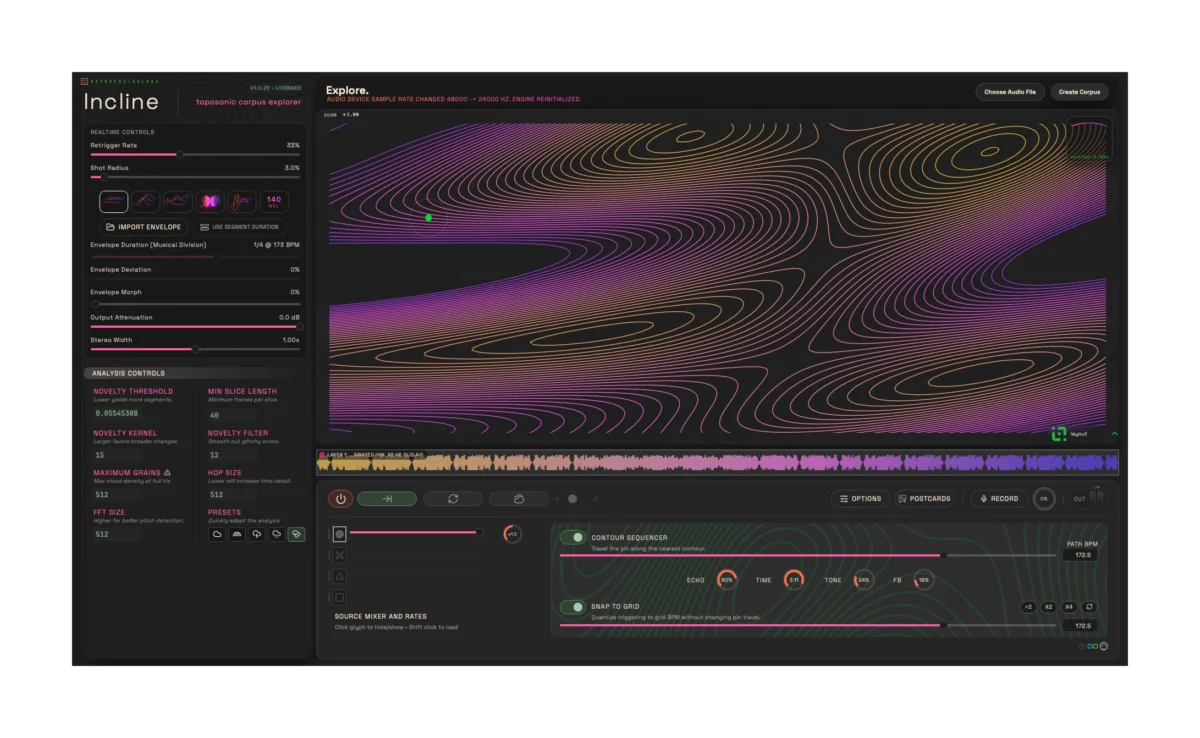
NeverEngine Labs has released a substantial update for its innovative sound design tool, Incline, a significant advancement that the developer has playfully dubbed an "Easter egg." This latest iteration, version 1.0.25, introduces a suite of powerful features aimed at deepening the user’s ability to explore and manipulate sonic landscapes. The update brings forth crucial enhancements including internal echo functionality within playback, advanced high-fidelity audio output options with refined tweaks, and a long-awaited, properly implemented zoom feature. These additions are set to revolutionize how sound designers, musicians, and audio researchers engage with Incline’s unique "toposonic" corpus exploration capabilities, powered by machine learning.
Incline, as previously detailed, is a groundbreaking tool designed to dissect and reimagine sound. It leverages sophisticated machine learning algorithms to segment audio into discrete units, which are then fed into a granular engine. This process allows users to explore sound not merely as a linear waveform but as a malleable, multi-dimensional "toposonic" space, where the very fabric of sound can be reconfigured and re-orchestrated. The granular engine, a staple in advanced sound synthesis, breaks down audio into tiny fragments, or "grains," which can then be manipulated in terms of their position, duration, pitch, and other parameters. Incline’s unique contribution lies in its intelligent segmentation, which aims to identify meaningful sonic events and structures within an audio file, making the granular synthesis process more intuitive and musically expressive.
The integration of internal echo in Incline’s playback is a particularly impactful development, especially for live performance and real-time sound manipulation. Previously, when Incline segmented a sound and users adjusted granular parameters, gaps or silences could arise in the playback. This often necessitated external processing to fill these sonic voids. The new update directly addresses this by allowing users to seamlessly incorporate free-running or tempo-synced delays within the playback engine itself. This means that the "dead air" between granular fragments can now be creatively filled, transforming the character of the audio. The ability to apply short delays and feedback within the echo system also opens up new avenues for sonic transformation, enabling users to create lush reverberations, rhythmic textures, or even chaotic sonic disintegration, all within the Incline environment. This internal echo functionality effectively closes a loop in the creative workflow, making Incline a more self-contained and powerful instrument for sonic sculpting.
Evolution of Incline: A Chronology of Development
The journey to this "Easter egg" update for Incline is a testament to NeverEngine Labs’ commitment to refining its innovative software. While the exact development timeline for version 1.0.25 is not publicly detailed, its release follows a period of active engagement with users and a consistent drive to enhance the tool’s capabilities.
Early Conceptualization and Release: Incline was initially introduced as a novel approach to sound exploration, proposing the concept of a "toposonic corpus." This conceptual framework, which views sound as a spatial entity to be navigated and dissected, was a significant departure from traditional audio editing paradigms. The initial release focused on establishing the core machine learning segmentation and granular synthesis engine.
Iterative Improvements: Following its initial release, NeverEngine Labs has consistently worked on refining Incline’s performance and user experience. This often involves subtle tweaks to the machine learning models for more accurate segmentation, optimizations for the granular engine to handle complex audio textures, and improvements to the user interface for better accessibility.
The "Easter Egg" Update (Version 1.0.25): The current update, while labeled playfully, represents a significant leap forward. The introduction of internal echo, high-fidelity audio options, and a functional zoom feature addresses key user requests and expands the creative potential of the software. The inclusion of echo, in particular, directly tackles a practical challenge faced by users when working with granular synthesis, making the tool more robust for live and experimental applications. The high-fidelity audio output options suggest a focus on professional audio workflows, where sound quality and accurate reproduction are paramount. The zoom feature, often a basic but essential element in any visual or interactive software, finally brings Incline up to par with industry standards for detailed waveform manipulation.
Future Outlook: The "Easter egg" moniker might also hint at further unannounced developments or a particularly ambitious set of features packed into this release. NeverEngine Labs’ approach suggests a development philosophy that values both robust functionality and a degree of creative surprise for its user base.
Deep Dive into the New Features
The update to Incline version 1.0.25 introduces several key enhancements that significantly bolster its utility for sound designers, musicians, and researchers alike.
Internal Echo and Temporal Manipulation
The most prominent new feature is the integration of internal echo directly into Incline’s playback engine. This addresses a critical aspect of granular synthesis: the potential for sonic discontinuities. When audio is segmented and grains are manipulated, unintended gaps can appear, disrupting the flow of the sound. Incline 1.0.25 now provides the tools to bridge these gaps creatively.
- Free-running Delays: Users can set delays that operate independently of the project’s tempo, allowing for more organic and atmospheric echo effects. This is ideal for creating spacious, evolving soundscapes where rhythmic precision is not the primary concern.
- Tempo-synced Delays: For rhythmic applications, the tempo-synced delay option ensures that echoes align with the project’s beat. This is invaluable for musicians and producers looking to integrate Incline’s unique sonic textures into rhythmic compositions.
- Character Transformation: The ability to utilize short delays and feedback allows for profound alterations to the character of the processed audio. Short, modulated delays can introduce subtle chorusing or flanging effects, while increased feedback can lead to complex, cascading repetitions and self-oscillation, pushing the boundaries of granular synthesis into more experimental territories. This feature transforms Incline from a purely analytical tool into a powerful generative instrument.
The implications of this internal echo are far-reaching. It enables Incline to function more effectively as a standalone effects processor, allowing users to create intricate delay-based textures without the need for external plugins or hardware. This streamlines the workflow and allows for more immediate sonic experimentation. For live performers, this means the ability to sculpt evolving sonic environments in real-time, reacting dynamically to input audio and audience feedback.
High-Fidelity Audio Output and Tweaks
NeverEngine Labs has also prioritized audio quality with the introduction of high-fidelity output options. This indicates a commitment to professional audio standards, ensuring that the sonic manipulations performed within Incline are reproduced with maximum clarity and accuracy.
- Advanced Output Options: While specific technical details of these options are not enumerated in the update notes, they likely include choices regarding bit depth, sample rate, and potentially different dithering algorithms. This allows users to tailor the output to their specific production needs, whether for archival purposes, high-resolution playback, or integration into complex mixing environments.
- Refined Tweaks: The mention of "tweaks" suggests that the developers have fine-tuned the audio engine to minimize digital artifacts, reduce latency, and improve the overall sonic fidelity of the granular synthesis process. This attention to detail is crucial for applications where pristine audio quality is paramount, such as film sound design, classical music production, or audiophile-grade sound art.
The emphasis on high-fidelity output is particularly important for Incline’s "toposonic" exploration. If the tool is designed to reveal the intricate details of sound, then the playback mechanism must be capable of reproducing those details faithfully. This update ensures that the sonic nuances uncovered by Incline’s analysis and manipulation are not lost in translation during playback.
Proper Zoom Functionality
The addition of a "proper zoom" feature, while seemingly basic, is a critical usability enhancement. In complex audio software, the ability to zoom in and inspect waveforms or spectral data at a granular level is essential for precise editing and analysis.
- Detailed Waveform Inspection: Users can now zoom in to examine the minutiae of segmented audio, allowing for precise control over the start and end points of individual grains or sonic events. This level of detail is crucial for fine-tuning the granular synthesis parameters and achieving desired sonic outcomes.
- Improved Navigation: A functional zoom feature significantly improves the navigation of complex audio projects within Incline. It allows users to focus on specific sections of the toposonic corpus, making the exploration process more efficient and less prone to errors.
This seemingly simple addition has profound implications for the practical application of Incline. It transforms the tool from a conceptually advanced but potentially cumbersome interface into a more user-friendly and precise instrument. For researchers analyzing sonic structures or sound designers meticulously crafting specific textures, the ability to zoom in and interact with the audio at a microscopic level is indispensable.
Technical Details and Distribution
The update, version 1.0.25, is available for macOS users. NeverEngine Labs has provided direct download links for both Apple Silicon (ARM) and Intel processors, indicating a commitment to broad compatibility within the Apple ecosystem.
- Apple Silicon (M1/M2/M3 etc.) Download:
https://cdn.crabnebula.app/download/neverenginelabs/nel-incline/latest/platform/dmg-aarch64 - Intel Download:
https://cdn.crabnebula.app/download/neverenginelabs/nel-incline/latest/platform/dmg-x86_64
A note from the developer indicated that a last-minute issue prevented the auto-update functionality from working as of the publication of the initial report. Users are therefore directed to download the latest version via the provided direct links. This temporary workaround ensures that users can access the new features without delay.
The official update details, though presented as an empty list in the provided excerpt, are understood to encompass the features described above. The "Easter egg" designation, while informal, suggests that this update is packed with significant improvements that may have been developed with a degree of playful anticipation.
Broader Impact and Implications for Sound Design
The enhancements in Incline 1.0.25 have significant implications for the field of sound design, music production, and audio research.
Democratizing Advanced Sonic Exploration
Incline’s core premise of exploring sound as a "toposonic corpus" is inherently complex, relying on sophisticated machine learning for segmentation. By integrating features like internal echo and a user-friendly zoom, NeverEngine Labs is making this advanced form of sonic exploration more accessible. Users no longer need to rely on a patchwork of external tools to achieve a desired sonic outcome; Incline is becoming a more integrated and powerful creative environment. This can empower a wider range of creators, from hobbyists to seasoned professionals, to experiment with cutting-edge sound manipulation techniques.
Expanding the Granular Synthesis Palette
Granular synthesis has long been a powerful tool for sound designers seeking to create unique textures, otherworldly soundscapes, and abstract sonic forms. However, it can also be challenging to control and integrate into musical contexts due to its inherent fragmentation. The addition of internal echo directly addresses this by providing a means to contextualize and connect the granular fragments. This allows for the creation of more cohesive and musically relevant sounds, bridging the gap between experimental sound design and more traditional musical composition.
Potential for Real-time Performance and Interactive Art
The combination of intelligent segmentation, granular synthesis, and now internal echo, makes Incline a compelling tool for real-time performance. Imagine a musician feeding live audio into Incline, having it intelligently segmented, and then manipulating the resulting grains with evolving delays and feedback to create an immersive sonic environment. This opens up possibilities for interactive art installations, live electronic music performances, and innovative approaches to sound art. The ability to shape sound in real-time with such a high degree of control and sonic fidelity is a significant advancement for performance-oriented audio practitioners.
Contribution to Audio Research
Beyond creative applications, Incline’s "toposonic corpus" concept and its machine learning segmentation capabilities hold promise for audio research. By providing tools to meticulously dissect and analyze the structural components of sound, researchers can gain deeper insights into acoustic phenomena, psychoacoustics, and the very nature of auditory perception. The enhanced playback and visualization (implied by the zoom feature) facilitate more detailed study of sonic structures and their transformations.
NeverEngine Labs’ "Easter egg" update for Incline is more than just a collection of new features; it represents a significant step forward in making advanced sonic exploration and manipulation more intuitive, powerful, and accessible. The introduction of internal echo, high-fidelity audio options, and a functional zoom feature transforms Incline into a more complete and potent creative instrument, poised to inspire new forms of sound design, music production, and audio research.