Kholidah
The Catalyst: A Profile Change and Global Brand Reaction
The sequence of events began on June 20, 2026, when Jungkook updated his personal Instagram profile picture. The new image featured characters from the critically acclaimed Netflix animation series Cyberpunk: Edgerunners. Known for his interest in animation and digital media, Jungkook’s choice of imagery immediately resonated with his audience of over 50 million followers.
The "Jungkook Effect"—a term coined by economists and media analysts to describe the immediate surge in popularity or sales of any product associated with the artist—was instantaneous. Netflix Brazil, recognizing the immense visibility afforded by the singer’s profile update, pivoted its social media strategy within hours. The official Netflix Brazil account updated its header to a scene from Cyberpunk: Edgerunners and modified its bio to read: “Jungkook watched ‘Cyberpunk: Edgerunners.’”
This interaction underscores the symbiotic relationship between high-profile celebrities and global streaming giants. Data from social media monitoring tools indicated a 400% spike in mentions of the anime series within the 24 hours following Jungkook’s profile update. For Netflix, the endorsement from a BTS member serves as a high-value marketing asset that transcends traditional advertising boundaries.
The Confrontation: Defending Personal Authenticity
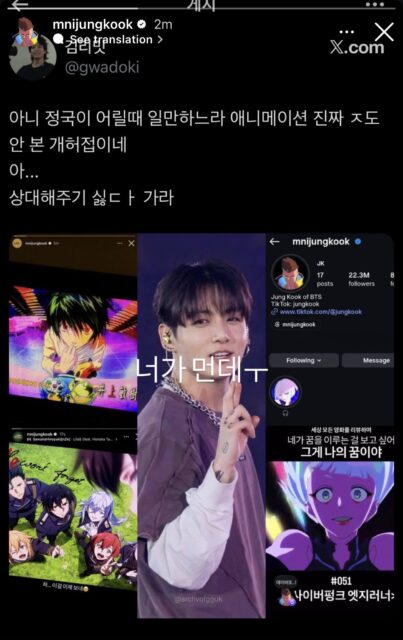
While the interaction with Netflix was a testament to his positive influence, the atmosphere shifted on June 23, 2026. Jungkook utilized the Instagram Stories feature to address a specific post that questioned his history and authenticity as a fan of the medium.
The critic’s post, which Jungkook shared via a screenshot, suggested that because the singer had been immersed in the rigorous idol training system and professional work from a very young age, he lacked the time or inclination to be a "true" fan of anime. The post stated: “Man, Jungkook worked so much when he was young, he was a novice who didn’t watch a da*n thing about anime… I don’t want to deal with him… go away.”
In a departure from the industry’s historical standard of ignoring online vitriol, Jungkook provided a direct rebuttal. His response was succinct: “Who do you think you are (to say that)?”
This direct engagement is significant within the context of the K-pop industry, where artists are often encouraged by management agencies to maintain a stoic silence in the face of online criticism to avoid escalating controversies. Jungkook’s decision to call out the individual suggests a growing level of autonomy and a refusal to allow his personal history to be misrepresented by third parties.
Chronology of the Social Media Incident
To understand the full scope of the event, it is necessary to examine the timeline of these digital interactions:
- June 20, 2026: Jungkook changes his Instagram profile picture to Cyberpunk: Edgerunners artwork. Fans (collectively known as ARMY) begin trending the series title globally.
- June 21, 2026: Netflix Brazil capitalizes on the trend, rebranding their social media assets to align with Jungkook’s profile change.
- June 22, 2026: Discussions regarding Jungkook’s "authenticity" as a fan begin to circulate in niche online communities and on X (formerly Twitter).
- June 23, 2026 (Early Morning): Jungkook uploads an Instagram Story featuring the screenshot of a hater’s post and his direct response.
- June 23, 2026 (Mid-Day): The response goes viral, with major news outlets and social media users analyzing the implications of the "clap back."
Supporting Data: Social Media Metrics and Engagement
The scale of Jungkook’s digital reach provides context for why his response carried such weight. As of June 2026, Jungkook remains one of the most-followed male artists on Instagram.

- Engagement Rate: Jungkook’s posts consistently garner engagement rates exceeding 15%, significantly higher than the industry average of 2-3% for verified accounts.
- Viral Velocity: The screenshot of his rebuttal was reshared over 1.2 million times on X within the first three hours of its posting.
- Brand Impact: Following the Netflix Brazil interaction, Google Trends reported a worldwide surge in searches for "Cyberpunk: Edgerunners," reaching its highest peak since the show’s initial release years prior.
These metrics demonstrate that Jungkook does not merely exist within the digital space; he actively shapes it. His decision to address a hater is not just a personal act but a broadcast to millions, effectively setting a boundary for how he expects to be treated by the public.
The "Arirang" World Tour and Group Maturity
The timing of this incident is particularly noteworthy as it coincides with the "Arirang" world tour. This tour represents a "Chapter 2" for BTS—a period of increased maturity and individual expression following their return from military service.
Industry analysts suggest that the members’ time in the military may have contributed to a more grounded and assertive worldview. No longer "idols" in the traditional, strictly controlled sense, the members of BTS are now established veterans of the industry. Their current tour, which has sold out stadiums in Seoul, Tokyo, Los Angeles, and London, showcases a group that is more comfortable in its own skin.
Jungkook’s directness on Instagram reflects this evolution. By challenging the narrative that he is a "novice" or a manufactured persona who lacks personal interests, he is asserting his identity as a 28-year-old man with his own tastes, hobbies, and the right to defend his reputation.
Official Responses and Public Sentiment
While HYBE (BTS’s management agency) has not issued a formal statement regarding this specific Instagram Story, the agency’s legal department has historically maintained a zero-tolerance policy toward malicious comments and defamation. However, Jungkook’s personal intervention marks a shift from legalistic defense to personal advocacy.
Public sentiment has been overwhelmingly supportive of the artist. On platforms like X and Reddit, fans have praised Jungkook for his "humanity" and "bravery." One widely shared post from a fan stated: “I’m so proud of him calling this person out. He knows what’s being said, and he isn’t afraid to stand up for himself anymore.”
Conversely, some media critics have debated whether direct engagement with haters encourages more "trolling" by providing critics with the attention they seek. However, in this instance, the general consensus is that Jungkook’s response was a necessary assertion of boundaries.
Broader Implications for the K-pop Industry
The incident involving Jungkook is indicative of a broader trend where K-pop artists are reclaiming their voices. Historically, the "idol" image was one of perfection and passivity. In 2026, however, the industry is seeing a shift toward transparency.
- Social Media Autonomy: Unlike previous generations, current K-pop stars often have personal accounts where they share unedited glimpses of their lives. This creates a more direct, unfiltered connection with fans.
- Mental Health and Boundaries: There is an increasing awareness of the mental health toll caused by online harassment. Direct responses like Jungkook’s may be seen as a form of self-preservation, signaling that celebrities are no longer willing to be silent targets.
- The End of the "Untouchable" Hater: For years, anonymous posters felt they could disparage celebrities without consequence. When an artist with a platform as large as Jungkook’s shines a light on a specific comment, it changes the power dynamic of the interaction.
Conclusion: A New Era of Celebrity Interaction
Jungkook’s direct response to a critic on Instagram is more than a fleeting social media moment; it is a reflection of his growth as an individual and a professional. As BTS continues their "Arirang" world tour, the members are demonstrating that they are not just global performers, but individuals who demand respect and authenticity in their digital lives.
By choosing to respond to a comment that questioned his past and his interests, Jungkook has signaled to his global audience—and to his critics—that he is fully aware of the discourse surrounding him and is unafraid to participate in it on his own terms. As the digital landscape continues to evolve, this incident will likely be cited as a pivotal moment in the ongoing evolution of idol-fan dynamics and the right of public figures to personal agency.