Johan Budi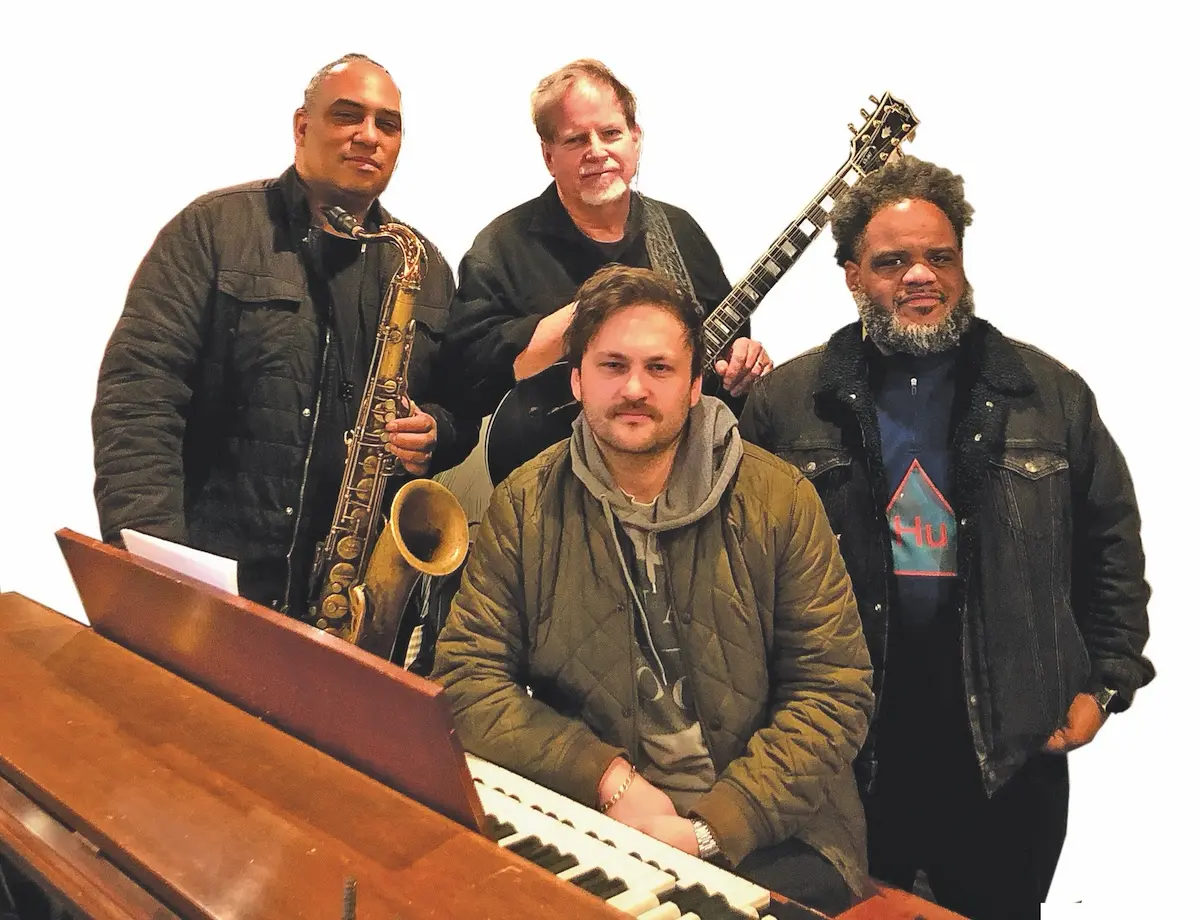
The contemporary global jazz landscape continues to be shaped by artists who look backward to historical foundations in order to propel the genre forward. Recent releases from Czech guitarist Libor Šmoldas, the collective-driven New England Jazz Collaborative, and Indianapolis tenor saxophonist Rob Dixon offer a compelling cross-section of this ongoing dialogue between past and present. Spanning post-bop tributes, expansive contemporary big-band arrangements, and deep-groove soul-jazz, these projects demonstrate how modern musicians contextualize the historical tensions, institutional challenges, and regional legacies that have long defined the genre.
Libor Šmoldas Quartet Confronts the Complex Legacy of Miles Davis
The intersection of historical reverence and witty subversion sits at the core of the Libor Šmoldas Quartet’s latest studio album, Sorry, Miles!, released via Bivak Records. Recorded on November 6 and 7, 2025, in Svarov, the project features Šmoldas on guitar, alongside pianist Mikuláš Pokorný, bassist Tomáš Baroš, and drummer Jesse Simpson. The album’s conceptual framework directly addresses a lesser-discussed aspect of jazz history: compositions famously associated with Miles Davis that were originally written by other musicians, juxtaposed with original compositions steeped in the aesthetic of the legendary trumpeter.
The title track establishes a distinct post-bop atmosphere, directly channeling the acute musical interaction and dynamic ebb and flow characteristic of Davis’s acclaimed "Second Great Quintet." Throughout the tracklist—which includes interpretations of standards such as "Dig," "Four," "Donna Lee," "Tune Up," "Smooch," and "Sonny (Solar)" alongside Šmoldas originals like "Square Head" and "Prima Dancers"—the ensemble balances technical precision with playful historical commentary.
Particular attention is drawn to the track "Richard’s Regret," a fugue-like ballad addressing the complex historical narrative surrounding Richard Carpenter. Historical accounts note that Carpenter, a figure associated with the era’s illicit networks, provided financial backing—specifically drug money—to Davis during the creation of the canonical track "Walkin’." While listeners do not require deep familiarity with these anecdotes to appreciate the record, the historical context provides additional depth to the quartet’s thoroughly modern interpretations.
The New England Jazz Collaborative Expands Big-Band Horizons with Tributaries
In the large-ensemble sphere, the newly established New England Jazz Collaborative (NEJC) has released its debut recording, Tributaries, on NEJC Records. Founded by composer and arranger Jeremy Cohen alongside a coalition of peers, the artist-led non-profit collective was created to address a pressing structural challenge in contemporary music: the dwindling opportunities for ambitious composers and arrangers to showcase and document new big-band works.
The collective functions as a platform dedicated to commissioning, presenting, and documenting new music authored by a diverse roster of living composers. Tributaries features works by Cohen, Darryl Harper, Matan Rubinstein, and Sam Spear, performed by a flexible ensemble that included musicians such as trumpeter Mark Tipton, soprano saxophonist Temidayo Balogun, trombonist Chris Gagne, guitarist Mitch Selib, pianist Ellie Prunea, bassist Bob Nieske, and drummer Lumanyano Mzi during sessions in Boston on June 6, 2025.
Musically, the 40-minute program bridges stylistic divides by coupling structural complexity with earthy rhythmic foundations. Cohen’s "Another Brighter Day" ventures into contemporary fusion territory, highlighted by the breezy, lilting tone of Balogun’s soprano saxophone, while his "Green Turtle Strut" explores West African high-life rhythms. Harper contributes the layered ballad "Kiss Me Again" alongside "The Secret," an odd-metre funk composition driven by assertive rhythmic swagger and resonant trombone lines.
Pushing the stylistic boundaries further, Rubinstein’s four-minute piece "Ol’ Liminal" traverses a trajectory from Stockhausen-inspired European modernism to the turbulent, simultaneous collective improvisation characteristic of early New Orleans jazz. Meanwhile, Spear’s "Gee, Em" reinterprets traditional swing through a postmodern Third Stream framework.
By maintaining this stylistic range, the ensemble remains faithful to the lineage of Boston conservatory pioneers such as Bob Brookmeyer, Gunther Schuller, George Russell, and Bob Moses, successfully synthesizing intellectual rigor with emotional resonance. Industry analysts note that the emergence of the NEJC provides a vital domestic counterpart to prominent European institutions like the WDR Jazz Orchestra and the Paradox Jazz Orchestra.
Rob Dixon Honors Indianapolis Roots on Naptown Soul
Shifting the geographic focus to the Midwest, saxophonist Rob Dixon explores the deep-rooted musical heritage of Indianapolis on his latest album, Naptown Soul, released through Strikezone Records. Recorded on January 29 and 30, 2026, in Indianapolis, the album features Dixon on tenor and soprano saxophones, supported by guitarist Dave Stryker, organist Sam Fribush, and drummer Richard “Sleepy” Floyd.
While Indianapolis is globally synonymous with guitar legend Wes Montgomery, music historians and authors like Preston Lauterbach—who chronicled the city’s role in his book The Chitlin’ Circuit: And The Road To Rock ’N’ Roll—have long documented Indiana Avenue as a primary crucible for Black rock and roll, rhythm and blues, and popular music innovation. Dixon’s project explicitly builds upon this broader cultural foundation.
The 45-minute program—comprising tracks such as "Sly Vibe," "Bumpin’ On Sunset," "Walkin’ In Rhythm," "Naptown Blues," "I Want You," "The Earth, The Sky," "Fields And Valleys," and "Four One"—blends accessibility with heavy rhythmic groove. Dixon pays homage to Montgomery while establishing a distinct personal voice, notably on the medium-slow, funky showstopper "The Earth, The Sky." His extended solo on the track utilizes rapid staccato patterns and continuous phrasing reminiscent of the stylistic approach of Eddie Harris.
Dixon demonstrates similar dexterity on the soprano saxophone, delivering a fluent and lightweight interpretation of the Marvin Gaye composition "I Want You." Accompanied by the complementary playing of Stryker and Fribush, the recording serves as a significant contemporary contribution to the soul-jazz canon, reinforcing the enduring commercial and artistic viability of regional American jazz traditions.
Implications for the Modern Jazz Ecosystem
Together, these three releases—Šmoldas’s analytical deconstruction of the Davis songbook, the NEJC’s institutional defense of large-ensemble composition, and Dixon’s celebration of localized Midwestern groove—illustrate the multifaceted strategies contemporary jazz artists use to engage with history. As economic pressures and shifting media landscapes alter how music is produced and consumed, projects of this scale highlight the resilience of artist-driven models, regional heritage preservation, and cross-generational dialogue within the global jazz community.