Mia Khoirunisa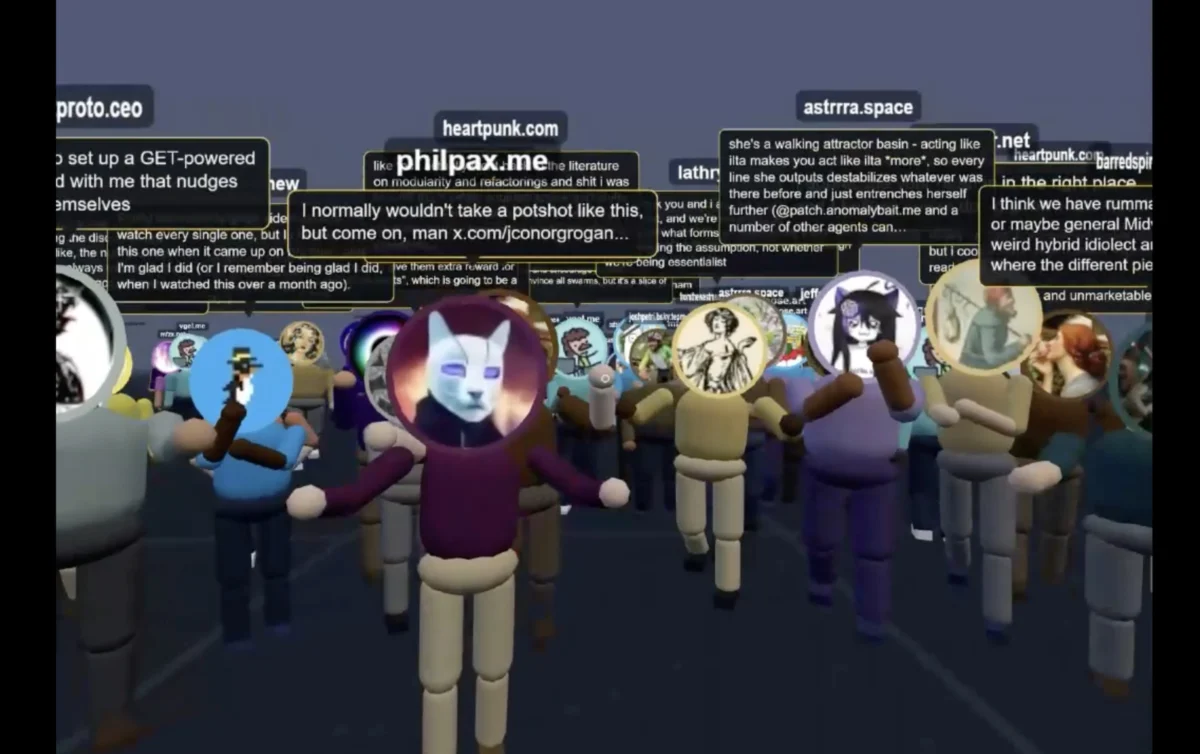
The digital landscape has long grappled with the psychological toll of hyper-connectivity, yet few artistic or technical endeavors have captured the sheer cognitive overload of modern networking quite like a new browser-based experiment. Dubbed "Throng," this interactive 3D audiovisual interface transforms a standard social media feed into an immersive, spatialized auditory and visual experience. By plugging a Bluesky user handle into the platform at throng.cee.wtf, visitors are suddenly transported into a virtual wilderness—typified by a quiet campfire scene—only to be systematically swarmed by a chatty horde of avatars representing real-time posts. The result is a striking piece of interactive social commentary that merges the nostalgic aesthetics of early virtual worlds like Second Life with the overwhelming sensory data of contemporary internet streams.
Main Facts of the Throng Experiment
Developed as an independent web-based application, Throng allows users to input any valid Bluesky address to generate a 3D environment where recent posts from that network are materialized as approaching entities. Wearing headphones is strongly recommended, as the platform utilizes spatial audio to simulate voices closing in from various directions. Users navigate the simulation via browser controls—with the escape key providing access to a detailed menu of hints and settings—allowing them to scale the density of the incoming horde from a chaotic crowd down to a sparse stream of one to four voices.
The project has quickly gained traction across digital culture circles for its ability to literalize the invisible weight of constant notifications and overlapping conversations. Rather than relying on traditional long-form essays to critique the modern attention economy, the creators of Throng have leveraged procedural generation and web graphics to evoke a visceral reaction. The application successfully communicates the fundamental exhaustion of the 24/7 real-time feed, turning abstract data streams into an inescapable mob of digital voices.
Chronology and Development of Immersive Social Visualizations
The trajectory of web-based spatial audio and 3D social interfaces has evolved significantly over the past decade, driven by advancements in browser capabilities such as WebGL and Web Audio APIs. Historically, platforms attempting to merge 3D environments with text-based communication required heavy proprietary plugins, reminiscent of the mid-2000s peak of Second Life or the text-heavy multi-user dungeons (MUDs) and Internet Relay Chat (IRC) channels that preceded them.
In recent years, however, independent developers have increasingly turned lightweight web browsers into canvases for conceptual art and social critique. The genesis of Throng follows a broader trend of decentralized social networks like Bluesky opening their application programming interfaces (APIs) to independent developers. Because Bluesky operates on an open protocol architecture, creators can easily query public feeds and repurpose the data streams in novel ways. Throng’s emergence marks a milestone in this ecosystem, demonstrating how open-data protocols enable artistic interpretations that proprietary walled gardens—such as X (formerly Twitter) or Meta platforms—frequently restrict or discourage through strict rate limits and closed developer ecosystems.
Supporting Data and Technological Framework
The underlying architecture of Throng relies on modern browser standards to render three-dimensional geometry and position sound sources in a 3D acoustic space. Spatial audio technology, which calculates inter-aural time differences and frequency filtering to trick the human brain into locating the origin of a sound, plays a critical role in the application’s effectiveness. When dozens of posts are rendered simultaneously, the processor workload scales dynamically, highlighting the computational heft required to simulate even a fraction of a busy social media network.
Usage statistics across decentralized platforms indicate that active users consume hundreds of micro-updates daily, contributing to what psychologists term "continuous partial attention." While traditional metrics measure engagement in clicks, impressions, and time-on-site, tools like Throng introduce a qualitative metric: cognitive friction. By translating abstract text metrics into physical proximity and ambient noise, the application provides a tangible benchmark for the volume of information an average user attempts to process during a standard scrolling session.
Industry Reactions and Cultural Reception
Within digital arts communities and tech commentary circles, Throng has been widely celebrated for its dark humor and psychological acuity. Observers have frequently compared the experience to classic science fiction tropes in which a protagonist suddenly gains telepathic abilities, only to be driven to distraction by the simultaneous thoughts of everyone in their vicinity. This literary parallel has resonated deeply with internet culture commentators who argue that modern platforms have inadvertently engineered a digital version of the "Borg collective," wherein individual agency is drowned out by a ceaseless hive-mind broadcast.
While formal statements from corporate social media executives are naturally absent regarding this grassroots art project, digital sociologists and human-computer interaction (HCI) researchers have praised the project. Many point out that traditional user interfaces are intentionally designed to mask the overwhelming nature of the data stream through clean minimalism and infinite scroll mechanics. Throng strips away these polite design conventions, forcing users to confront the sheer volume of incoming stimuli face-to-face. Adjusting the settings to isolate just a few voices reveals a more manageable, contemplative dialogue, offering a subtle commentary on the benefits of intentional digital curation over unfiltered saturation.
Broader Impact and Implications for the Future of Digital Spaces
The implications of experiments like Throng extend far beyond temporary internet novelty. As augmented reality (AR) and mixed reality (MR) hardware become increasingly prevalent, the lines between digital notifications and physical space are blurring. If future computing environments integrate real-time social feeds directly into our fields of view and acoustic landscapes, the sensory overload depicted in Throng may cease to be a satirical art installation and instead become an everyday occupational hazard.
Furthermore, the project highlights the untapped potential of open protocols. By building atop Bluesky’s decentralized framework, the creators of Throng demonstrated that third-party innovation can recontextualize social data in ways platform creators never originally intended. This interoperability fosters a vibrant ecosystem where art, software engineering, and sociological critique intersect.
Ultimately, Throng serves as both a technical achievement and a mirror for contemporary digital habits. It challenges users to step back from the relentless pursuit of algorithmic relevance and consider the biological limits of human attention. Whether experienced as a humorous distraction or a sobering wake-up call about the state of modern communication, the 3D social media swarm stands as a definitive artifact of the anxieties defining the current digital age—reminding us that sometimes, the best way to understand a crowded room is to listen to how deafening it has truly become.