Aveline Kirana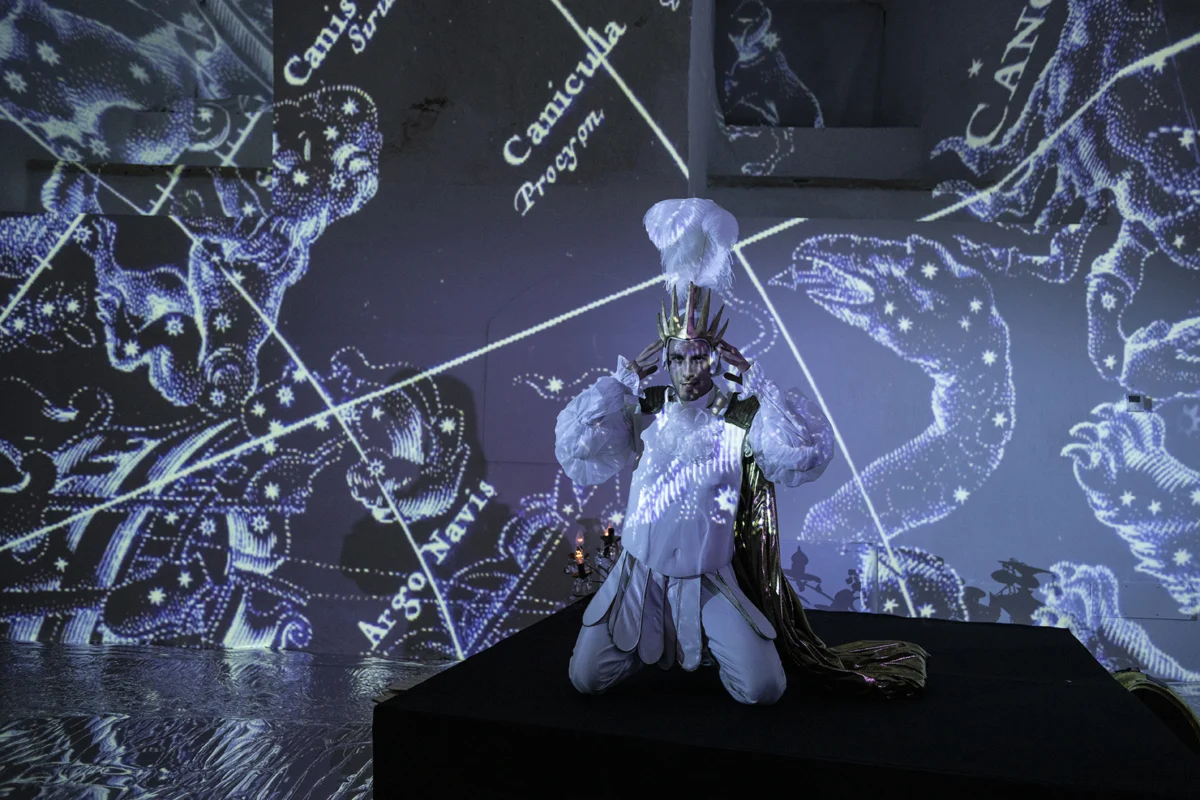
Carlo Maria Michelangelo Nicola Broschi, known to history simply as Farinelli, remains the most celebrated castrato in the annals of Western music. During the 18th century, his vocal prowess transcended the boundaries of the operatic stage, elevating him to a status comparable to the modern-day pop idol. He served as a cultural titan, courted by European monarchs from Madrid to London, and amassed a fortune that few contemporary artists could match. Yet, the glitz and glamour that defined his public persona masked a profound, lifelong tragedy. This duality of immense artistic triumph and deep personal alienation is the subject of the new performance work, Farinelli: The Voice That Remains, which recently premiered at the Festival Internazionale Castel dei Mondi in Andria, Italy.
A Historical Context of the Castrato Phenomenon
To understand the weight of the performance, one must contextualize the era of the castrati. The practice of castrating young boys before puberty to preserve their high vocal ranges was a brutal byproduct of a rigid social and musical hierarchy. Between the 16th and 19th centuries, thousands of young boys—often from impoverished backgrounds—were subjected to the procedure, fueled by the hope of social mobility and the insatiable demand for high voices in both the Catholic Church and the burgeoning opera industry.
Farinelli was born in 1705 in Andria, a city in the Puglia region. His ascent was meteoric. After training under the famed pedagogue Nicola Porpora, he debuted in Rome in 1720. His vocal range, flexibility, and sustained breath control became legendary, reportedly capable of holding a note for an entire minute without pause. His career trajectory is well-documented:
- 1720: Professional debut in Rome, gaining immediate acclaim for his technical mastery.
- 1734: Arrival in London, where he dominated the "Opera of the Nobility" at the Lincoln’s Inn Fields Theatre, effectively eclipsing his contemporaries.
- 1737: Relocation to the Spanish court, where he served King Philip V for over two decades, allegedly using his voice to alleviate the monarch’s chronic bouts of clinical depression.
- 1782: Death in Bologna, marking the end of an era for the castrato voice.
The Production: A Fusion of Music and Melancholy
The new work, written and directed by MariaLuisa Bafunno, serves as a bridge between historical documentary and contemporary music theater. Performed by male soprano Nicolò Balducci, the production avoids the common pitfalls of biographical plays by focusing on the psychological erosion caused by the singer’s early mutilation. Rather than attempting to chronicle every triumph, Bafunno focuses on the "aftermath" of the surgical act, examining the isolation that persisted despite the roar of the applause.
The performance took place within the historic Palazzo Ducale in Andria. The site-specific nature of the show played a pivotal role in its reception. By utilizing a candlelit, intimate space, the production team recreated the atmosphere of a private baroque salon. The audience was greeted by a performer portraying a servant, establishing a sensory contract: "He sings only by candlelight," the servant noted, framing the voice not just as an instrument, but as a living, breathing, and fragile entity.
Narrative Structure and Artistic Choices
Bafunno’s script is an exercise in restraint. The term "castration" is notably absent from the dialogue, a decision that enhances the power of the narrative. By omitting the clinical term, the script forces the audience to confront the human consequences of the procedure without the safety net of medical terminology. The narrative relies on anecdotes—some historical, some illustrative—to depict Farinelli’s alienation. A poignant example involves a scene with a Neapolitan flower girl, used to highlight the moment Farinelli realizes his fundamental difference from other men. His internal monologue, "Other men go on, and I… I stop," serves as the emotional anchor of the play.
The staging, supported by video mapping from Luca Attilli and lighting design by Gianni Bertoli, successfully balances 18th-century aesthetics with 21st-century technology. The use of a desiccated, warrior-like costume draped over a podium effectively symbolized the emptiness of the "star" after the music fades. This visual metaphor of a hollowed-out suit of armor serves as a commentary on the commodification of the human body in the pursuit of artistic perfection.
Musical Analysis of the Performance
The success of the work rested almost entirely on the shoulders of Nicolò Balducci. The vocal demands of the Farinelli repertoire are notoriously difficult, requiring a blend of athletic virtuosity and extreme emotional vulnerability. Balducci’s interpretation of Riccardo Broschi’s Qual guerriero in campo armato and Son qual nave provided the necessary "star power" expected of a piece about Farinelli. These arias require rapid-fire coloratura and precise vocal leaps, which Balducci executed with notable technical confidence.
However, the production truly shifted into a higher gear when Balducci transitioned into the more introspective works of Hasse, Giacomelli, and Duni. In Pallido il sole, Balducci utilized his vocal timbre to convey genuine bitterness rather than simple sadness. By integrating the spoken word with these aria selections, the production managed to maintain a consistent narrative tension. The final selection, Handel’s Lascia ch’io pianga, served as the perfect denouement, stripping away the ornamentation to reveal the raw, aching core of the character.
Broader Implications and Future Outlook
The production of Farinelli: The Voice That Remains raises important questions regarding how we view historical figures of such extreme physical and social status. In contemporary arts, there is a tendency to romanticize the baroque era, yet this production challenges that impulse by centering the trauma of the subject.
From a professional standpoint, the success of this 75-minute production in a smaller, non-traditional venue like the Palazzo Ducale demonstrates a viable model for the future of regional opera. By moving away from massive, expensive orchestral productions and toward more intimate, text-driven "pastiche" works, smaller festivals can attract high-caliber talent while providing a deeper, more intellectually rigorous experience for the audience.
The implications for the future of such works are significant. While the show is currently a niche production, the combination of strong, historically-informed dramaturgy and high-level vocal performance makes it an ideal candidate for touring. It avoids the stagnation often found in traditional operatic revivals by grounding the music in a narrative that is both specific to the 18th century and universally applicable to the human condition.
In conclusion, Bafunno and Balducci have succeeded in creating a work that honors the technical brilliance of the castrati while refusing to look away from the human cost of their fame. By humanizing the "superstar" of the 18th century, they have ensured that the voice of Carlo Broschi remains relevant, not merely as a historical curiosity, but as a poignant reminder of the enduring struggle between the desire for artistic immortality and the need for a meaningful, ordinary life. The performance concludes not with a flourish of triumph, but with a quiet, lingering meditation on the price of greatness—a fitting end for a figure whose life was defined by the very thing that made him both an icon and an outsider.