Johan Budi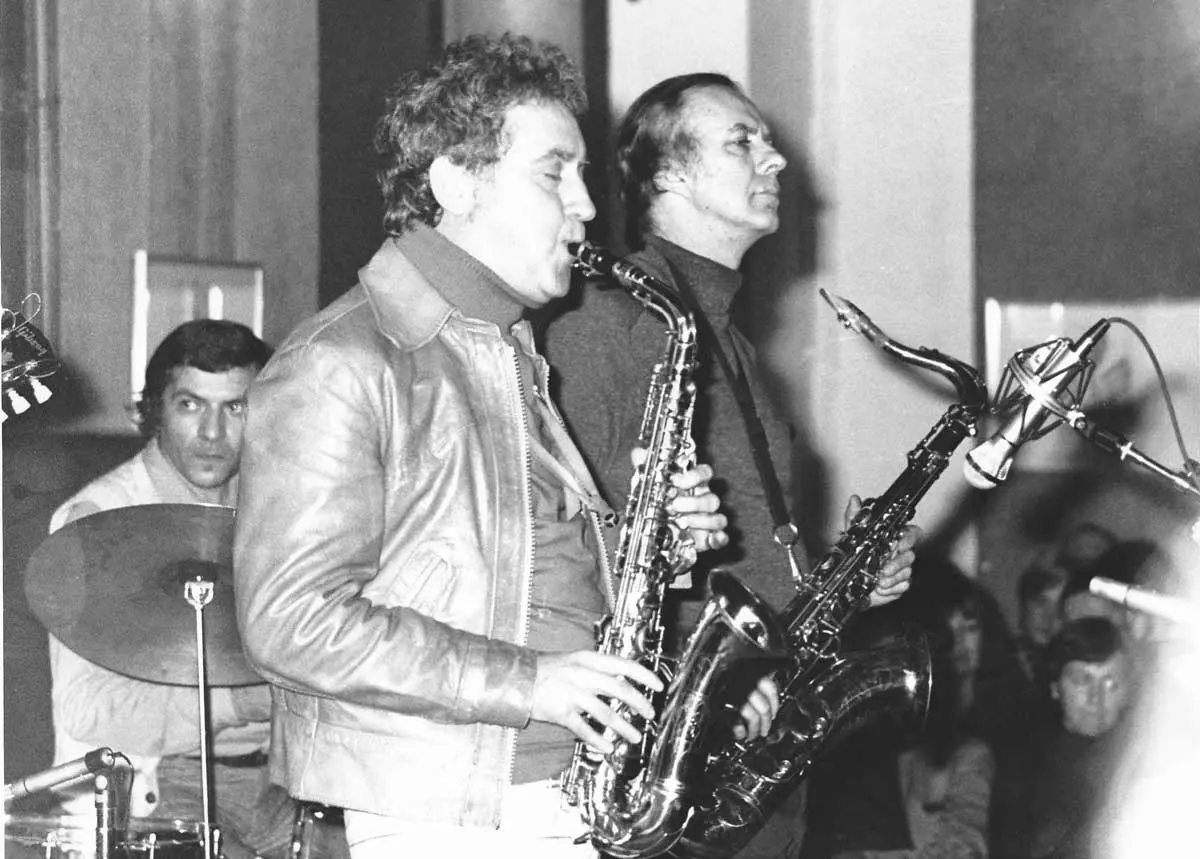
The appearance of Lee Konitz and Warne Marsh at a performance in Hull represents one of the most significant and unlikely jazz milestones of the current decade. For aficionados of the genre, the prospect of these two seminal figures sharing a stage after an eleven-year hiatus is a momentous occasion in its own right; however, the fact that this reunion took place in Hull adds a layer of improbability to an already extraordinary event. Orchestrated through the diligent efforts of promoter and musician Bernie Cash, the concert on March 9th drew approximately three hundred enthusiasts who witnessed a two-hour display of musical sophistication that reaffirmed the enduring relevance of the Tristano school of jazz.
This performance follows a brief series of engagements, including a notable appearance at the Seven Dials in London late last year, which served as a precursor to the current tour. For those in attendance, the impact of Warne Marsh’s current technical command was nothing short of revelatory. While Marsh has long been respected by critics and peers, his live performance in Hull suggested that he may currently be the most accomplished tenor saxophonist active in the jazz idiom. The disconnect between his recorded output and his live prowess remains a point of discussion among enthusiasts, as many argue that no existing recording has fully captured the sheer depth of his improvisational invention or the fluidity of his execution.
The Technical Mastery of Warne Marsh and Lee Konitz
The evening was defined by a series of solos that showcased the divergent yet complementary styles of the two protagonists. Marsh’s contributions were particularly noteworthy for their harmonic complexity and rhythmic elasticity. During an exquisite rendition of "Easy Living," Marsh demonstrated a melodic sensibility that bypassed traditional clichés, opting instead for a winding, investigative approach to the ballad. This was followed by a medium-tempo exploration of "It’s Only A Paper Moon," in which Marsh utilized breathtaking double-time passages that remained perfectly articulated despite their velocity.
Lee Konitz, the alto saxophonist whose name is synonymous with the "Cool Jazz" movement and the seminal Birth of the Cool sessions, provided a masterclass in thematic development. His performance of "You Go To My Head" began as an unaccompanied soliloquy, a daring choice that highlighted his pure tone and precise intonation. As the piece progressed, bassist Peter Ind joined the fray to create a delicate duo, eventually followed by drummer Alan Levitt to complete the trio. Marsh, recognizing the definitive nature of Konitz’s interpretation, opted for a contrasting approach in the subsequent numbers, illustrating the profound mutual respect and ego-free collaboration that characterizes their partnership.
Despite the lack of formal rehearsal time—evidenced by the quiet, "sotto voce" discussions between the musicians as they decided on the next direction—the ensemble navigated some of the most challenging repertoire in the jazz canon. The setlist included several intricate compositions from the Lennie Tristano school of the 1940s, such as "Wow," "Sound Lee," "Subconscious Lee," and "East 32nd." These pieces, known for their long, winding linear melodies and absence of traditional blues inflections, were executed with remarkable precision. The quartet also tackled bebop staples including Charlie Parker’s "Chi Chi" and the notoriously difficult "Donna Lee," proving that their intellectual approach to improvisation is grounded in a deep mastery of the fundamental jazz tradition.
Historical Context: The Tristano School and the Eleven-Year Gap
To understand the weight of this reunion, one must look back at the pedagogical and stylistic foundations laid by Lennie Tristano in the late 1940s and early 1950s. Both Konitz and Marsh were star pupils of Tristano, a blind pianist and theorist who emphasized a rigorous, almost mathematical approach to improvisation. Tristano’s students were encouraged to avoid "licks" or practiced patterns, instead striving for a continuous stream of consciousness that adhered strictly to the underlying harmony while exploring unconventional rhythmic displacements.
The partnership between Konitz and Marsh reached its early zenith in the mid-1950s, most notably on the Atlantic Records sessions which are now considered cornerstones of modern jazz. However, as the jazz landscape shifted toward the more aggressive sounds of Hard Bop and later the avant-garde and Fusion movements, the subtle, cerebral counterpoint of the Konitz-Marsh duo became a rarity. The eleven-year gap in their collaboration was not merely a matter of logistics but reflected the diverging paths of two artists who continued to evolve in isolation. Marsh remained largely a "musician’s musician," often based in Los Angeles and occasionally withdrawing from the public eye to focus on teaching and private study. Konitz, conversely, remained more visible on the international circuit, constantly seeking new contexts for his alto saxophone.
The reunion in Hull, therefore, serves as a bridge between the foundational era of the Tristano school and the contemporary jazz environment. It signifies a resurgence of interest in a style of jazz that prioritizes linear clarity and harmonic sophistication over volume or theatricality.
The Role of the Rhythm Section: Peter Ind and Alan Levitt
A performance of this complexity requires a rhythm section capable of providing a stable yet flexible foundation. Peter Ind, the British-born bassist who spent years in New York City working directly with Tristano and Konitz, proved to be the ideal anchor for the evening. Ind’s history with the group is extensive; he was the bassist on many of the original Tristano-led recordings and has since become a vital figure in the preservation of this specific musical lineage. His performance on a "themeless" version of "Lady Be Good" was a highlight of the night. In this instance, Konitz played the famous 1936 Lester Young choruses from memory, with Ind providing a walking bass line that was both supportive and melodically interactive.
Drummer Alan Levitt provided the necessary propulsion without ever overpowering the delicate textures of the saxophones. Levitt’s style is characterized by a light touch and a keen awareness of the soloists’ rhythmic intent. In the context of the Tristano school, the drummer’s role is often to maintain a steady pulse while allowing the melodic instruments to dictate the tension and release of the performance. Levitt executed this role with professional poise, ensuring that even the most complex "double-time" explorations by Marsh remained grounded.
Analysis of Implications and the Future of the Collaboration
The success of the Hull concert, and the broader tour of which it is a part, suggests a significant appetite for high-level acoustic jazz in the United Kingdom. In an era where many jazz venues have shifted toward more commercially viable genres, the presence of three hundred dedicated fans in a city like Hull is a testament to the enduring pull of Lee Konitz and Warne Marsh.
From a critical perspective, the performance highlighted the unique synergy between the two saxophonists. It has often been observed that neither musician is capable of a subpar performance when in the presence of the other. The mutual respect they share acts as a catalyst, pushing each to strive for a level of perfection that is rarely achieved in a live, unrehearsed setting. This was most evident during their rendition of "Body and Soul," where the two horns intertwined in a display of spontaneous counterpoint that felt both composed and entirely fresh.
The logistical challenges of the tour—including Konitz’s brief struggle with reed issues and the lack of rehearsal—did little to dampen the quality of the output. In fact, these elements of human fallibility and spontaneous problem-solving are central to the appeal of the genre. When Konitz winced at a squeak from his reed, it served as a reminder of the physical demands of the instrument, making his subsequent triumphs on "Lady Be Good" all the more impressive.
Broader Impact on the Jazz Landscape
The reunion of Konitz and Marsh arrives at a time when the jazz world is reflecting on its mid-century innovators. As the "Cool Jazz" label is increasingly viewed not as a limitation but as a description of a specific, rigorous aesthetic, the work of the Tristano school is being re-evaluated by a new generation of musicians. The Hull performance provides a contemporary data point in this ongoing evaluation, proving that the techniques pioneered in the 1940s remain a potent vehicle for expression.
Bernie Cash’s role in bringing this event to fruition cannot be overstated. By facilitating this tour, Cash has provided a platform for a musical dialogue that many feared had been lost to history. The event also underscores the importance of regional jazz circuits in the UK, demonstrating that world-class artistry is not the exclusive domain of major metropolitan hubs.
As the quartet continues its tour, the jazz community will be watching closely to see if this reunion leads to a more permanent collaboration or a new series of recordings. Given the technical peak both Marsh and Konitz currently inhabit, a studio document of this period would be a vital addition to the jazz archives. For now, the three hundred enthusiasts in Hull can claim to have witnessed a rare moment of musical history—a night where the unlikely became reality and the standards of jazz improvisation were once again elevated to the highest level.