Nayara Elvina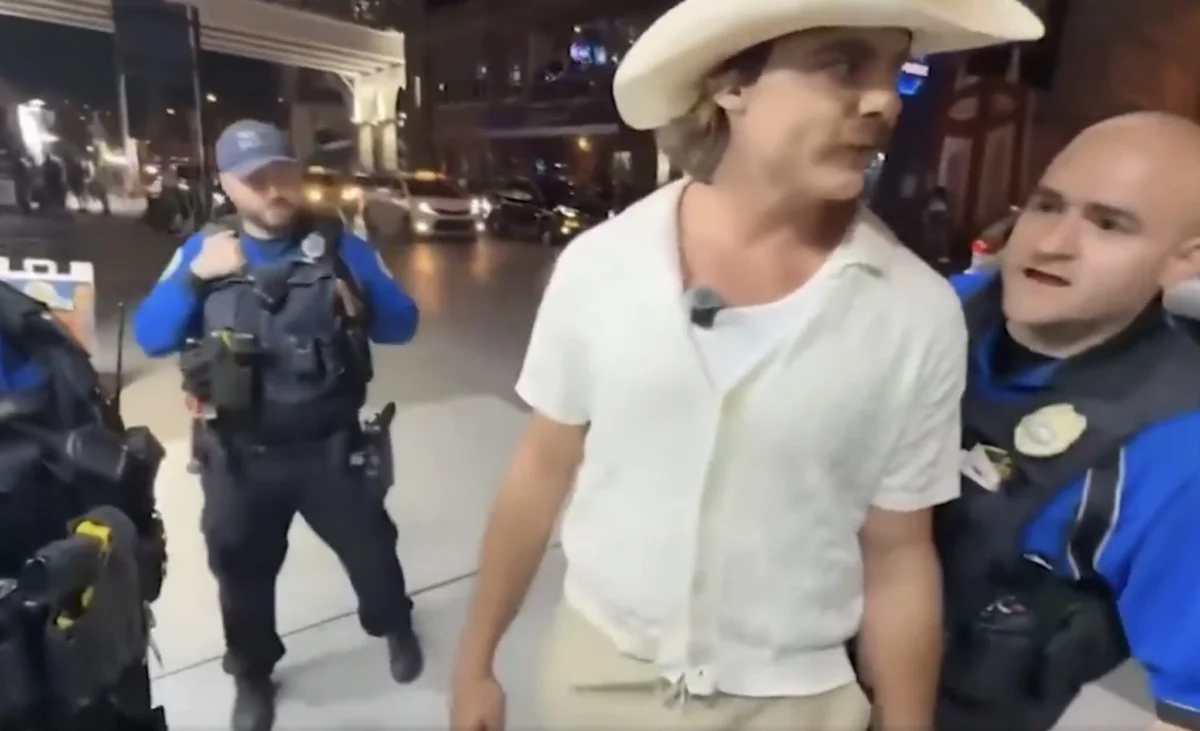
Authorities in Clarksville, Tennessee, are investigating a shooting involving a prominent and controversial internet personality that occurred on Monday afternoon outside the Montgomery County Courthouse. The individual, 28-year-old Dalton Eatherly, known online as “Chud the Builder,” was reportedly injured during the altercation, which resulted in at least one other person being airlifted to a regional trauma center. The incident marks a significant escalation in a series of legal and physical confrontations involving Eatherly, who had been released from custody in Nashville just 48 hours prior following a separate arrest on Broadway.
The shooting took place in broad daylight in a high-traffic area near the legal heart of Clarksville. According to preliminary reports and footage captured on Eatherly’s own livestream, the confrontation began when Eatherly was approached by a group of individuals outside the courthouse. Eatherly, a Clarksville resident, has gained notoriety for a specific style of “In-Real-Life” (IRL) streaming that involves traveling to public spaces to provoke bystanders with inflammatory language, including racial slurs and anti-Semitic rhetoric, often referred to in digital media circles as “rage baiting.”
Details of the Courthouse Confrontation
The sequence of events leading to the discharge of a firearm remains under active investigation by the Clarksville Police Department and the Montgomery County Sheriff’s Office. However, Eatherly’s own livestream provides a partial, albeit subjective, account of the moments preceding the violence. In the footage, Eatherly can be heard speaking to law enforcement officers while receiving medical attention. He claimed that he was initially targeted by a group of people who were pointing at him and shouting.
Eatherly told officers that he attempted to walk away from the group, but was subsequently pursued by an unidentified male. According to Eatherly’s statement on the recording, the man threatened him before the encounter turned physical. Eatherly alleged that the individual began “wailing” on him—a colloquial term for a sustained physical assault—prompting Eatherly to produce a firearm and fire multiple shots.
First responders arriving at the scene treated Eatherly for what was described in radio dispatches as a “graze” wound to his arm and a “slight abrasion” to his head. In the recorded video, a visibly shaken Eatherly is seen being loaded into an ambulance, at one point questioning medical personnel whether he had accidentally shot himself or if the injury was the result of a direct hit from another party.
The second individual involved in the shooting suffered more critical injuries. While the Clarksville Police Department has not released the identity of the other man, officials confirmed that he was life-flighted to a hospital for emergency surgery. His current condition remains undisclosed, and it has not yet been clarified whether the second individual was also armed at the time of the altercation.
Recent Legal History and the Nashville Arrest
The shooting in Clarksville occurred while Eatherly was out on bond for a series of charges stemming from an incident in Nashville over the preceding weekend. On Saturday, May 11, 2026, Eatherly was arrested by the Metropolitan Nashville Police Department (MNPD) following a disturbance at a restaurant in the city’s popular Lower Broadway entertainment district.
According to court records, Eatherly was charged with theft of services, disorderly conduct, and resisting arrest. The theft charge originated from a dispute over a restaurant bill totaling approximately $400. Staff at the establishment alleged that Eatherly refused to pay for his meal and drinks after being asked to leave due to disruptive behavior. When police arrived, the situation reportedly escalated, leading to the additional charges of resisting arrest and disorderly conduct. Eatherly was booked into the Davidson County Jail and was subsequently released on a $2,500 bond.
This Nashville incident was not an isolated event but part of a documented pattern of behavior. In the weeks leading up to his arrest, several videos of Eatherly had gone viral on social media platforms. One clip showed Eatherly engaged in a heated argument with an older man outside Honky Tonk Central, a well-known bar on Broadway, after Eatherly allegedly used racial slurs in public. Another video captured Eatherly directing derogatory language at a security guard outside Barstool Nashville after he was denied entry. In these videos, Eatherly often defends his actions as an exercise of his First Amendment rights, frequently carrying bear spray and threatening to use it against those who react aggressively to his provocations.
A History of Provocative Content and Digital Infamy
Dalton Eatherly’s rise to digital notoriety is rooted in the controversial "IRL streaming" subculture. Operating under the moniker “Chud the Builder,” Eatherly’s content strategy relies heavily on high-conflict interactions. By broadcasting live to thousands of viewers, Eatherly monetizes the tension generated by his confrontational behavior.
This brand of content has drawn criticism even from within the far-right and "alternative media" spheres. Nick Fuentes, a prominent and often controversial streamer known for his own inflammatory views, recently publicly distanced himself from Eatherly. Fuentes characterized Eatherly’s tactics as “not nice” and “unethical,” suggesting that the "Chud the Builder" persona was designed purely for harassment rather than political discourse.
The use of "rage bait" as a financial model has become a growing concern for law enforcement in major metropolitan areas like Nashville. These streamers often intentionally walk the line between protected speech and "fighting words"—a legal category of speech that is not protected by the First Amendment because it tends to incite an immediate breach of the peace. Eatherly’s frequent use of racial and religious slurs in crowded public areas is viewed by critics and legal experts as a deliberate attempt to trigger such a breach for the purpose of generating "viral" content.
Chronology of Legal Escalation
To understand the context of the courthouse shooting, a review of Eatherly’s legal timeline is necessary:
- 2025: Eatherly is charged with harassment in Montgomery County, Tennessee. These charges were recently bound over to a grand jury, indicating that a judge found sufficient evidence for the case to proceed to trial.
- May 11, 2026: Eatherly is arrested in Nashville for theft of services ($400), disorderly conduct, and resisting arrest. He is released on a $2,500 bond.
- May 13, 2026 (Afternoon): While out on bond for the Nashville charges and the 2025 harassment charges, Eatherly is involved in a shooting outside the Montgomery County Courthouse.
- May 13, 2026 (Evening): Reports emerge that Eatherly is in police custody following medical treatment, though formal charges related to the shooting have not been finalized.
Potential Legal Consequences and Bond Revocation
The shooting at the courthouse places Eatherly in a precarious legal position regarding his existing bonds. Under Tennessee law, a defendant’s bond can be revoked if they are arrested for a new offense while awaiting trial on prior charges. Given that Eatherly was already facing harassment charges in Montgomery County and fresh charges in Davidson County, the District Attorney’s office may petition the court to revoke his bond entirely.
Furthermore, the nature of the shooting will be scrutinized under Tennessee’s self-defense and "Stand Your Ground" laws. While Eatherly claims he acted in self-defense after being "wailed on," investigators will look at whether his own provocative behavior contributed to the inception of the violence. In Tennessee, a person generally cannot claim self-defense if they were the initial aggressor or if they provoked the confrontation that led to the use of force, unless they clearly withdrew from the encounter and communicated that withdrawal to the other party.
The fact that the shooting occurred outside a courthouse—a location with high security and surveillance—means that investigators likely have access to multiple angles of CCTV footage in addition to Eatherly’s own livestream. This evidence will be critical in determining whether the use of deadly force was legally justified.
Broader Impact on Public Safety and Streaming Regulation
The incident involving Dalton Eatherly highlights a growing friction between the digital economy of livestreaming and physical public safety. Cities like Nashville and Clarksville are increasingly becoming the backdrop for "clout-chasing" behavior, where the potential for violence is a feature, not a bug, of the content being produced.
Public officials in Nashville have previously expressed concern over the impact of disruptive streamers on the city’s tourism industry. The Broadway district, which generates significant tax revenue for the state, relies on a perception of safety. Persistent harassment of tourists and staff by individuals seeking to provoke reactions for an online audience creates a volatile environment that exhausts police resources.
As the investigation into the Montgomery County shooting continues, the case may serve as a catalyst for legislative discussions regarding the regulation of "monetized harassment." While the First Amendment provides broad protections for speech, the transition from verbal provocation to physical violence—and now a shooting—demonstrates the tangible risks associated with the IRL streaming phenomenon.
Current Status of the Investigation
As of Monday evening, the Clarksville Police Department has not confirmed whether Eatherly will face immediate charges such as aggravated assault or attempted murder, or if the case will be presented to a grand jury for a determination on the self-defense claim. Eatherly remains under medical supervision and/or in police custody. The identity and medical status of the second individual remain the primary focus for local authorities as they attempt to piece together the full narrative of the afternoon’s violence.
The Montgomery County Sheriff’s Office has urged any witnesses who were near the courthouse at the time of the shooting to come forward with information or video footage. The area surrounding the courthouse remained cordoned off for several hours following the incident as forensic teams processed the scene for ballistic evidence. Further updates from law enforcement are expected as the investigation progresses.