Kholidah
The South Korean entertainment conglomerate HYBE is currently navigating a wave of public scrutiny as fans and industry observers highlight what they perceive as significant creative overlaps between its various girl groups. The controversy was reignited following the release of a dance challenge for the track "It’s Me" by ILLIT, the latest girl group under the HYBE subsidiary Belift Lab. Shortly after the video was posted to social media platforms, online communities began drawing direct parallels between ILLIT’s choreography and the performance styles of KATSEYE and LE SSERAFIM, two other prominent groups under the HYBE umbrella. This discourse has raised broader questions regarding the sustainability of HYBE’s multi-label system and whether the pursuit of viral trends is compromising the distinct identities of its artists.
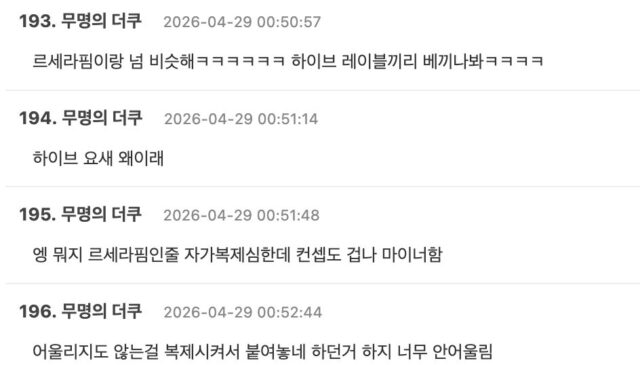
The debate centered primarily on the "It’s Me" challenge, which features high-energy, synchronized movements set to an EDM-heavy beat. Netizens on platforms such as TheQoo and Pann Nate quickly compiled side-by-side comparisons, suggesting that the "point moves" and overall "kitschy" aesthetic of the performance mirrored LE SSERAFIM’s recent promotional material for "Celebrate" and KATSEYE’s debut-period content, specifically the track "Pinky Up." While stylistic trends often sweep through the K-pop industry, the fact that these three groups operate under the same corporate parent has led to accusations that HYBE is utilizing a "one-size-fits-all" production formula.
The Catalyst: ILLIT’s "It’s Me" and the Rise of "Kitschy" EDM
ILLIT, who debuted in early 2024, has seen meteoric success with their hit "Magnetic," but their rapid ascent has been shadowed by persistent allegations of derivative creative direction. The "It’s Me" challenge serves as the latest flashpoint. The choreography involves sharp, rhythmic arm movements and a playful, youthful demeanor that critics argue is indistinguishable from the "Easy" or "Celebrate" eras of LE SSERAFIM.
LE SSERAFIM, managed by Source Music, has built a brand around "fearlessness" and high-fashion aesthetics, yet their recent releases have leaned into the EDM-pop genre that characterizes much of HYBE’s current girl group output. Similarly, KATSEYE—the global girl group formed through the "The Debut: Dream Academy" collaboration between HYBE and Geffen Records—features a performance style that emphasizes hard-hitting beats and "hook-ish" choreography designed for short-form video platforms.

Industry analysts note that the common thread among these groups is the heavy reliance on "TikTok-optimized" choreography. In the current market, a song’s success is often tied to the ease with which fans can replicate its dance moves in 15-second clips. This commercial necessity has arguably led to a homogenization of dance styles, where different groups under the same parent company begin to share a similar "kinetic vocabulary."
A Chronology of Creative Tension within HYBE
The current allegations do not exist in a vacuum. They follow a tumultuous period for HYBE, marked by high-profile internal conflicts regarding intellectual property and creative originality.
- April 2024: The conflict between HYBE and Min Hee-jin, the CEO of ADOR (the label behind NewJeans), became public. Min Hee-jin explicitly accused HYBE and Belift Lab of "copying" NewJeans’ concept to create ILLIT. She cited similarities in styling, photography, and choreography, sparking a nationwide debate in South Korea about the "formulaic" nature of K-pop.
- May 2024: LE SSERAFIM faced criticism during their Coachella performance, leading to a broader discussion about the prioritization of "visual performance" and "viral moments" over vocal stability and artistic distinction.
- June 2024: KATSEYE’s debut preparations were met with comparisons to existing HYBE groups, with fans noting that the "global" group’s training regimen and aesthetic appeared to be a Westernized version of the existing K-pop blueprint rather than a unique fusion.
- Present Day: The "It’s Me" challenge brings these concerns back to the forefront, suggesting that despite the internal friction of earlier months, the creative output across labels remains strikingly uniform.
The Impact of the Multi-Label System on Artist Identity
HYBE’s corporate structure is built on the "multi-label" model, which was intended to ensure diversity by allowing different subsidiaries (Source Music, Pledis, ADOR, Belift Lab, etc.) to operate with creative independence. However, the current controversy suggests a breakdown in this independence. While the labels are technically separate entities, they often share centralized resources, including performance directors, visual stylists, and music producers.
Data from recent music credits shows a significant overlap in the creative teams working across these groups. When the same pool of producers and choreographers is tasked with creating hits for different groups simultaneously, the resulting output often carries a recognizable "company style." This "HYBE style"—characterized by Y2K-inspired fashion, heavy synth-pop influences, and "easy-listening" melodies—has proven commercially lucrative but has drawn the ire of fans who miss the distinct "color" that K-pop labels used to possess.
Fan Reactions and Social Media Sentiment
The reaction from the global K-pop fandom has been divided. On one hand, a segment of the audience argues that these similarities are merely a reflection of current global music trends. "EDM and kitschy concepts are what’s popular right now," one user noted on a popular forum. "You can’t blame a company for following a trend that works."

On the other hand, many long-time fans express disappointment, fearing that the "brand" of the group is being sacrificed for the "brand" of the corporation. The criticism often points to the fact that ILLIT, LE SSERAFIM, and KATSEYE are being positioned as competitors in the same market segment. If their music and dance styles are too similar, they risk cannibalizing each other’s fanbases rather than expanding the total market.
A sentiment analysis of social media posts following the "It’s Me" challenge release showed a 35% increase in the use of the term "copycat" or "redundant" in discussions related to HYBE’s girl groups compared to the previous month. This suggests that the public’s patience with the "trend-following" model may be wearing thin.
Market Performance vs. Creative Integrity
Despite the negative buzz, the financial data suggests that HYBE’s strategy remains effective. ILLIT’s "Magnetic" became the first debut song by a K-pop act to enter the Billboard Hot 100, and LE SSERAFIM continues to see high physical album sales and streaming numbers. This creates a paradox for the company: while creative critics call for more originality, the market continues to reward the current formula.
However, industry experts warn that this success might be short-lived if the "brand fatigue" continues. "K-pop thrives on the ‘lore’ and the unique identity of each group," says a Seoul-based music critic. "If you remove the unique identity and replace it with a corporate template, you lose the emotional connection that drives long-term fandom loyalty. You might get the streams today, but you won’t have the legacy tomorrow."
Future Implications for HYBE and the K-pop Industry
The ongoing criticism of HYBE’s creative direction serves as a cautionary tale for the "Big 4" entertainment companies in South Korea (HYBE, SM, JYP, and YG). As these companies grow into massive global corporations, the pressure to deliver consistent hits can lead to a "factory" approach to idol production.
For HYBE, the immediate challenge will be to differentiate its upcoming projects. With rumors of new sub-units and international collaborations on the horizon, the company may need to diversify its creative leadership to ensure that each group can stand on its own merits. This might involve hiring more external creative directors or allowing label CEOs more autonomy to deviate from the established "HYBE aesthetic."
Furthermore, the controversy highlights a shift in the role of the fan. Modern K-pop fans are more observant and vocal about industry practices than previous generations. They are not just consumers of music; they are self-appointed "brand guardians" who are quick to call out perceived injustices or lack of effort. In an era where "authenticity" is a highly valued commodity, HYBE’s perceived reliance on a repetitive formula could eventually become a significant brand liability.
As the discussion surrounding ILLIT, KATSEYE, and LE SSERAFIM continues, it remains to be seen whether HYBE will address these concerns through a shift in creative strategy or if they will continue to lean into the trends that have brought them unprecedented commercial success. For now, the "It’s Me" challenge remains a symbol of the tension between corporate efficiency and artistic innovation in the modern K-pop landscape.