Aveline Kirana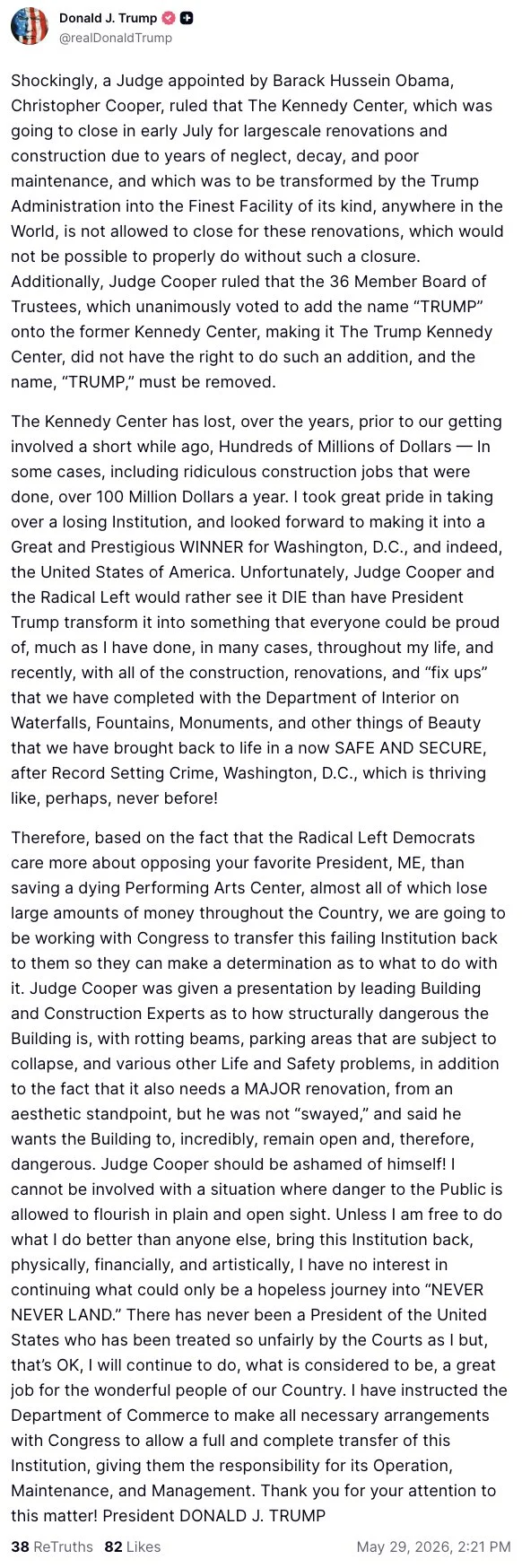
Following a decisive ruling by Judge Paul L. Friedman of the U.S. District Court for the District of Columbia, ordering the Kennedy Center’s board to cease the renaming of the performing arts institution in honor of former President Donald J. Trump, President Trump has publicly declared his disinterest in the matter. The former President, through a statement on his social media platform Truth Social, indicated he would defer any further decisions regarding the Kennedy Center to Congress, while simultaneously launching sharp criticisms against the Democratic Party and the judicial system he believes has treated him unfairly.
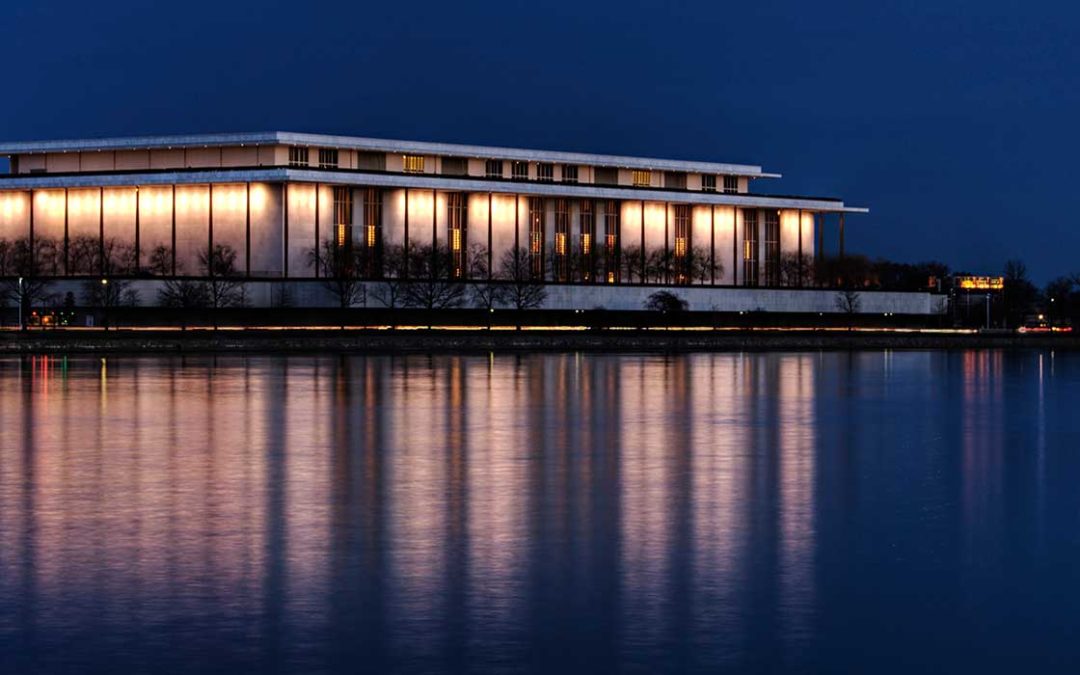
This development marks a significant turn in the ongoing controversy surrounding the proposed renaming of the John F. Kennedy Center for the Performing Arts. The initial decision by the Kennedy Center’s Board of Trustees to honor Trump for his alleged "historic contributions" had sparked considerable debate and legal challenges, ultimately leading to the court’s intervention.
Background of the Renaming Controversy
The controversy ignited when the Kennedy Center’s Board of Trustees, in a move that surprised many in the arts and political spheres, voted to rename the iconic institution the "Trump Center for the Performing Arts." This decision was reportedly influenced by legislative provisions enacted during the Trump administration that allocated significant federal funding for renovations and enhancements to the Center. Proponents of the renaming argued that it was a fitting recognition of the financial support provided.
However, the proposal immediately drew strong opposition from various quarters. Critics argued that naming a national cultural landmark after a highly polarizing political figure was inappropriate and divisive, potentially politicizing an institution meant to serve as a unifying force for the arts. Concerns were raised about the long-term implications for the Kennedy Center’s non-partisan status and its ability to attract diverse audiences and artists.
The legal challenge was spearheaded by a coalition arguing that the renaming violated established statutes governing the Kennedy Center and potentially infringed upon the legacy of President John F. Kennedy, for whom the center is currently named. These statutes emphasize the Center’s role as a living memorial to Kennedy’s commitment to the arts and his vision of a nation enriched by cultural expression.
Judicial Intervention and Trump’s Response
On Friday, May 29, Judge Paul L. Friedman delivered a ruling that decisively sided with the plaintiffs. The court found the Board’s decision to rename the Kennedy Center illegal and ordered the immediate removal of any signage bearing Donald J. Trump’s name. Furthermore, the Center was instructed to update its website to reflect this ruling and was prohibited from closing for renovations, a measure that had been planned in conjunction with the proposed renaming.
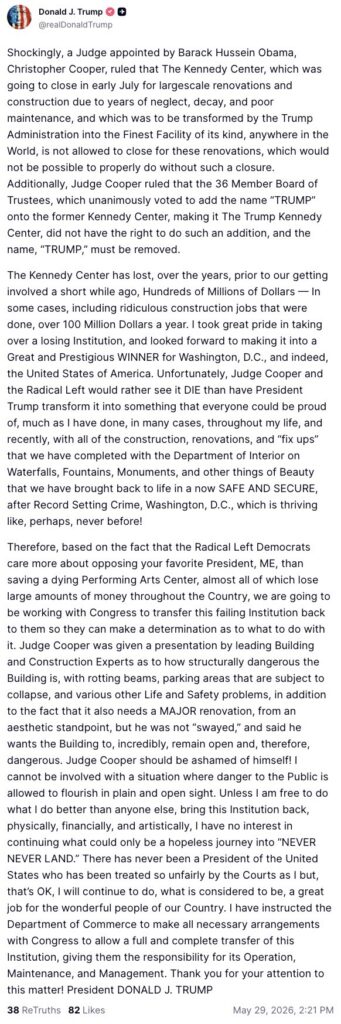
In the wake of this judicial setback, Donald Trump took to Truth Social to express his displeasure. He stated, "I will be transferring all the power back to the Congress so they could figure out what to do with the performing arts center." This statement suggests a deliberate distancing from the issue, framed as a consequence of the court’s decision and what he perceives as a lack of respect for his authority.
Trump did not shy away from making pointed remarks about his political adversaries, characterizing the Democratic Party as "radical." He also directly addressed Judge Cooper, stating that the judge "should be ashamed" for his ruling. Trump further asserted that he is the only president in history to have been treated so "unfairly" by the courts, implying a pattern of persecution. He concluded his statement by declaring that unless he was permitted to act "freely," he had "no interest in the Kennedy Center any longer."
Kennedy Center’s Stance and Potential Appeal
The Kennedy Center, through its vice president of public relations, Roma Daravi, has maintained a position of confidence in its original decision. Daravi stated, "We are confident that on appeal the court will uphold the Board’s will to recognize President Trump’s historic contributions to our nation’s cultural center." This indicates that the Center intends to pursue legal avenues to challenge Judge Friedman’s ruling, suggesting that the legal battle over the renaming may not be entirely concluded.
The statement from the Kennedy Center’s PR department underscores their belief in the validity of the Board’s decision, likely rooted in the interpretation of the legislative provisions that facilitated the federal funding. Their confidence in an appeal suggests a belief that the appellate court might view the matter differently, potentially focusing on the Board’s autonomy in managing the Center and acknowledging the financial contributions as a basis for recognition.
Broader Implications and Analysis
The judicial ruling and President Trump’s subsequent reaction carry significant implications for both the Kennedy Center and the broader landscape of political influence on national cultural institutions.
Impact on the Kennedy Center:
The immediate effect is the preservation of the Kennedy Center’s current identity as a memorial to John F. Kennedy. This decision safeguards the institution’s historical legacy and its perceived non-partisan status, which is crucial for its mission of serving all Americans through the arts. The inability to close for renovations, as ordered by the court, could also lead to delays in much-needed infrastructure improvements, potentially impacting operational efficiency and artistic programming in the short term. The Center’s commitment to an appeal signals a determination to fight for what it believes is its right to honor perceived contributions.
Political and Judicial Ramifications:
President Trump’s strong rhetoric highlights the ongoing tension between political power and the autonomy of cultural institutions. His declaration of disinterest and his criticisms of the judiciary and the Democratic Party reflect a broader pattern of his engagement with institutions he perceives as challenging his authority. The judge’s ruling, on the other hand, reinforces the principle of judicial oversight and the importance of adherence to legal statutes governing public institutions. The reference to the "radical" nature of the Democratic Party and the assertion of unfair treatment by the courts are characteristic of Trump’s political discourse and may be seen as an attempt to rally his base by framing the judicial decision as politically motivated.
Future of National Cultural Institutions:
This case raises pertinent questions about the future relationship between political administrations and national cultural bodies. It underscores the need for clear guidelines and robust legal frameworks to ensure that decisions regarding the naming and governance of such institutions are made with transparency, impartiality, and in alignment with their foundational missions. The episode serves as a reminder that while political support can be vital for the arts, it should not come at the cost of compromising the integrity and inclusivity of these national treasures.
The legal and political ramifications of this controversy are likely to resonate within discussions about the role of arts funding and political influence for years to come. The outcome of any potential appeal by the Kennedy Center will be closely watched as it could set a precedent for how such disputes are resolved in the future. The decision by the court to uphold the integrity of the Kennedy Center’s naming conventions and to prevent its closure for renovations signifies a victory for those who advocate for the separation of political agendas from national cultural heritage.