 Mia Khoirunisa
Beirut, Lebanon – In a significant advancement for musicological research and digital music production, Dr. Khyam Allami presented his extensive, long-term research project in Beirut yesterday, culminating in the release of a free, open-access archive of hundreds of tuning systems, microtonal scales (ajnāws), and Maqamat. Simultaneously, a novel free MIDI plug-in, also developed by Allami, was introduced, enabling musicians to apply and dynamically adjust these complex tunings across various major software formats. This initiative promises to democratize access to a vast repository of sonic traditions and provide unprecedented tools for their practical application.
A Digital Repository of Sonic Diversity
The core of Allami’s project lies in the creation of a comprehensive digital archive, meticulously compiled over years of dedicated research. This archive encompasses a vast array of tuning systems from diverse musical traditions, with a particular emphasis on Arabic music. The collection includes, but is not limited to, hundreds of ajnāws, the microtonal intervals that form the building blocks of many Middle Eastern musical scales, and maqāmāt, the melodic modes that define Arabic musical expression. The archive is distinguished not only by its breadth but also by its multifaceted approach to presenting information. Users can explore these tuning systems through various lenses, including string length, fret length, pitch class, traditional staff notation, and precise measurements in cents. This allows for a deeply analytical and comparative study, catering to scholars, musicians, and enthusiasts alike.
The initiative is a product of the Music Intelligence Lab at the American University of Beirut (AUB), a venerable institution with a rich history of contributing to Lebanese and Arabic academic and cultural landscapes. The project was undertaken by Dr. Khyam Allami in collaboration with Ibrahim El Khansa, underscoring the collaborative spirit of academic inquiry and technological innovation. The American University of Beirut, while bearing a historical "American" designation, has long served as a vital hub for intellectual and artistic endeavors within the region.
Tanghēm: Bridging the Gap Between Theory and Practice
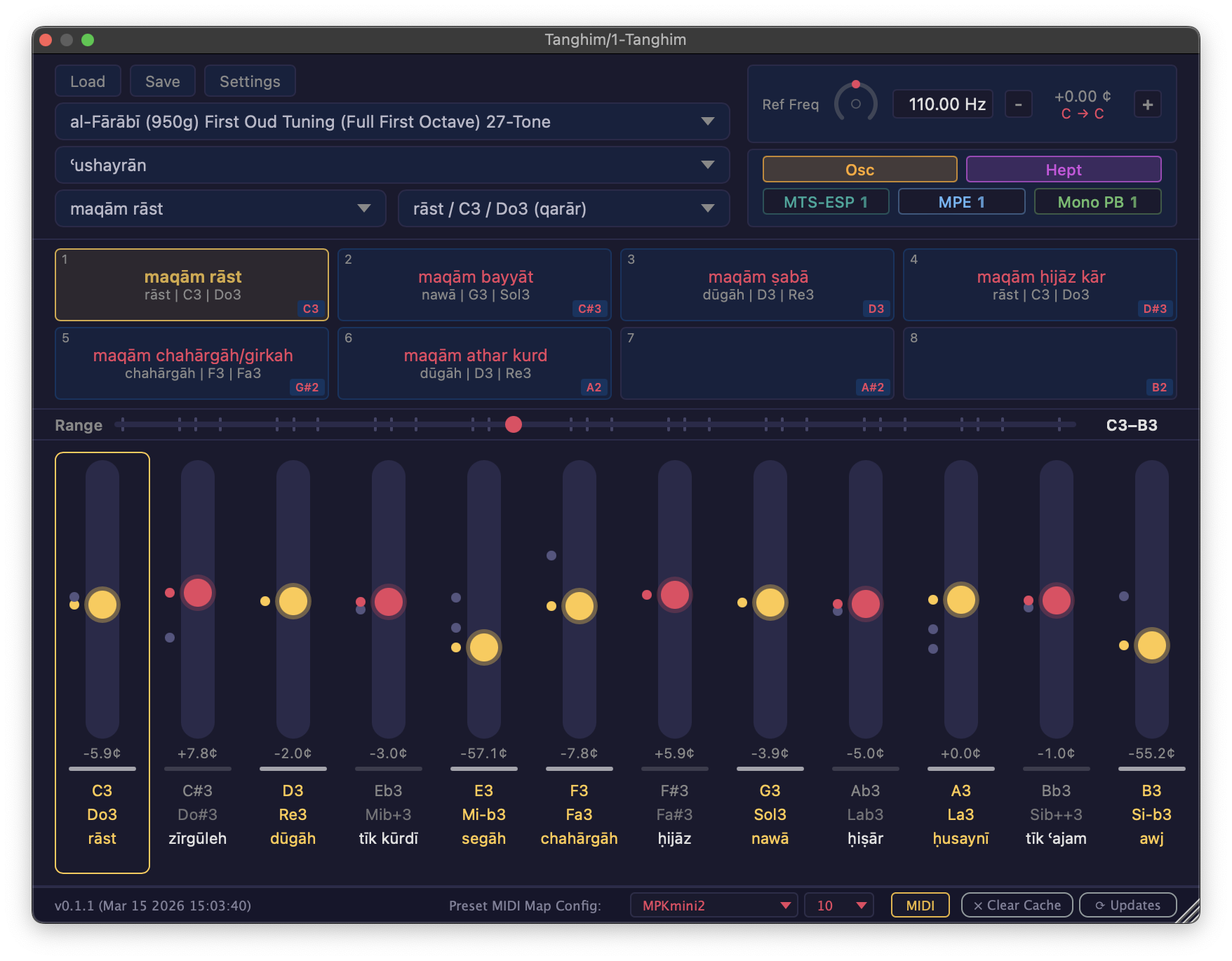
Complementing the archive is the "Tanghēm" software, a free MIDI effect plug-in designed to address a critical limitation in current digital music environments: the static nature of tuning systems. Traditional tuning interfaces, including those supporting MTS-ESP (MIDI Tuning Standard Extended), MPE (MIDI Polyphonic Expression), and even Ableton Live’s built-in tuning systems, often lack a dynamic, real-time interface for adjusting intonation. This stands in stark contrast to acoustic instruments and vocal performance, where musicians intuitively adjust pitch and intonation based on context and ensemble.
Tanghēm aims to rectify this by providing a fluid and responsive platform. It supports MTS-ESP and MPE, ensuring broad compatibility with modern MPE-enabled hardware and software such as Ableton Live. Crucially, it also extends its functionality to monophonic pitch bend, a feature present in virtually all MIDI hardware and software since the inception of the MIDI specification. This backward compatibility ensures that the plug-in’s capabilities can be harnessed by a wide spectrum of users, from those employing cutting-edge MPE controllers to those working with legacy MIDI equipment.
For Ableton Live users, for whom direct MIDI effect plug-in support is still under development, the Tanghēm package includes bundled PE Receiver and Mono Pitch Bend Receiver devices designed as Max for Live objects. This thoughtful integration ensures that the benefits of Tanghēm are accessible within one of the most popular digital audio workstations.
The Philosophy of Intonation: Beyond Standardization
The name "Tanghēm" itself is deeply rooted in the project’s philosophical underpinnings. Derived from an Arabic maṣdar (verbal noun), it signifies the act of intoning or setting pitch, akin to the linguistic concept of "intonation" as the melodic contour of speech. This is deliberately contrasted with dāzīn, the Arabic term for the mechanical tuning of an instrument’s strings, which is a borrowing from Ottoman Turkish and implies a more rigid, ordered approach. Allami’s use of "Tanghēm" emphasizes a return to the nuanced, living practice of intonation, challenging what he describes as the "colonialist, 20th-century idea of standardization" that has often dominated music theory and technology.
This philosophical stance is articulated in the project’s descriptive materials: "Tanghēm is an Arabic maṣdar, or verbal noun, denoting the act of intoning or setting pitch. In linguistics it is the standard equivalent of intonation, the melodic contour of speech. Here it names intonational tuning (the pitch relationships that make up a system) as distinct from the Arabic usage of دوزن (dāzin) for the mechanical tuning of an instrument’s strings. Dāzin is a borrowing from Ottoman Turkish düzen (‘order, arrangement, tuning’), from the verb düzmek (‘to arrange, put in order’)."
The project’s emphasis on live adjustment and nuance is particularly relevant to traditions like Maqam music, where subtle variations in pitch and melodic phrasing are paramount to expressive performance. The idea of a fixed, standardized tuning fails to capture the fluidity and improvisational spirit inherent in these musical forms. While some might argue that ensemble music like Gamelan relies on more fixed tunings, even in such contexts, the performance is imbued with spirit and nuance that transcends mere mechanical precision.
A Dream Archive Realized
The creation of such an archive has long been a desideratum for ethnomusicologists and musicians interested in microtonal and non-Western tuning systems. Its significance lies not only in its comprehensiveness, acknowledging the near-infinite possibilities within tuning, but also in its innovative presentation. The ability to visualize and audibly explore tunings through a variety of models—Western and Arabic, historical and contemporary—offers a powerful pedagogical and creative tool. The side-by-side comparison of different models, such as those based on string length versus pitch class, highlights the underlying principles of each system and underscores the ultimate necessity of internalizing these tunings for accurate performance.
Chronology of Development and Presentation
While the formal presentation in Beirut marks a public unveiling, the project represents years of dedicated research and development. The conceptualization likely began with Allami’s early explorations into microtonality and Arabic music theory, possibly spurred by earlier discussions and writings on the limitations of Western-centric musical software. Collaborations within academic circles, particularly at the American University of Beirut’s Music Intelligence Lab, would have provided the foundational support and intellectual environment for such an undertaking.
The development of the software, including the MIDI plug-in and associated Max for Live devices, would have followed the establishment of the archive’s core structure and content. This phase would involve significant coding, user interface design, and rigorous testing to ensure compatibility and functionality across various platforms and digital audio workstations. The choice to make both the archive and the software freely available signifies a commitment to open access and the democratization of musical knowledge and tools.
The presentation in Beirut yesterday served as a culmination of this extensive work, bringing together the research data and the practical application tools in a unified offering to the global music community. The event likely included demonstrations of the software, discussions on the archival content, and insights into the philosophical motivations behind the project.
Implications for Decolonizing Music Theory and Practice
The work of Khyam Allami and collaborators like Sami Shumays, a Palestinian-American scholar and musician who has also critically examined the political dimensions of pitch, speaks to a broader movement to "decolonize our hearing." For many musicians, particularly those from diasporic communities or those seeking to engage deeply with non-Western musical traditions, the dominance of 20th-century Western music theory and its technological manifestations has presented significant barriers. These reductive systems often struggle to model the fluid modulations, nuanced explorations, and culturally specific naming conventions that characterize rich musical traditions worldwide.
Tanghēm and its accompanying archive offer a powerful counterpoint to these limitations. By providing tools that can accurately represent and manipulate the intricate tunings of various traditions, they empower musicians to engage with this music more authentically and deeply. The ability to "name the notes" with culturally relevant terminology, rather than relying solely on numerical representations, is a crucial step in reclaiming and revitalizing these sonic heritages.
The implications extend beyond academic circles, resonating with musicians in diverse geographical locations, from Beirut to Dearborn, Michigan. The project offers a pathway for musicians to move beyond adapting to standardized, often insufficient, systems and to embrace the potential of technology to support, rather than constrain, diverse musical practices. The message is clear: the computer, when developed with a conscious understanding of musical diversity and cultural heritage, can indeed do better, and so can we.
A Call for Further Innovation
The release of the Tanghēm project is not merely an endpoint but a catalyst. Allami expresses hope that this initiative will "open the floodgates of people trying similar ideas across musical traditions." The extensive effort invested in this project—a testament to its complexity and importance—is an invitation for further exploration and innovation in the field of digital musicology and microtonal music technology. The potential for this work to influence future developments in music software, educational tools, and artistic practice is immense.
The project’s website, musicintelligencelab.com, serves as a central hub for accessing the archive and the Tanghēm software. Further details and ongoing developments related to this groundbreaking research are expected to be disseminated through this platform, encouraging continued engagement and collaboration within the global music community. The initiative stands as a beacon for how technology, when guided by deep cultural understanding and a commitment to inclusivity, can profoundly enrich our sonic world.