Mia Khoirunisa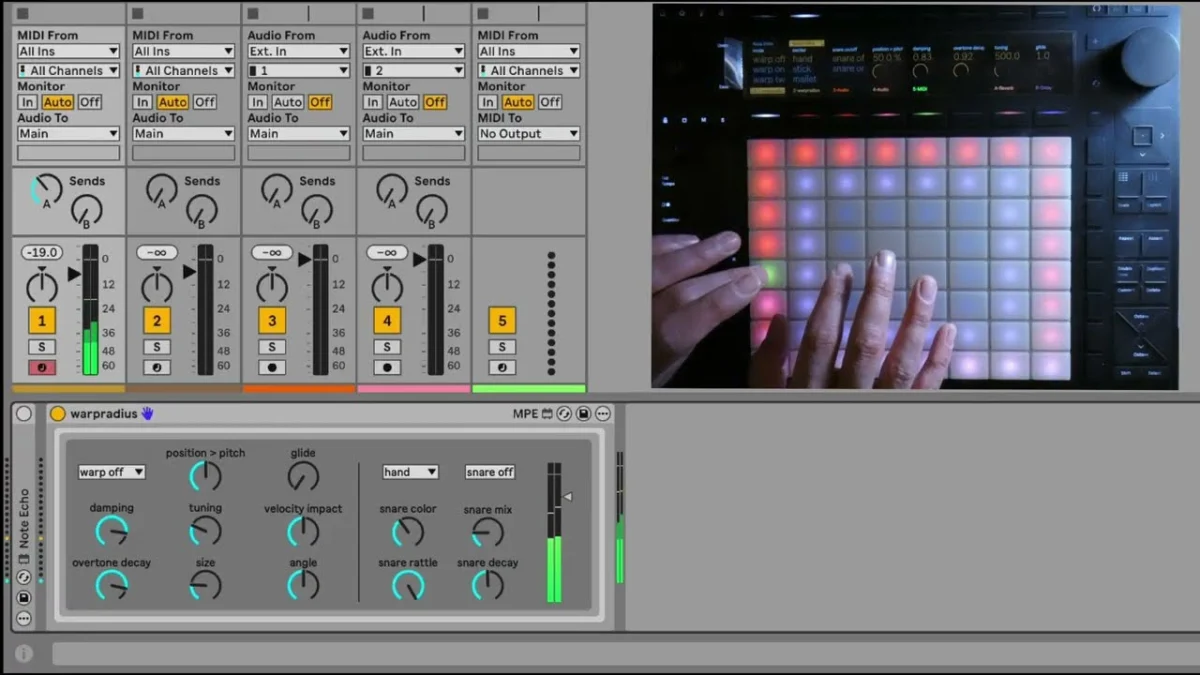
The spring season for Ableton Live users has seen the emergence of a particularly innovative and accessible tool that redefines the capabilities of the Ableton Push 3 hardware. Warpradius, a free Max for Live device developed by Jon Doe One, transforms the entire 8×8 grid of the Push 3 into a single, dynamic percussion surface. This groundbreaking device leverages a Bessel membrane resonator model, a sophisticated modal synthesis technique, to generate remarkably realistic and diverse percussion sounds. The accessibility of this powerful tool, combined with its advanced sonic capabilities, positions it as a significant development for electronic music producers.
Unlocking New Dimensions of Percussion with Warpradius
At its core, Warpradius is designed to harness the full expressive potential of the Ableton Push 3, particularly its MPE (MIDI Polyphonic Expression) capabilities. Unlike traditional drum pads that trigger discrete sounds based on individual pad hits, Warpradius treats the entire 8×8 grid as a continuous, unified membrane. This approach allows for nuanced control over percussive elements by analyzing the precise strike position of each touch across the grid. The device provides visual feedback, illuminating the grid based on where a user taps, but the true innovation lies in Push 3’s ability to report not just the activated pad, but the exact X and Y coordinates of the strike. This granular data translates into a far richer palette of sonic textures and articulations, enabling performers to sculpt percussion sounds with an unprecedented level of detail and responsiveness.
The technical foundation of Warpradius is rooted in modal synthesis, a method that simulates the vibrational characteristics of physical objects to produce sound. The Bessel membrane resonator model, a specialized application of this technique, is particularly adept at creating the complex resonant frequencies that define realistic percussive impacts. This scientific approach to sound design offers a departure from more common synthesis methods, providing users with a unique sonic signature that can add depth and originality to their productions.
The Genesis of Warpradius and its Technical Underpinnings
The development of Warpradius is a testament to the vibrant ecosystem of the Max for Live platform and the collaborative spirit within the electronic music production community. Jon Doe One, the creator of Warpradius, has provided a detailed walkthrough of the device, highlighting its specific design considerations for the Push 3. The decision to leverage the Push 3’s MPE capabilities was strategic, as it provides the necessary data resolution for the Bessel membrane model to function optimally. The device effectively merges the entire 8×8 grid into a single, continuous drum head, allowing for continuous sonic variation based on the nuances of each touch.
The sophisticated sound generation in Warpradius is made possible by a gen~ port of Bessel functions. gen~ is a powerful object within Max/MSP that allows for the creation of custom audio processing objects with extremely high performance. The implementation of Bessel functions within gen~ represents a significant technical achievement, enabling real-time, computationally intensive modal synthesis. This work builds upon prior explorations of Bessel functions in sound design, notably by Ersatz Ben, and further refined by the influence of Philip Meyer, who is credited for his contributions to this specific gen~ version.
The ability to integrate such advanced signal processing within a Max for Live device means that the core sonic engine of Warpradius is, in essence, portable. While the device is optimized for the Push 3’s expressive grid, the underlying gen~ patch containing the Bessel functions can, in principle, be adapted for use with other controllers or within different environments. This opens up possibilities for producers who may not own a Push 3 to still explore the unique sonic textures generated by this modal synthesis approach, potentially by porting the sound generation engine to other platforms or by utilizing alternative controllers that offer similar MPE capabilities.
A Collaborative Spirit: The Influence of Prior Work
The development of Warpradius is not an isolated event but rather a culmination of research and experimentation within the Max/MSP community. The reference to Ersatz Ben and Philip Meyer underscores the importance of shared knowledge and iterative development. Ersatz Ben’s prior work has provided a foundational understanding of applying Bessel functions to sound synthesis. Philip Meyer, in turn, has contributed significantly to the exploration of modal synthesis with Bessel functions in Max/MSP, developing accessible examples and tutorials that have inspired subsequent innovation.
This collaborative lineage is evident in the open sharing of code and knowledge. The core Bessel function synth in Warpradius is freely available, with a link to a pastebin containing the patch data. This allows users to not only experience the Warpradius device but also to delve into its inner workings and potentially adapt it for their own purposes. The availability of such resources is crucial for fostering a creative and educational environment where producers can learn, experiment, and push the boundaries of sound design.
Exploring the Sonic Landscape: Examples and Applications
To illustrate the potential of Bessel function-based synthesis, several examples and related projects have been highlighted. Ben Johnson’s creation, which features sequenced Bessel sounds, demonstrates the versatility of this synthesis method beyond real-time performance. These sequenced patterns showcase the rich timbral qualities and rhythmic possibilities inherent in modal synthesis.
Philip Meyer’s work further expands on this, offering a patch for modal synthesis with Bessel functions and providing comprehensive tutorials. His GitHub repository contains valuable resources, including patchers and explanations, which serve as excellent starting points for anyone interested in exploring this sonic domain. These examples collectively demonstrate that Bessel function synthesis can be applied to a wide range of musical contexts, from intricate percussive textures to broader sonic explorations. The ability to generate such unique and realistic sounds through physical modeling is a significant asset for any producer seeking to diversify their sonic palette.
The Broader Implications: Human Collaboration and the Future of AI in Music Production
The context surrounding the development and sharing of Warpradius offers a compelling perspective on the evolving landscape of music production, particularly in relation to artificial intelligence (AI) coding tools. The author points to the direct exchange of knowledge and code between individuals like Jon Doe One, Ersatz Ben, and Philip Meyer as a model of productive collaboration. This process involved deep understanding of the underlying code, shared experimentation, and direct human interaction, leading to legible and transferable innovation.
The concern raised is that if AI coding tools become overly relied upon without a thorough understanding of the generated code, the resulting creations might become "unreadable" or opaque to human collaborators. This lack of transparency could hinder the iterative development process and the organic growth of creative ideas that stems from shared understanding and dialogue. The author emphasizes that the very act of dissecting and understanding the components of a sound synthesis engine, especially in a complex field like modal synthesis, is fundamental to the creative process and the acquisition of knowledge.
While acknowledging the potential benefits of AI-assisted coding, the article stresses the indispensable value of human connection and dialogue in creative endeavors. The ability to build inspiration from other individuals, to engage in meaningful conversations about creative processes, and to share knowledge transparently are presented as crucial elements that should be actively defended. The message is not one of outright rejection of AI, but a call for a balanced approach that prioritizes human collaboration and understanding, ensuring that technology serves as a tool to augment, rather than replace, human ingenuity and connection.
Max for Live’s Enduring Relevance Amidst Evolving Technologies
The discussion around Warpradius also touches upon the ongoing debate about the future of Max for Live in light of Ableton’s introduction of Extensions. There is a perception among some users that Extensions might render Max for Live obsolete. However, the article firmly counters this notion by highlighting a critical distinction: current Ableton Extensions do not have direct access to live audio and MIDI input and output streams. This capability is fundamental for many advanced audio processing and performance tools, and its absence in Extensions, with no immediate indication of its future inclusion, suggests that Max for Live will continue to be a vital platform for innovation.
The continued development and release of sophisticated Max for Live devices like Warpradius serve as concrete evidence of its enduring relevance. The platform’s flexibility and deep integration with Ableton Live’s core functionalities ensure its continued utility for creating custom instruments, effects, and control surfaces.
Furthermore, the article broadens the perspective by noting that the choice of development environment is not limited to Max for Live or Ableton Extensions. Developers have a range of options, including using Max/MSP alongside other programming languages like TypeScript, potentially with WebAssembly integration. This indicates a diverse and non-exclusive technological landscape, where different tools and platforms can coexist and complement each other, rather than engaging in a zero-sum competition. The continued vibrancy of the Max for Live community, evidenced by projects like Warpradius, reinforces its position as a cornerstone of creative sound design within Ableton Live for the foreseeable future.
Conclusion: Embracing Modal Synthesis and Collaborative Innovation
The emergence of Warpradius as a free Max for Live device represents a significant advancement in accessible, expressive sound design for Ableton Live users. By expertly combining the advanced capabilities of the Ableton Push 3 with sophisticated modal synthesis techniques, Jon Doe One has created a tool that empowers musicians to explore new sonic territories. The underlying Bessel membrane resonator model, coupled with the granular control offered by the Push 3’s MPE capabilities, allows for the generation of highly realistic and nuanced percussion sounds.
The open sharing of the core synthesis engine and the clear lineage of collaborative development highlight the strength of the Max for Live community. This spirit of shared knowledge and iterative improvement, as exemplified by the contributions of Ersatz Ben and Philip Meyer, is crucial for driving innovation in electronic music production.
As the industry grapples with the integration of new technologies like AI coding tools, the Warpradius story serves as a powerful reminder of the enduring value of human collaboration, deep technical understanding, and transparent knowledge sharing. The platform’s continued relevance, despite the introduction of new development paradigms like Ableton Extensions, is assured by its ability to facilitate such groundbreaking and accessible creative tools. The exploration of modal synthesis, as showcased by Warpradius, is not merely a technical curiosity but a gateway to a richer and more expressive world of sonic creation, a world that continues to thrive on innovation and community.