
 Mia Khoirunisa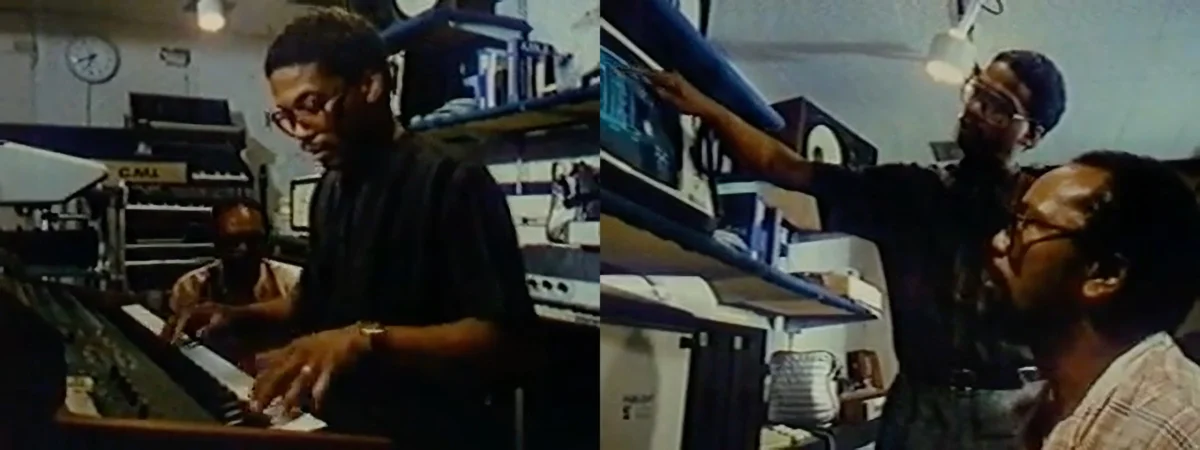
A resurfaced archival video from 1984 featuring legendary jazz and electronic music icons Herbie Hancock and Quincy Jones offers a profound philosophical examination of human agency and technology. The footage, captured during the production of Eric Lippmann’s star-studded documentary I Love Quincy, presents a candid studio interaction between two of the most influential figures in modern music history. Beyond its nostalgic value for synthesizer enthusiasts and music historians, the clip provides a timeless framework for understanding the ethical responsibilities associated with technological innovation—a topic that remains intensely relevant in the era of artificial intelligence and digital automation.
The Archival Context: 1984 and the Dawn of Digital Sampling
The footage originates from the mid-1980s, a transitional period in music production defined by the rapid commercialization of digital synthesizers and samplers. In the video, Hancock demonstrates the capabilities of the pioneering Fairlight CMI (Computer Musical Instrument) digital sampler alongside the Rhodes Chroma synthesizer. Released in 1979, the Fairlight CMI was a watershed technology, notable for introducing wavetable synthesis and a light pen interface that allowed users to draw waveforms directly onto a cathode-ray tube screen.
The documentary I Love Quincy, directed by Eric Lippmann and preserved through archival institutions such as the British Film Institute (BFI), captured the vibrant intersections of jazz, pop, and emerging electronic production techniques championed by Jones and his contemporaries. Unlike modern promotional videos or sponsored tech demonstrations, the interaction between Hancock and Jones is stripped of corporate posturing. It reveals an authentic dialogue between two master artists exploring the boundaries of musical composition through new gear.
Hancock’s Philosophy of Technology: Tools, Intent, and Responsibility
The core significance of the 1984 studio session lies in Hancock’s reflection on the nature of instruments and technology. Rather than attributing agency to the machinery, Hancock articulated a strict philosophy of human accountability, famously comparing synthesizers to primitive tools like axes:
"These instruments were designed for people to use. For people to use. You know, it’s just a tool, another tool. The way an axe is a tool, an axe can be a tool to cut wood, to build a house—or can be a tool to slaughter your neighbor, you know? The same thing a synthesizer can be a tool to really hurt people’s ears or interfere with their lives or can be a tool to make a really nice sounding instrument that can really affect people in a positive way. It all depends on the person that’s using them. People blame machines very often for—oh, it’s the machine’s fault. How can it be the machine’s fault? We have to plug it in."
This perspective cuts to the heart of contemporary debates surrounding advanced automation and artificial intelligence. Hancock’s observation anticipates the modern ethical dilemmas faced by software developers, scientists, and ethicists. While computational tools in the 1980s were largely confined to creative industries and defense applications, today’s digital infrastructure—ranging from algorithmic decision-making systems to automated deployment technologies—has dramatically amplified the stakes of human design and intent.
Notably, Hancock also injected a touch of prescient humor into the discussion, remarking that machines do not program themselves "yet," adding, "It’s on the way, though. It’s on the way." Four decades later, as generative artificial intelligence systems draft code, compose music, and generate synthetic media autonomously, Hancock’s foresight underscores the urgency of maintaining rigorous human oversight.
Cognitive Science and the Necessity of Physical Motor Input
The philosophical implications of Hancock’s studio jam intersect directly with modern research in cognitive science and neuroscience regarding how human beings process information and interact with their environments. Recent discourse in the scientific community challenges traditional computational models of the brain—models that view the mind merely as an information processor receiving data and outputting responses.
In contemporary neuroscientific literature, scholars such as University of Montreal neuroscientist Paul Cisek argue that the brain is more accurately understood as a feedback-control system. According to this framework, human physiology is inherently active; the body does not merely passively absorb sensory inputs, but actively executes motor actions to continuously adjust and shape those inputs based on available options and environmental constraints.
This perspective builds upon early 20th-century functionalist philosophy, notably the work of philosopher John Dewey. Dewey conceptualized the mind as a continuous organic circuit wherein motor responses determine stimuli just as sensory stimuli incite movement. Applied to creative practices, this feedback loop emphasizes the irreplaceable value of physical engagement—such as turning a physical knob, manipulating a fader, or holding a light pen to edit a digital score.
When musicians interact with hardware instruments, the spatial-motor engagement bridges internal imagination with external reality. The human mind evolved to navigate the physical world through active manipulation. Consequently, the proliferation of purely abstract, disembodied digital interfaces risks detaching creators from the foundational feedback loops necessary for deep comprehension and original thought.
Implications for Modern Creativity and Artificial Intelligence
As industries across the globe grapple with the rapid integration of generative artificial intelligence and automated content creation, the insights derived from Hancock’s 1984 studio session and contemporary cognitive science offer critical lessons.
First, the pursuit of technological enhancement must not supersede the cultivation of human agency. Just as a synthesizer’s musical output is entirely contingent on the artistic vision and ethical framework of the performer, AI tools derive their utility and moral alignment entirely from their human creators and operators. Blaming autonomous systems for systemic failures or unintended harms represents a fundamental evasion of human responsibility.
Second, the tactile and collaborative nature of traditional studio production highlights the importance of social engagement in cognitive development. Hancock and Jones did not operate in isolated silos; their creative output was forged through genuine interpersonal collaboration, shared experience, and physical interaction with musical hardware.
As cultural institutions, educators, and technologists evaluate the future of work and art, the historical record preserved in archives like Lippmann’s I Love Quincy serves as a vital reminder. The ultimate answer to technological complexity does not lie in an endless search for newer plugins, automated shortcuts, or synthetic substitutes for human thought. Rather, it resides in the deliberate preservation of physical motor input, critical imagination, and interpersonal collaboration—ensuring that humans remain active, accountable agents in shaping the tools of tomorrow.