 Nayara Elvina
As the autumn fishing season transitions across northern fisheries and anglers pivot their focus toward late-year patterns, technological advancements continue to reshape how watercraft are utilized in competitive and recreational angling. Among the most significant shifts in recent years is the rapid scaling of professional-grade marine electronics into compact, kayak-friendly footprints. Equipment traditionally reserved for large-scale bass boats—such as high-definition side imaging, advanced GPS cartography, and sophisticated forward-facing sonar—is now being integrated into lightweight watercraft setups. Central to this evolution are products like the Humminbird Xplore series and the Minn Kota Terrova Kayak trolling motor, which have demonstrated how modern anglers can maximize efficiency without sacrificing maneuverability or space.
The Evolution of Kayak Angling and Technological Integration
Historically, kayak fishing was defined by simplicity: a paddle, a basic portable depth finder, and reliance on manual positioning. However, the commercial growth of kayak bass fishing tournaments and the desire to access hard-to-reach fisheries have driven a demand for high-performance marine electronics. Modern kayak anglers frequently navigate tight spaces, shallow flats, and complex underwater structures where larger fiberglass boats cannot operate.
The introduction of the Humminbird Xplore series addresses a primary historical limitation of kayak fishing—the compromise between advanced sonar performance and physical hardware constraints. Previous high-end fish finders often required bulky external processors, commonly referred to as "black boxes," to run forward-facing sonar systems like MEGA Live. For a watercraft with limited cockpit real estate and strict weight capacities, these auxiliary components presented significant logistical challenges. The Xplore series successfully condenses these capabilities into a unified system, offering tournament-grade imaging and processing power within a compact chassis.
Technical Specifications and Elite Sonar Capabilities
At the core of the Humminbird Xplore series is a high-performance quad-core processor designed to eliminate lag during menu transitions, cartography rendering, and sonar adjustments. This processing speed is critical for anglers making split-second decisions while operating in moving water or tracking active fish schools.
The unit’s imaging suite incorporates several proprietary technologies designed to enhance underwater visibility:
- MEGA Side Imaging+: Delivers ultra-clear structural and cover details extending laterally from the watercraft, allowing anglers to identify submerged timber, rock piles, and weed lines from a distance.
- MEGA Down Imaging+: Provides a high-resolution vertical perspective directly beneath the kayak, clarifying bottom composition and fish positioning.
- Dual Spectrum CHIRP: Offers detailed target separation across adjustable frequency ranges, ensuring individual fish can be distinguished from baitfish and cover.
Furthermore, the integration of forward-facing sonar compatibility via MEGA Live 2 allows anglers to observe fish movement in real time. This capability has fundamentally altered tactical approaches to species like largemouth and smallmouth bass, enabling precise presentation delivery to suspended or moving fish.
Precision Navigation and Cartography
Maintaining precise boat position is paramount in kayak angling, where wind and current can easily displace an unanchored watercraft off a productive structure. The Xplore series features integrated GPS functionality alongside comprehensive pre-loaded cartography, including Humminbird LakeMaster and CoastMaster mapping databases.
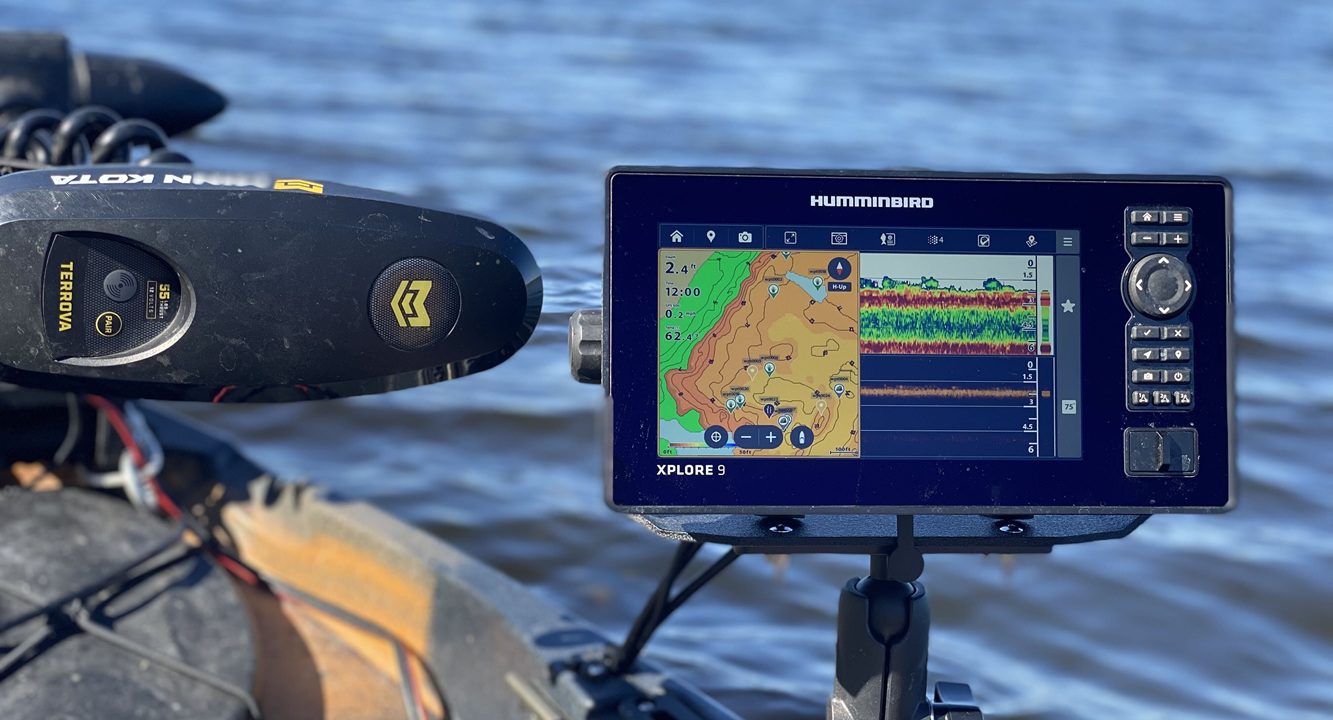
These mapping systems provide contour detail down to one-foot increments on many bodies of water, allowing operators to identify subtle drop-offs, submerged roadbeds, and channel swings. With a capacity to store up to 10,000 waypoints, anglers can meticulously log seasonal patterns, productive structural anomalies, and specific honey holes over multiple seasons. Waypoint management tools facilitate the organization of extensive data sets, ensuring repeat visits to productive coordinates are executed with pinpoint accuracy.
Ecosystem Synergy: Minn Kota Integration and the One-Boat Network
The efficiency of a modern motorized kayak relies heavily on ecosystem interoperability. The integration between Humminbird fish finders and Minn Kota trolling motors—facilitated through the One-Boat Network—represents a major advancement in watercraft control.
By pairing the Humminbird Xplore with a Minn Kota Terrova Kayak trolling motor, operators gain access to advanced navigation features such as GPS anchor lock (Spot-Lock), heading sensors, and automated route tracking. The Terrova’s ability to navigate shallow waters and thick cover while holding position against strong winds and currents provides a distinct operational advantage.
The One-Boat Network further streamlines equipment management by enabling direct software updates via mobile devices, alongside seamless waypoint sharing across interconnected hardware. This connectivity reduces time spent troubleshooting technology on the water, allowing anglers to focus entirely on tactical execution.
Durability and Ergonomic Design in Confined Cockpits
Operating in a kayak exposes electronic equipment to constant moisture, physical impacts during transport, and vibration from motor operation. The Xplore series is engineered to withstand these harsh environmental factors while maintaining a lightweight footprint that integrates easily with standard mounting platforms, such as RAM or YakAttack systems.
Industry observers note that the reduction in hardware footprint—achieved by eliminating external processing modules—significantly improves cockpit ergonomics. The user-friendly touchscreen interface allows for rapid customization of display layouts, ensuring critical data fields remain visible without obstructing physical movement within the watercraft.
Market Implications and the Future of Angling Technology
The proliferation of advanced electronics within the kayak fishing sector reflects a broader industry trend toward miniaturization and cross-platform capability. As manufacturers continue to refine power consumption, processing speed, and sensor resolution, the operational gap between motorized bass boats and specialized fishing kayaks continues to narrow.
For recreational and competitive anglers alike, systems like the Humminbird Xplore and Minn Kota Terrova represent a shift toward maximum efficiency. By combining high-definition sonar, robust cartography, and automated positioning into manageable, energy-efficient packages, modern marine technology has permanently redefined the standards of autonomous watercraft angling.