 Johan Budi
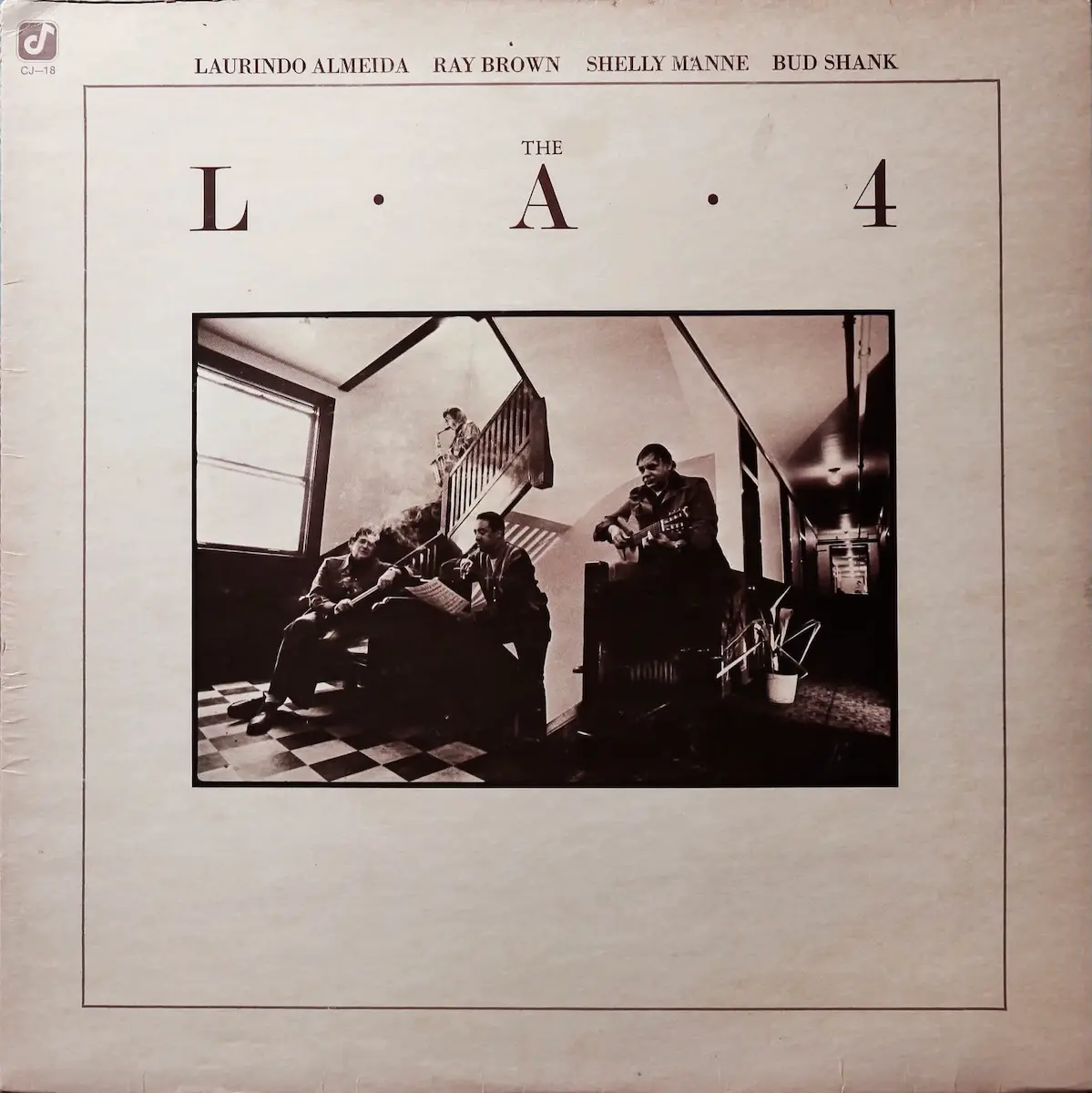
The contemporary jazz landscape continues to evolve through the deliberate dissolution of rigid genre boundaries, a stylistic fluidity prominently displayed in the latest release from the elite ensemble known as The L.A. Four. Recorded in Los Angeles in early 1976 and distributed via Swift Record Distributors at a retail price of £3.99, the group’s sophomore album for Concord Jazz (catalogued as Concord Jazz CJ-18) captures a rare convergence of classical discipline, Brazilian warmth, and traditional American swing. Featuring alto saxophonist and flutist Bud Shank, classical and jazz guitarist Laurindo Almeida, bassist Ray Brown, and drummer Shelly Manne, the album stands as a testament to mature musicianship, operating above commercial formulas to explore a diverse sonic palette.
Main Facts and Album Overview
The newly issued 1976 LP comprises six distinct compositions spanning approximately forty-five and a half minutes of total performance time. Side one features "Dindi," Shank’s original composition "Rainbows," Bach’s intricate "Rondo Espressivo," and a dynamic interpretation of Dizzy Gillespie’s "Manteca," which runs for a combined duration of 25 minutes. Side two presents Sonny Rollins’ "St. Thomas" alongside a nuanced adaptation of Joaquín Rodrigo’s "Concierto De Aranjuez," accounting for the remaining 20 and a half minutes.
Rather than catering to shifting commercial trends, the quartet focuses on an intricate, highly collaborative interplay that has come to define the "chamber jazz" idiom. This stylistic approach relies on acoustic transparency, mutual listening, and a sophisticated harmonic framework where rhythm and melody share equal structural weight. The ensemble’s ability to transition seamlessly from baroque counterpoint to Afro-Cuban rhythms highlights the uncommon technical versatility of its individual members, each of whom commands an extensive legacy within twentieth-century recorded music.
Historical Context and Chronological Roots
The artistic partnership binding Bud Shank and Laurindo Almeida is deeply rooted in the developmental history of West Coast jazz. Their foundational collaboration dates back to 1953 and 1954 sessions for World Pacific (catalogued as WP1412 and Vogue LAE12019), recordings that significantly predated and anticipated the bossa nova explosion popularized globally by Stan Getz nearly a decade later. Shank and Almeida were genuinely pioneering figures in integrating Brazilian rhythmic structures with modern jazz harmony.
The trajectory of their professional relationship accelerated notably in 1950, when both musicians played pivotal roles in Stan Kenton’s groundbreaking orchestra. Within that experimental environment, Shank and Almeida established an intuitive rapport that has endured for over twenty-five years. This ongoing musical dialogue eventually culminated in the formation of The L.A. Four.
Laurindo Almeida’s career has long defied conventional categorization, characterized by a fluid movement between classical concert halls, Brazilian folk traditions, jazz ensembles, and occasional collaborations with mainstream vocalists. His arrangement of Joaquín Rodrigo’s masterwork, the "Concierto De Aranjuez," specifically tailored for The L.A. Four, represents a significant milestone in bridging classical guitar literature with improvisational frameworks. In this specific setting, Almeida handles the foundational harmonic and thematic material, while Shank executes the intricate orchestral voicings on flute.
Supporting Data and Rhythm Section Dynamics
A critical component of The L.A. Four’s enduring cohesion is its exceptional rhythm section, anchored by bassist Ray Brown and drummer Shelly Manne. Brown, widely regarded as one of the definitive architects of modern jazz bass, emphasizes the artistic freedom inherent in the ensemble’s mandate.
"I love this group because it’s doing jazz, classical, bossa nova, a lot of different things. We don’t have to cater to anything," Brown remarked regarding the collective’s philosophy. His contributions on Concord Jazz CJ-18—particularly in the imaginative, opening bass-and-drums dialogue that launches the rendition of "Manteca"—elevate the baseline performance standards expected of contemporary acoustic jazz units.
Shelly Manne complements Brown’s precision through a style of drumming that prioritizes melodic construction over percussive punctuation. Manne’s approach provides a steady, adaptive pulse that sustains listener interest throughout extended forms without resorting to heavy-handed dynamic shifts. The synergy between Brown and Manne establishes a formidable bedrock that permits Shank and Almeida to explore complex arrangements with complete rhythmic security.
Bud Shank’s Virtuosity and Critical Acclaimed Pedigree
Bud Shank’s dual mastery of the alto saxophone and the flute remains a central pillar of the ensemble’s sonic identity. On the current Concord release, Shank performs exclusively on alto saxophone for his original composition "Rainbows" and the demanding "Concierto De Aranjuez," while switching to flute for the remainder of the tracks.
Shank’s reputation among peers and critics has been forged over decades of rigorous performance and studio work. A notable testament to his standing within the jazz community occurred following his work on the soundtrack for the motion picture Assault On A Queen. Impressed by Shank’s technical facility and expressive depth, Duke Ellington formally offered him a permanent position in the Ellington Orchestra. Ellington reportedly remarked at the time that he could not recall when Johnny Hodges had last been so profoundly challenged and impressed by another alto saxophonist. Ultimately, Shank was forced to decline the offer due to pre-existing, long-term studio commitments in Los Angeles.
Broader Impact and Implications for Modern Jazz
The release of Concord Jazz CJ-18 arrives at a time when commercial pressures frequently incentivize musicians to dilute their artistic output for broader radio appeal. By refusing to compromise their artistic vision, the members of The L.A. Four demonstrate the commercial and critical viability of uncompromising acoustic music that draws equally from European classical traditions, Latin American folk forms, and African-American jazz roots.
The album’s synthesis of Bach, Rodrigo, Gillespie, and Rollins underscores a broader movement within elite jazz circles toward a universal musical language. By treating diverse repertoires with equal academic rigor and improvisational freedom, the ensemble challenges historical divisions between "serious" concert music and popular vernacular styles. For listeners and critics alike, The L.A. Four serves as a masterclass in ensemble balance, proving that supreme technical proficiency, when paired with deep historical awareness, can yield enduring artistic statements capable of transcending generational and stylistic boundaries.