Nayara Elvina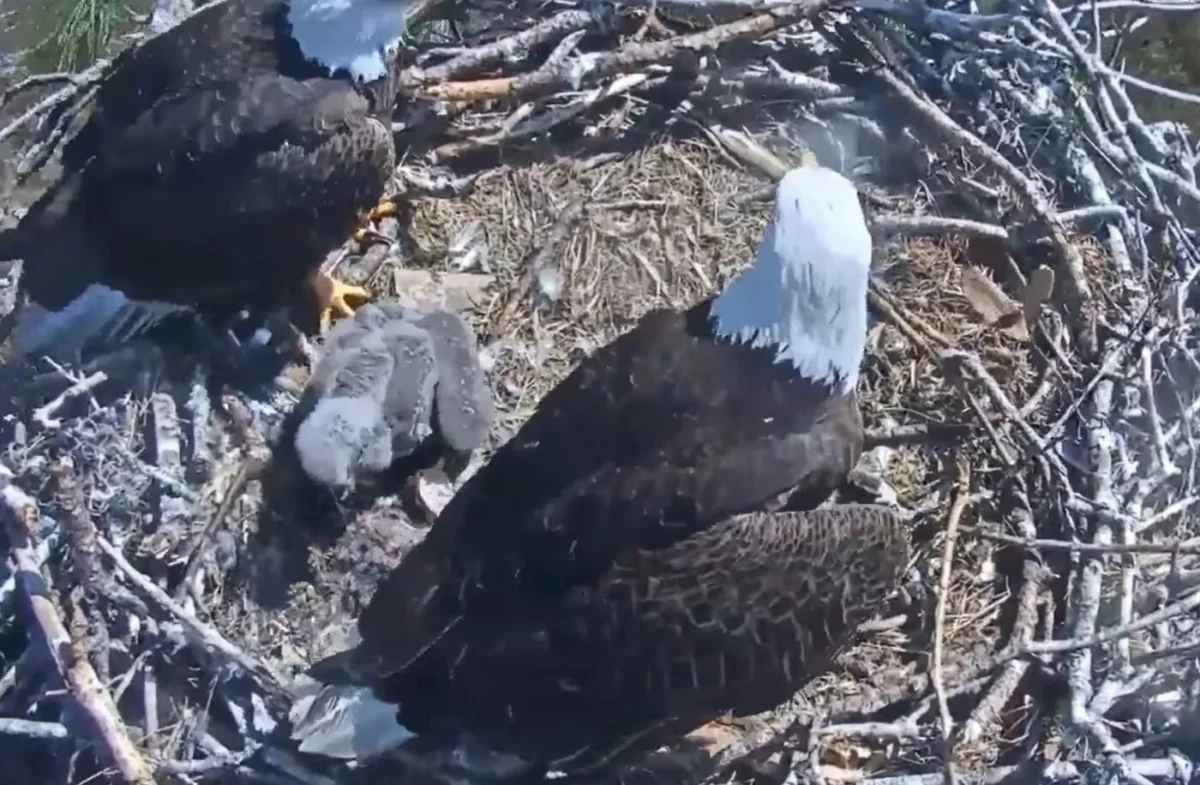
The survival of the fittest was broadcast in high definition to a global audience when a bald eagle nesting in Fort Myers, Florida, returned to its aerie carrying the remains of a domestic house cat to feed its developing chicks. The incident, captured by the Southwest Florida (SWFL) Eagle Cam, serves as a stark reminder of the predatory nature of the American bald eagle (Haliaeetus leucocephalus) and the often-unfiltered reality of the natural food chain. While the footage sparked significant discussion across social media platforms regarding the safety of domestic pets, wildlife experts emphasize that such behavior is consistent with the opportunistic hunting and scavenging patterns that have allowed the species to thrive.
The Incident at the Southwest Florida Nest
The event took place at the well-known nesting site located on the property of Dick Pritchett Real Estate. This specific nest has gained international fame through the use of 24/7 live-streaming technology, which allows researchers and the general public to observe the daily lives of these raptors without human interference. The eagles featured in the footage, identified by enthusiasts and researchers as Harriet and her mate M15, were in the process of rearing two young eaglets, designated as E17 and E18.
During a routine afternoon, the adult female, Harriet, arrived at the nest carrying a substantial prey item. As the camera zoomed in and the motion slowed, viewers identified the carcass as that of a domestic cat. The remains, which included the head and a paw, were subsequently distributed among the chicks as a source of vital protein. Observers noted that the feline appeared to be deceased prior to the eagle’s arrival, leading to the widely held conclusion among wildlife biologists that the cat was a victim of a vehicular collision and was scavenged by the eagle from a nearby roadway.
Anatomical Precision: The Biology of an Apex Predator
To understand why a bald eagle is capable of such a feat, one must examine the specialized biological adaptations that define the species. Bald eagles are recognized as apex predators, possessing sensory and physical attributes that place them at the top of the avian hierarchy. Their visual acuity is perhaps their most formidable asset. While a human with 20/20 vision can see an object clearly from five feet away, an eagle possesses the same clarity from a distance of twenty feet. This 20/5 vision allows them to spot movement or prey from altitudes exceeding 1,000 feet.
Furthermore, their field of vision is vastly superior to that of primates. While humans are limited to a 180-degree field of view, bald eagles possess a 340-degree range, utilizing both monocular and binocular vision to track prey while simultaneously monitoring their surroundings for threats. Their eyes are also capable of perceiving the ultraviolet spectrum. This allows them to track the urine trails of small mammals, which reflect UV light, effectively creating a "neon" trail that leads the raptor directly to its target.
The physical mechanics of the eagle’s strike are equally impressive. When diving for prey, these birds can reach speeds of up to 100 miles per hour. Upon impact, their talons exert a crushing force of approximately 400 pounds per square inch (PSI). For context, this is more than double the grip strength of the average human male and is sufficient to puncture vital organs or snap the vertebrae of small to medium-sized mammals instantly.
A Chronology of the Event
The timeline of the February 15, 2021, incident began with a period of relative inactivity at the nest, a common occurrence during the mid-day heat in Florida. The two chicks, E17 and E18, were waiting for a meal delivery, a task shared by both Harriet and M15.
At approximately 4:00 PM local time, Harriet was seen approaching the nest from the northwest. Upon landing, the weight and size of the prey were immediately apparent to those monitoring the livestream. The eagle began the process of "mantling," a behavior where a bird of prey spreads its wings over its food to hide it from other potential scavengers. However, as she began to tear into the prey to feed the eaglets, the identifying features of the feline—specifically the fur color and the structure of the paw—became visible to the camera.
The feeding session lasted for approximately twenty minutes. In nature, nothing is wasted; the eagle utilized the high-calorie meal to ensure the rapid growth of the chicks, who require a constant supply of nutrients to develop the flight muscles and feathers necessary for their upcoming fledging stage. By the time the sun set, the remains had been largely consumed or pushed to the edge of the massive nest, which, after years of annual additions, was estimated to weigh over a ton.
Scavenging vs. Hunting: The Opportunistic Nature of Bald Eagles
While the image of an eagle snatching a pet from a backyard is a common fear for pet owners, biological data suggests that bald eagles are as much scavengers as they are hunters. They are frequently observed feeding on carrion, particularly during the winter months or in areas where live prey is less abundant.
In the Fort Myers case, the condition of the feline remains suggested "roadkill" scavenging. Bald eagles are highly intelligent and have learned that roadways are a consistent source of easy meals. When a domestic animal or a wild mammal is struck by a vehicle, the eagle will often descend to the pavement to claim the carcass. This behavior, while efficient for the bird, often puts the eagles themselves at risk of vehicle strikes, which remains a leading cause of mortality for the species in urbanized areas of Florida.
The Florida Fish and Wildlife Conservation Commission (FWC) has noted in various reports that the diet of a bald eagle is diverse. While fish comprise about 70% to 90% of their intake, they are known to take birds, reptiles, and small mammals. The inclusion of a domestic cat in the diet, while rare, is not outside the biological norms for a large raptor provided with a scavenging opportunity.
The Ecological Context: Domestic Cats and Avian Populations
The public reaction to the video was polarized, with many expressing sympathy for the "poor kitty." However, ornithologists and conservationists have pointed out the ecological irony of the situation. Domestic and feral cats are considered one of the most significant threats to bird populations worldwide.
According to a landmark study by the Smithsonian Conservation Biology Institute and the U.S. Fish and Wildlife Service, outdoor cats are responsible for the deaths of an estimated 1.3 to 4.0 billion birds annually in the United States alone. Cats are listed among the world’s 100 worst invasive species by the International Union for Conservation of Nature (IUCN). In this context, the event in Fort Myers represents a rare "role reversal" where a bird of prey utilized a member of a predatory invasive species as a food source.
Wildlife advocates argue that this event highlights the necessity of keeping domestic cats indoors. Not only does this protect local bird populations from feline predation, but it also protects the cats themselves from the numerous dangers of the outdoors, including vehicle strikes, disease, and predation by larger animals such as eagles, owls, and coyotes.
The Role of Live-Streamed Wildlife Observations
The SWFL Eagle Cam is part of a broader trend in "citizen science" and wildlife education. By providing an unedited look into the lives of Harriet and M15, the stream offers educational value that traditional nature documentaries often omit. Documentaries frequently edit out the more gruesome aspects of survival to cater to a general audience, whereas live streams provide the "raw and unfiltered" reality of the natural world.
These streams have become vital tools for researchers. They allow for the monitoring of nesting success rates, feeding frequencies, and the impact of environmental factors on chick development. The fame of eagles like Harriet, and other famous pairs such as Jackie and Shadow in Big Bear, California, has fostered a global community of eagle advocates. This increased public interest often translates into greater support for conservation laws, such as the Bald and Golden Eagle Protection Act.
Public Safety and Responsible Pet Ownership in Raptor Habitats
The incident serves as a practical warning for residents in regions with high raptor populations. Florida has one of the densest populations of nesting bald eagles in the lower 48 states, with over 1,500 nesting pairs. As urban sprawl continues to encroach on natural habitats, the frequency of interactions between wildlife and domestic pets is expected to rise.
Experts recommend several precautions for pet owners:
- Supervision: Small dogs and cats should never be left unattended in backyards, especially in areas where large raptors are known to nest.
- Structural Protection: Utilizing "catios" or enclosed outdoor runs can allow pets to enjoy the outdoors without being exposed to predators.
- Eliminating Attractants: Raptors are attracted to areas with high concentrations of small mammals. Reducing birdseed on the ground (which attracts rodents) and ensuring trash is secured can reduce the likelihood of a raptor choosing a backyard as a hunting ground.
Broader Implications for Wildlife Management
The management of bald eagle populations in the United States is one of the greatest success stories in conservation history. After being pushed to the brink of extinction by habitat loss and the use of the pesticide DDT, the species was removed from the endangered species list in 2007. However, their transition into suburban and urban landscapes, as seen in the Fort Myers nest, creates new challenges for wildlife management.
The "cat in the nest" incident is a symptom of this transition. As eagles adapt to living near humans, their diet and behavior will inevitably reflect the environment they inhabit. While the sight of a domestic animal being consumed may be distressing to some, it is a testament to the adaptability and resilience of the bald eagle.
In summary, the footage provided by the SWFL Eagle Cam offers a profound look at the intersection of human civilization and the wild. It underscores the fact that the bald eagle, while a symbol of national pride, remains a wild animal governed by the instincts of survival. For the eaglets E17 and E18, the feline remains were simply another meal provided by a successful parent, ensuring that the next generation of this majestic species continues to soar over the Florida landscape.