Aveline Kirana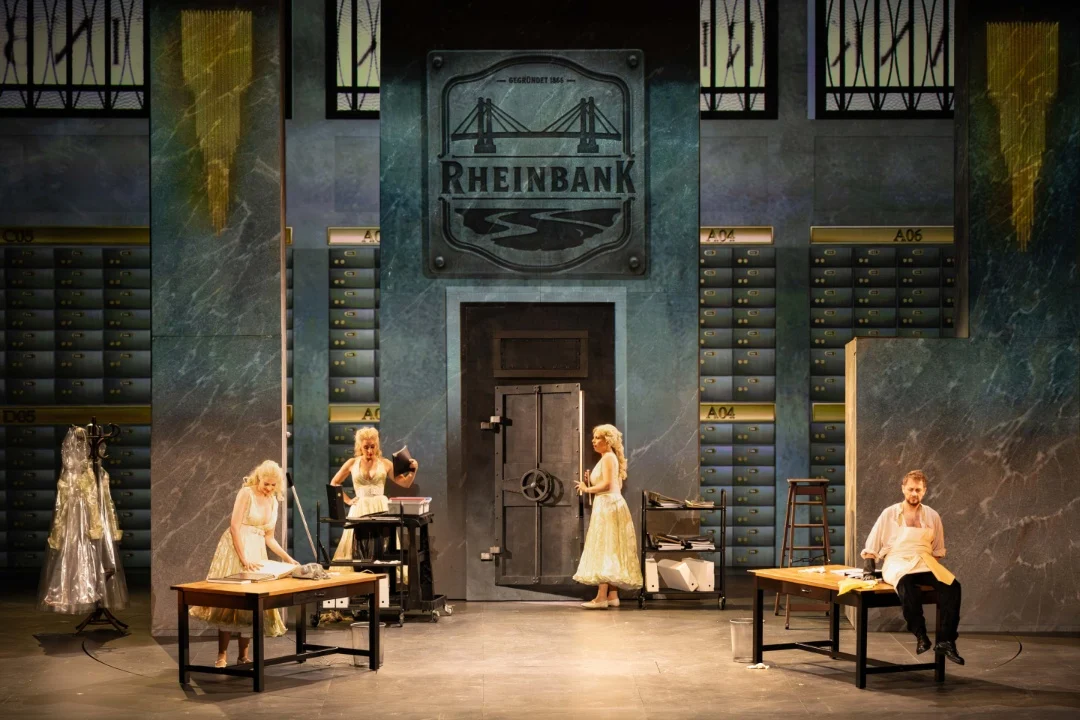
The Opéra de Marseille’s ambitious new production of Richard Wagner’s "Das Rheingold" marks a significant cultural moment for France’s second-largest city, representing the first staging of a Ring cycle opera since 1996. This highly anticipated premiere not only revives a crucial cornerstone of the operatic canon in Marseille but also signals a promising new chapter under the leadership of the company’s dynamic young music director, Michele Spotti, whose energetic conducting and clear vision appear poised to guide the Opéra de Marseille towards a vibrant future. The production, a co-production with the Opéra de Nice, has been met with considerable enthusiasm, suggesting a strong appetite for Wagnerian works in the region and setting a high bar for subsequent installments of the monumental Ring cycle.
A Modern Retelling of Mythical Beginnings
Director Charles Roubaud’s staging of "Das Rheingold" offers a contemporary yet remarkably accessible interpretation of Wagner’s foundational music drama. The opera commences not with the traditional watery depths, but within the stark, functional confines of a vaguely postwar "Rheinbank," a setting that serves as the production’s primary, and arguably only, overt nod to the operatic world’s aquatic origins. As the overture’s foundational E-flat major chords resonate from the orchestra pit, the scene unfolds in the quiet solitude of early morning, with the bank’s lone janitor, Alberich, meticulously mopping the floor. This mundane task is soon interrupted by the appearance of the Rhinemaidens, reimagined as striking bank employees, clad in unexpectedly alluring, flouncy dresses. Their mockery of Alberich stems not from his appearance, but from his perceived low social standing, a subtle yet potent recontextualization of the original myth’s emphasis on physical rejection.
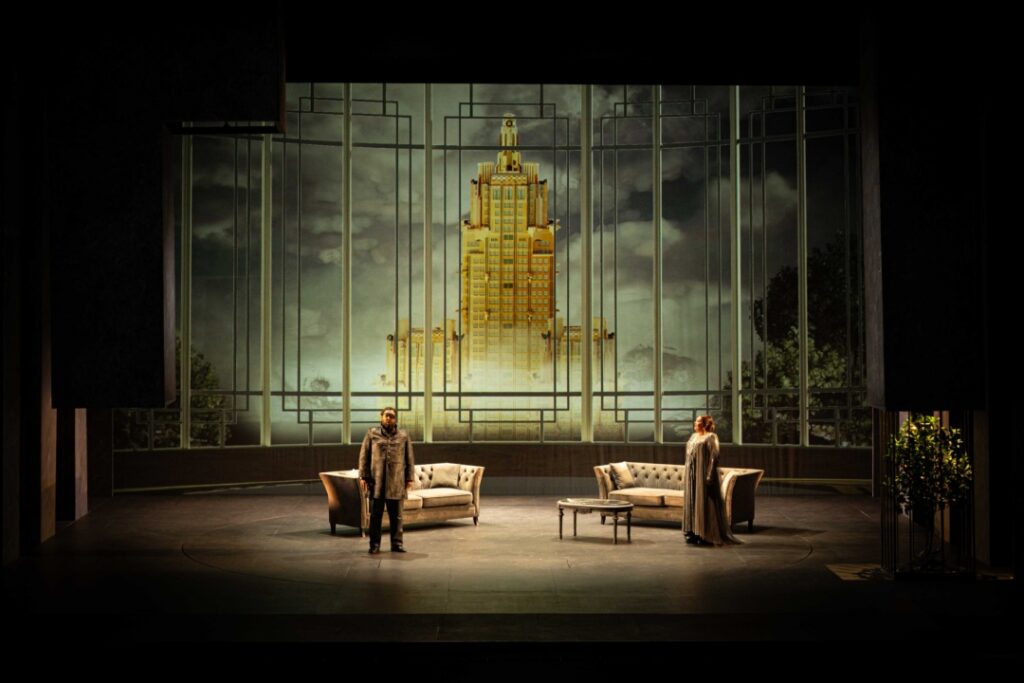
The production’s modern sensibility extends to its climactic moments. Instead of the traditional rainbow bridge, Roubaud presents the flawed and diminished pantheon of gods ascending into their newly acquired Valhalla via a gleaming golden elevator, a visual metaphor that pointedly evokes the ostentatious architecture and ambition often associated with figures like Donald Trump, adding a layer of contemporary socio-political commentary. This visual choice, while potentially jarring for some purists, effectively underscores the production’s thematic exploration of wealth, power, and the corrupting influence of avarice in a modern capitalist landscape.
Capitalism, Comedy, and the Loss of Love
Interpreting Wagner’s Ring cycle as a critique of capitalism is by no means a novel approach; indeed, it has become a recurring theme in many modern productions. However, Roubaud navigates this territory with commendable restraint, eschewing heavy-handed philosophical pronouncements for a lighter, often more comic, touch. In the opera’s opening scene, Alberich’s pursuit of the Rhinemaidens possesses a playful, almost farcical quality, reminiscent of the charming courtship between Papageno and Papagena in Mozart’s "The Magic Flute."
Yet, this comedic framing, while entertaining, does present a subtle dramatic challenge. The gradual accumulation of dramatic tension, crucial to understanding Alberich’s descent into despair and his eventual renunciation of love – the pivotal act that ignites the entire cycle – feels somewhat diminished. The operatic text explicitly details the Rhinemaidens’ taunts and their refusal to yield the Rhinegold, a rejection that drives Alberich to his fateful decision. By softening this initial encounter, the production risks diluting the profound psychological and cosmic consequences that stem from this singular act of renunciation. The operatic universe’s moral fabric is irrevocably altered by Alberich’s curse, a seismic shift that the production’s lighter tone, while visually engaging, doesn’t fully convey with the necessary gravitas.
Stagecraft: Minimalist Design, Maximum Impact
The stage design by Emmanuelle Favre is characterized by its elegant simplicity and strategic use of a steeply raked stage, dominated by a rotating circular platform. This minimalist approach allows for fluid scene transitions and focuses attention on the dramatic action. The restrained deployment of video projections proved particularly effective, enhancing key moments without overwhelming the narrative. During orchestral interludes between scenes, the curtain was deliberately lowered, allowing the music to breathe and the audience to absorb the preceding events. This deliberate pause amplified the impact of the few instances where special effects were employed.
Julien Soulier’s striking hologram-style projections brought Alberich’s transformations through the Tarnhelm to vivid life. His disappearance, his metamorphosis into a menacing dragon, and finally into a lowly toad were realized with a visually arresting blend of illusion and digital artistry, providing moments of genuine theatrical spectacle that resonated powerfully with the audience. This judicious use of technology ensured that the visual elements served the drama rather than distracting from it.
Vocal Prowess and Character Portrayals
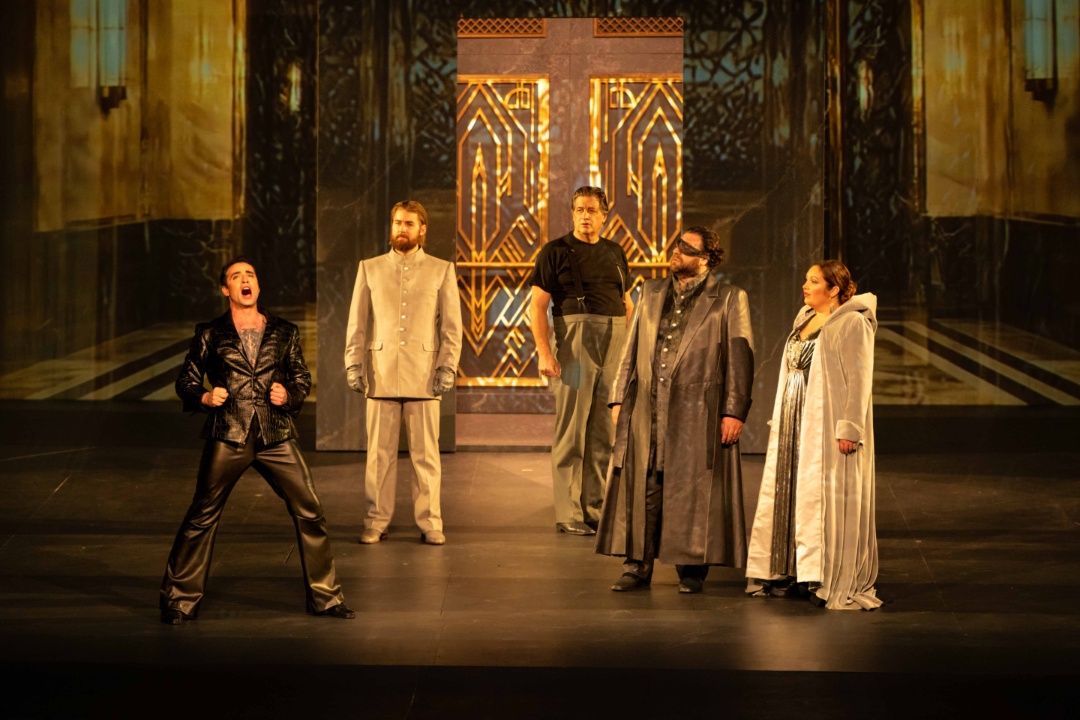
The vocal performances at the Opéra de Marseille were largely of a high caliber, with several singers delivering truly memorable interpretations. Zoltán Nagy, as the pivotal character of Alberich, delivered a performance of exceptional depth and intensity, particularly in the opera’s final scene. His rendition of Alberich’s curse upon the ring was delivered with searing power, capturing the character’s profound bitterness and despair with chilling conviction.
Equally compelling was Samy Camps in the role of Loge, the cunning demigod of fire. Camps proved to be a superb comic actor, his performance enhanced by a slick, contemporary costume that might have been more at home in a Las Vegas nightclub than in the realm of the gods. Despite occasional moments of strain in his upper register, Camps’ incisive delivery of Loge’s sardonic commentary on the gods’ hypocrisy and his masterful stage presence earned him widespread acclaim. His interpretation of the enigmatic trickster figure was a highlight of the evening.
The cast was predominantly comprised of Francophone singers, with the notable exceptions of Nagy and Marius Brenciu as the nimble but morally compromised Mime. While Cornelia Oncioiu’s brief appearance as Erda was vocally sound, her German diction presented some challenges, a minor issue that did not detract significantly from the overall vocal quality. The ensemble’s vocal styles were generally well-matched, though the opera house’s acoustics presented a consistent challenge, impacting the audibility of certain singers.
When singers were not positioned downstage and directly facing the audience, their voices were frequently obscured by the orchestra, even during passages with relatively sparse accompaniment. This was particularly noticeable in the second scene, where Alexandre Duhamel’s portrayal of Wotan, the king of the gods, was initially almost inaudible, as was Éric Huchet’s Froh. In stark contrast, Elodie Hache’s vibrant soprano as Freia consistently projected with clarity and strength, a testament to her vocal power and stage presence. Similarly, the imposing figures of the giants Fasolt and Fafner, portrayed by Patrick Bolleire and Louis Morvan respectively, commanded attention with their resonant vocal performances.
Spotti’s Orchestral Vision: A Sound of the Future
Michele Spotti’s conducting of the Opéra de Marseille orchestra was nothing short of electrifying. He elicited a performance characterized by incisive brass playing and a propulsive rhythmic drive, imbuing Wagner’s complex score with a fresh and invigorating energy. Spotti’s innovative staging of the orchestra, a practical solution to the perennial challenge of accommodating Wagner’s massive forces in a traditional opera pit, proved to be a stroke of genius.
By strategically positioning the harps, timpani, and cymbals in boxes adjacent to the stage, and even incorporating the Rhinemaidens into this spatial arrangement in the final scene, Spotti not only ensured that delicate harp passages, often submerged in standard orchestral textures, were clearly audible but also created a remarkable stereophonic effect. This spatial distribution lent the final scene an unusual sonic grandeur, with the rhythmically intricate harp figures appearing to ripple outwards from both sides of the hall, enhancing the sense of arrival in Valhalla. This bold orchestral conception suggests a forward-thinking approach to Wagnerian performance, one that prioritizes clarity, impact, and a truly immersive auditory experience.
Broader Implications and Future Prospects
The successful premiere of "Das Rheingold" at the Opéra de Marseille carries significant implications for the city’s cultural landscape and for the future of Wagnerian opera in France. The robust attendance and the overwhelmingly positive reception suggest a strong public appetite for the Ring cycle, a monumental undertaking that requires substantial investment and commitment from opera houses. This production’s success serves as a powerful validation of the Opéra de Marseille’s artistic direction under Michele Spotti. His leadership, marked by a clear artistic vision, a willingness to embrace modern interpretations, and a commitment to nurturing both established and emerging talent, appears to be breathing new life into the institution.
The co-production with the Opéra de Nice also highlights the potential for regional collaboration to enhance artistic output and reach wider audiences. As the Ring cycle continues its ambitious journey through Marseille, the early success of "Das Rheingold" bodes well for the remaining operas, "Die Walküre," "Siegfried," and "Götterdämmerung." The production’s ability to balance artistic innovation with accessible storytelling, coupled with Spotti’s dynamic conducting, positions the Opéra de Marseille as a vital center for operatic excellence in France, capable of presenting the grandest works of the repertoire with both intellectual rigor and exhilarating theatrical flair. The resonance of this "Das Rheingold" extends beyond a single performance; it is a resounding statement of intent for the Opéra de Marseille’s artistic future.