Nayara Elvina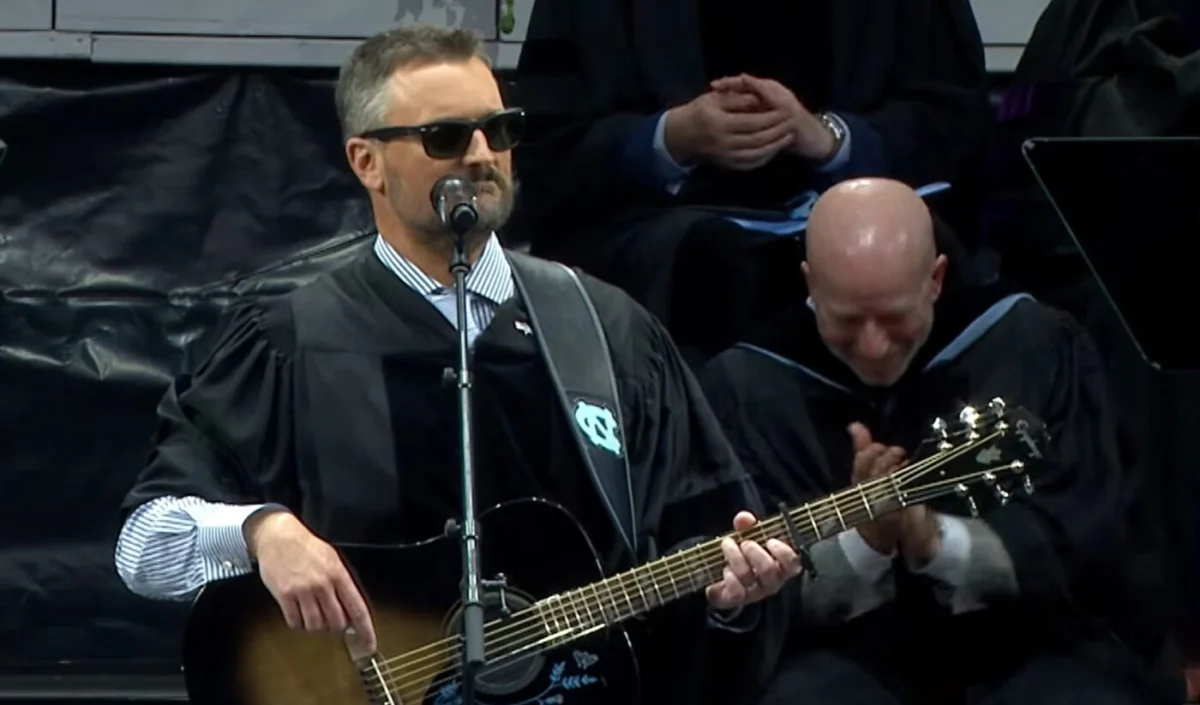
The multi-platinum country music artist Eric Church, a native of North Carolina and a prominent alumnus of the state’s university system, delivered a resonant commencement address to the graduating class of the University of North Carolina at Chapel Hill, utilizing a unique musical metaphor to outline a framework for a meaningful life. Church, often referred to in the music industry as "The Chief," appeared before thousands of graduates, faculty, and families at Kenan Memorial Stadium on May 11, 2024, to share a message centered on authenticity, resilience, and the maintenance of personal values. The speech, which has since garnered millions of views across digital platforms, was the result of nearly nine months of preparation and a deeply personal creative process that the singer-songwriter recently detailed in a national television appearance.
The Foundations of the Six Strings Metaphor
At the heart of Church’s address was the comparison of a human life to the six strings of an acoustic guitar. Drawing from his two decades as a songwriter and performer, Church argued that a balanced and harmonious life requires constant "tuning" of six specific pillars: faith, family, community, moral compass, ambition, and resilience. He posited that when these elements are in alignment, the resulting "chord" of one’s life possesses a resonance capable of profound impact. Conversely, he warned that the neglect of even a single pillar could cause the entire structure of one’s character to unravel.
Church told the graduates that the world does not require "another cover song," but rather "an original." This call for individual authenticity served as the thesis of his speech, urging the Class of 2024 to resist the pressures of social media-driven conformity and the temptation to compare their internal struggles with the curated external successes of others. He emphasized that the sound of an individual’s life—their unique contribution to the world—is a voice that has never existed before and will never exist again.
Chronology of the Speech’s Creation and Delivery
The process of crafting the commencement address began approximately eight to nine months prior to the ceremony, when the University of North Carolina administration first contacted Church. Despite his extensive experience writing lyrics for nine studio albums, Church admitted that the task of addressing a graduating class presented a unique set of challenges. During a follow-up interview on "Fox & Friends," Church revealed that he struggled with the speech for months, attempting to write it in a traditional oratorical style that ultimately felt disconnected from his personal truth.
The breakthrough occurred during a moment of professional frustration. Church recounted that while attempting to draft the speech, he picked up his guitar to find relief from the creative block. As he struck the six strings, the metaphor of life’s "pillars" as "strings" crystallized. This realization shifted the direction of his preparation from a standard academic address to a philosophical reflection on the mechanics of character.
On the day of the commencement, Church balanced his spoken remarks with a musical performance. He concluded his address by performing "Carolina," a track from his 2009 sophomore album Carolina. The song, which serves as a tribute to his home state, provided a thematic bookend to a speech that focused heavily on the importance of roots and community.
Supporting Data and Digital Impact
The impact of the speech was immediate and measurable. Within 72 hours of the ceremony, a clip of the address shared on X (formerly Twitter) by user J.P. Hovey surpassed 1.6 million views. On YouTube, the full version of the speech has consistently trended within the education and music categories. This level of engagement is notable for a commencement address, which typically sees localized interest.
Church’s message resonated particularly well within the context of current social trends. According to data regarding digital wellness and youth mental health, there is an increasing demand for "unfiltered" messaging. In his subsequent media commentary, Church noted that his sons, aged 14 and 11, represent a generation that consumes information almost exclusively through digital filters—social media, YouTube, and gaming platforms. He expressed concern that fundamental messages regarding character and resilience are often lost in the noise of the digital age.
The irony of the speech’s virality was not lost on the artist. A significant portion of his address was dedicated to the necessity of ignoring social media and focusing on tangible, local communities. During his interview on "Fox & Friends," Church remarked on the paradox of a speech criticizing digital noise becoming a viral digital sensation, calling the situation "fascinating" and "ironic."
Official Reflections and Personal Vulnerability
A defining characteristic of Church’s address was his admission of personal fallibility. Rather than presenting himself as a paragon of the "six strings" philosophy, Church clarified that his understanding of these pillars came from "failing miserably" at maintaining them throughout his career. He explained that he has experienced the dissonance of having his life out of tune and, through that struggle, learned the value of the "tune-up."
"The difference between a life that sounds like music and a life that sounds like noise is whether you stop and listen," Church told the graduates. This emphasis on humility and the willingness to make adjustments was a central theme. He argued that life is an "imperfect world that doesn’t stop to let us tune up," placing the responsibility for maintenance squarely on the individual.
Church also credited his wife, Kathryn, for her influence on the speech’s development. He noted that her perspective helped him refine the message to ensure it reached the graduates not just as a celebrity appearance, but as a sincere transmission of life experience. The artist’s deep ties to North Carolina—having grown up in Granite Falls and attended Appalachian State University—added a layer of regional credibility to his performance at the state’s flagship university.
Analysis of Implications and Cultural Context
The reception of Eric Church’s speech reflects a broader cultural appetite for authenticity in public discourse. In an era where many public figures rely on polished, focus-grouped messaging, Church’s admission of failure and his use of a simple, tactile metaphor (the guitar) provided a stark contrast. The speech aligns with the "outlaw" persona Church has maintained in the country music industry—a reputation built on creative independence and a refusal to follow standard industry "cover song" formulas.
From a sociological perspective, Church’s focus on "community" as a vital string is particularly relevant for the Class of 2024. This cohort of graduates faced significant disruptions to their traditional educational experience due to global events, making the call to rebuild and prioritize physical communities especially poignant. By defining community as a "pillar" that can sometimes feel like an "obligation," Church acknowledged the labor required to maintain social bonds in a fragmented society.
Furthermore, the speech serves as a case study in effective communication for the modern era. By grounding abstract concepts like "moral compass" and "resilience" in the physical reality of a musical instrument, Church made his philosophy accessible to a broad audience. The performance of "Carolina" acted as a "sonic anchor," reinforcing the emotional weight of his words through the medium that made him a household name.
Conclusion
Eric Church’s commencement address at the University of North Carolina stands as a significant moment in the history of the institution’s graduation ceremonies. By blending the technicality of his craft with the vulnerability of his personal life, he provided the graduates with a framework for navigating an increasingly complex world. His message—that a resonant life requires the constant, humble tuning of one’s core values—remains a subject of significant public interest as the video continues to circulate globally. As Church himself summarized, the goal is not to achieve a state of permanent perfection, but to have the honesty to hear when a string has drifted and the courage to bring it back into tune.