Nayara Elvina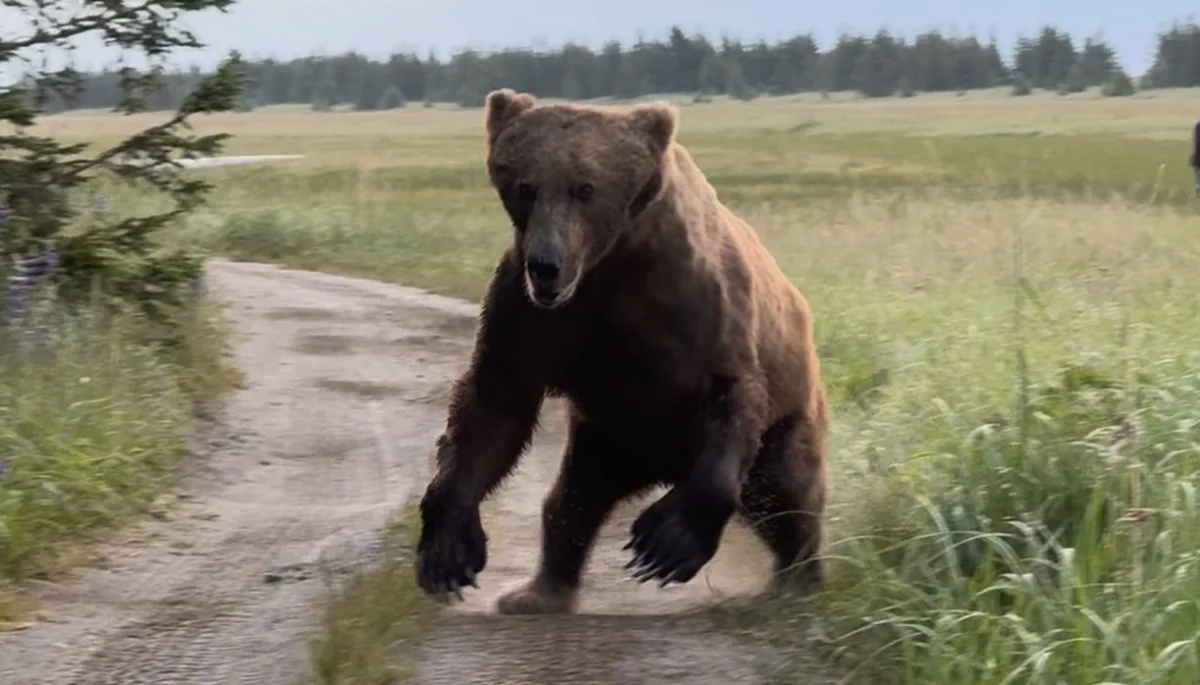
The vast and unforgiving landscape of Alaska, often referred to as "The Last Frontier," serves as a primary habitat for some of North America’s most formidable apex predators. Among these, the grizzly bear—a subspecies of the brown bear (Ursus arctos)—stands as a symbol of the wild’s raw power and unpredictable nature. While these animals generally avoid human contact, the intersection of wildlife photography and natural animal behavior can occasionally result in high-stakes confrontations. Recently, Brooke Bartleson, a professional wildlife photographer known for her extensive work documenting North American fauna, experienced a life-threatening encounter that has since become a vital case study in bear safety and behavioral management.
The incident, captured on video and shared across social media platforms, depicts a moment of "misplaced aggression" by a large male brown bear. The encounter occurred while Bartleson was positioned in the Alaskan wilderness, documenting the local ecosystem. The situation escalated rapidly when she found herself inadvertently positioned between a female bear (sow) and an pursuing male (boar). The resulting footage and Bartleson’s subsequent analysis provide a rare, first-person perspective on the efficacy of established wildlife safety protocols when faced with a charging apex predator.
Chronology of the Encounter
The event began with a high-speed pursuit involving two bears. In the wild, male grizzly bears often chase females during the mating season or as a display of dominance and territoriality. As Bartleson was observing the area, a female bear crested a ridge or moved along a trail at a full sprint, passing within close proximity to the photographer. Moments later, a significantly larger male bear followed in pursuit, maintaining a high velocity.
The trajectory of the chase brought the male bear directly toward Bartleson’s position. Upon noticing the human presence, the male bear’s focus shifted instantaneously. Experts in ursine behavior identify this as redirected or misplaced aggression; the bear, already in a state of high agitation due to the chase, perceived the stationary human as a secondary target or an obstacle.
The bear initiated what appeared to be a predatory or territorial charge, closing the distance between itself and Bartleson in seconds. At this critical juncture, the photographer was forced to make a split-second decision. Rather than retreating—an action that often triggers a bear’s predatory chase instinct—Bartleson opted to stand her ground. She stepped forward toward the animal, increasing her perceived physical profile, and delivered a sharp, authoritative vocalization. This assertive display successfully broke the bear’s momentum, causing it to veer off the trail and continue its pursuit of the female, leaving Bartleson unharmed.
Biological Context: Misplaced Aggression and Mating Behavior
To understand why the encounter occurred, it is necessary to examine the biological drivers of grizzly bear behavior in the Alaskan interior. During certain times of the year, particularly the late spring and early summer breeding season, male bears exhibit heightened levels of testosterone and territorial irritability.
In this specific instance, the male bear was focused on a potential mate. When a female bear attempts to evade a male, the male’s pursuit is driven by intense biological imperatives. When Bartleson appeared in the bear’s line of sight, the animal’s neurological state was already primed for conflict. The "misplaced aggression" Bartleson described is a documented phenomenon where an animal, unable to reach the primary object of its frustration, directs its energy toward the nearest available target.
Wildlife biologists note that grizzly bears are capable of reaching speeds of up to 35 miles per hour. At such speeds, a human has no physiological capacity to outrun the animal. Therefore, the psychological battle—the "bluff" versus the "stand"—becomes the only viable survival strategy in a close-quarters surprise encounter.
Adherence to and Deviation from Safety Protocols
The National Park Service (NPS) and the Alaska Department of Fish and Game (ADFG) provide stringent guidelines for traversing bear country. These regulations are designed to minimize the frequency of human-wildlife conflicts, which can be fatal for both parties.
Distance Regulations
Standard NPS safety protocols dictate that visitors must maintain a minimum distance of 100 yards (the length of a football field) from bears and wolves. For less aggressive species, such as elk, bison, and deer, the recommended distance is 25 yards. These buffers are intended to prevent "habituation"—where animals become too comfortable around humans—and to ensure that humans have adequate time to react if an animal’s behavior turns aggressive.
In Bartleson’s case, the distance was closed not by her own movement toward the animal, but by the animal’s rapid movement toward her. This highlights a common reality in the Alaskan wilderness: even when a photographer or hiker adheres to safety distances, the mobile nature of wildlife can bridge those gaps in a matter of seconds.
The "Stand Your Ground" Strategy
Bartleson’s response aligned with expert recommendations for "surprising" a bear or facing a "non-predatory" charge. When a bear charges, it is often a "bluff charge" intended to intimidate the threat into fleeing. If the human flees, the bear’s instinct to hunt is activated. By standing her ground, stepping forward, and shouting, Bartleson signaled to the bear that she was not prey and was willing to defend her space.
"Stand your ground. Do not run or back off. Be ready to defend yourself. Get big and loud," Bartleson explained in her post-event analysis. This methodology is taught by wildlife agencies as a last-resort tactic when bear spray or other deterrents are not immediately deployed or when the bear is too close for other measures.
Statistical Overview of Bear Encounters in Alaska
Alaska is home to approximately 30,000 brown bears, representing one of the densest populations in the world. Despite this high population, fatal bear attacks remain statistically rare. According to data from the Alaska Department of Health and Social Services, between 2000 and 2017, there were 68 hospitalizations in Alaska due to bear attacks, and roughly one to two fatalities occur annually across the state.
However, the frequency of "encounters"—interactions where no physical contact occurs—is much higher. The ADFG emphasizes that most bears prefer to avoid humans. Conflicts usually arise from three scenarios:
- Surprise: Stumbling upon a bear at close range, especially near a food source or with cubs.
- Protection of Young: Sows are notoriously protective of their offspring.
- Food Conditioning: Bears that have learned to associate humans with food.
In Bartleson’s encounter, the catalyst was neither food nor cubs, but rather the internal agitation of a male bear during a pursuit. This category of encounter is less common than "surprise" encounters but is considered highly dangerous due to the bear’s elevated adrenaline levels.
Expert Reactions and Safety Analysis
While Bartleson’s actions were successful, wildlife safety experts use such incidents to reinforce the importance of carrying deterrents. Bear spray, a non-lethal aerosol containing capsaicinoids, has been proven to be more than 90% effective in stopping aggressive bear behavior in close-range encounters.
"The photographer’s reaction was textbook for someone caught without a secondary deterrent," says a hypothetical analysis based on standard wildlife safety training. "However, the primary goal for any wilderness professional is the prevention of the ‘close-quarters’ scenario. In brushy terrain or areas with high bear activity, making noise to alert bears of human presence is the first line of defense."
Bartleson’s experience also underscores the importance of situational awareness. In her account, she noted that the female bear ran past her first. This "early warning" gave her a few critical seconds to prepare her mental state before the male arrived. For less experienced hikers, the first sign of danger might have been the male bear itself, potentially leading to a panic response.
Implications for Wildlife Photography and Tourism
The incident raises questions regarding the ethical and safety boundaries of wildlife photography. As digital media increases the demand for high-quality, "up-close" wildlife content, more individuals are venturing into remote habitats. This increase in foot traffic can lead to more frequent encounters.
Professional photographers like Bartleson often serve as educators, using their platforms to demonstrate the realities of nature. By sharing the "heart-pounding" reality of the charge, she provides a sobering counter-narrative to the "sanitized" view of nature often seen in documentaries.
The broader implications for Alaskan tourism involve a continued push for mandatory bear safety education for all backcountry permit holders. As the climate changes and bear habitats shift, the overlap between human recreation areas and bear foraging territories is expected to increase.
Conclusion
The encounter between Brooke Bartleson and the charging grizzly bear serves as a potent reminder of the inherent risks associated with the Alaskan wilderness. Through a combination of professional composure, knowledge of animal behavior, and the successful application of "fight-or-flight" management, Bartleson was able to turn a potentially fatal disaster into an educational milestone. Her ability to remain stationary and assertive in the face of a charging 800-pound predator remains a definitive example of how human intervention, when executed correctly, can de-escalate a natural conflict. For the public, the takeaway remains clear: respect for the 100-yard buffer is not merely a suggestion, but a fundamental requirement for survival in the domain of the grizzly.