Nayara Elvina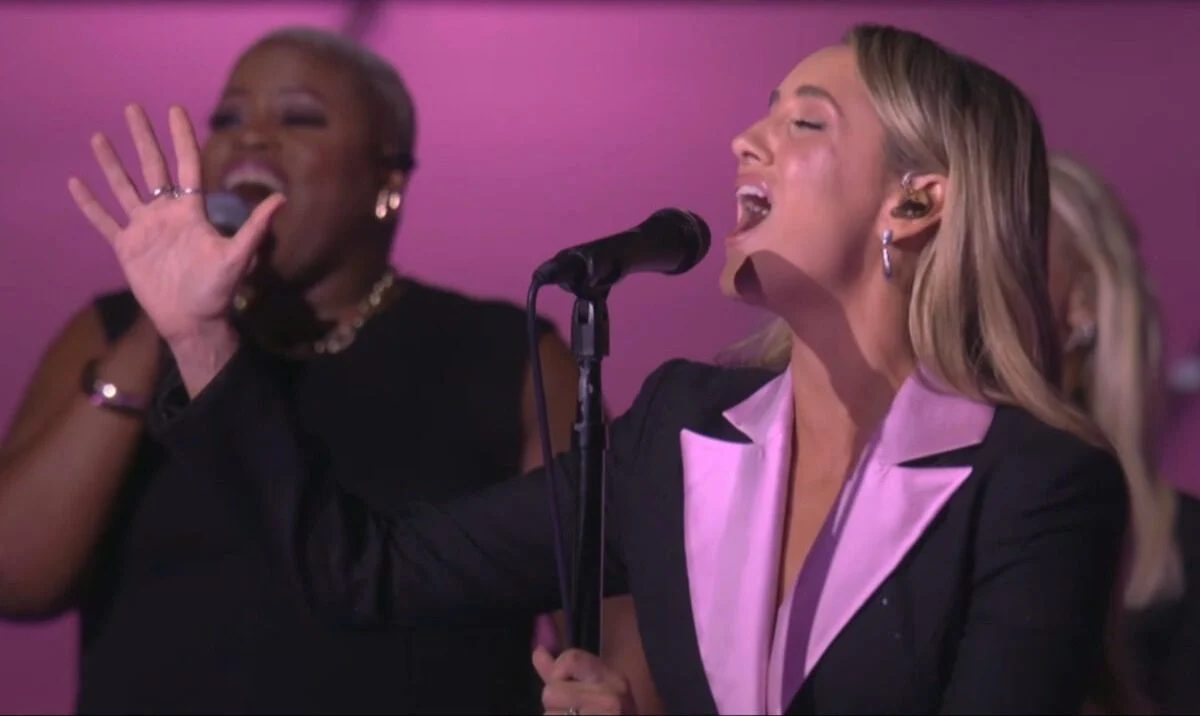
Country music star Lainey Wilson joined a roster of prominent artists in Lower Manhattan to participate in the official ABC News television special commemorating the anniversary of the September 11 terrorist attacks. Performing at the base of the iconic Tribute in Light installation, the Louisiana-born singer-songwriter delivered a soaring and emotionally resonant version of the historic hymn “Amazing Grace.” The broadcast, titled 9/11 Tribute in Light: Live from Lower Manhattan, was produced in partnership with the 9/11 Memorial & Museum and broadcast live before being made available for on-demand streaming on Disney+ and Hulu.
The nationwide broadcast served as a focal point for collective remembrance, drawing millions of viewers from across the United States. Wilson’s performance, backed by a full vocal choir, stood out as one of the central musical offerings of the evening. Other notable artists, including Cyndi Lauper and John Ondrasik of Five for Fighting, also contributed musical tributes during the special. However, Wilson’s interpretation of the centuries-old hymn drew widespread acclaim for its solemnity, vocal control, and deeply personal connection to her southern musical roots.
Background Context and Personal Reflection
For a generation of Americans, the events of September 11, 2001, remain a defining historical demarcation. Wilson, reflecting on her own memories of the tragedy prior to taking the stage, recounted being a fourth-grade student in Mrs. Debbie Bryan’s classroom when the national emergency unfolded. Like millions of classrooms across the country that morning, her school wheeled a television set into the room, allowing students and educators to bear witness in real time to the unfolding aviation attacks on the World Trade Center towers in New York City, the Pentagon in Arlington, Virginia, and the crash of Flight 93 in Shanksville, Pennsylvania.
Speaking to her followers and the public ahead of the broadcast, Wilson articulated the profound weight of returning to the site two decades later. “Where were you when the world stopped turning? I was in 4th grade in Mrs. Debbie Bryan’s class. I remember when she rolled in the TV and put the news on,” Wilson shared via social media. “Twenty-five years later, I had the honor of performing in NYC at the base of the iconic beams where the Twin Towers stood and where nearly 3,000 people lost their lives. A night I’ll never forget. God Bless America.”
This personal connection added an intrinsic layer of gravity to her performance. Growing up in a musically inclined household in Baskin, Louisiana, Wilson was introduced to singing at an early age through her local church community. Gospel and traditional church hymns formed the bedrock of her early vocal training, a background that informed the effortless cadence and spiritual sincerity she brought to her rendition of “Amazing Grace.”
Chronology of the Tribute in Light Installation
The Tribute in Light has served as a visual anchor for New York City’s commemorative ceremonies since it was first mounted on March 11, 2002, exactly six months after the attacks. Composed of 88 vertical searchlights—arranged in two immense squares mirroring the footprints of the original Twin Towers—the art installation projects twin beams of light straight up into the night sky, reaching several miles high. Visible from up to 60 miles away on clear nights, the installation is widely recognized as one of the most poignant temporary public art displays in modern history.
The logistical coordination of the installation involves the Municipal Art Society of New York, along with numerous technological partners, labor unions, and local agencies. Each year on the anniversary, the beams are illuminated at dusk and remain lit through dawn. The integration of live musical broadcasts, such as the ABC News special featuring Wilson, Lauper, and Ondrasik, seeks to bridge the physical solemnity of the ground-zero site with a broader national audience.
Throughout the decades following the attacks, the commemoration events in Lower Manhattan have evolved to incorporate both formal readings of the victims’ names and artistic expressions designed to foster collective healing and historical education. The inclusion of contemporary artists representing diverse musical genres ensures that younger generations—many of whom, like Wilson in 2001, were children or not yet born when the attacks occurred—remain engaged in the ongoing narrative of national memory.
Cultural Significance and Broader Impact
The musical choices for national days of remembrance frequently carry significant cultural weight. “Amazing Grace,” written by English clergyman and poet John Newton in 1773, has transcended its religious origins to become a secular anthem of solace, resilience, and redemption in American society. Its utilization during major historical tragedies—including national memorial services, state funerals, and post-disaster vigils—highlights its enduring resonance.
Media analysts and cultural observers noted that Wilson’s performance capitalized on the authenticity of her public persona. Known primarily for her high-energy contemporary country anthems, modern fashion sense, and multi-platinum hits such as "Heart Like a Truck," Wilson’s transition into a strictly reverent, acoustic-driven performance underscored her vocal versatility. Industry commentators frequently point to her gospel-infused delivery as evidence of a deeper artistic range that extends well within traditional American musical forms.
Furthermore, the integration of streaming platforms like Disney+ and Hulu into the distribution model for live patriotic programming reflects changing media consumption habits. By making the 9/11 Tribute in Light special instantly accessible on-demand, ABC News and the 9/11 Memorial & Museum ensured that the broadcast reached demographics that rely less on traditional linear television, expanding the reach of the historical commemoration to digital-first audiences.
Official Responses and Institutional Statements
Representatives from the 9/11 Memorial & Museum emphasized the necessity of continued public programming to maintain awareness of the historical impacts of the attacks. As the timeline of the event moves further into history—transitioning from contemporary news into standard school curriculum—institutional stakeholders place a high priority on creative mediums to convey the scale of the loss and the subsequent unity demonstrated by emergency responders and ordinary citizens alike.
In a joint statement released following the broadcast, network and institutional organizers reflected on the tone of the evening: “As Lainey Wilson sang ‘Amazing Grace’ beneath Tribute in Light, the familiar hymn became a moment for people across the country to pause and remember together. Twenty-five years after 9/11, we continue to come together to honor those we lost and reflect on the strength, compassion, and unity that followed.”
The broadcast also served to spotlight the ongoing mission of the 9/11 Memorial & Museum, which relies on public engagement, educational outreach, and philanthropic support to preserve the historical record of the site. Security and logistical teams coordinated closely with the City of New York to ensure that the live broadcast from Lower Manhattan proceeded safely, accommodating both invited dignitaries and members of the public who gathered along the perimeter to pay their respects.
As the anniversary concluded and the searchlights were eventually powered down at dawn, the performance left an indelible impression on the cultural landscape of the week. For Lainey Wilson, the event marked a poignant intersection of personal history, national memory, and musical heritage, cementing a solemn milestone in an otherwise fast-paced and high-profile touring career.