Mia Khoirunisa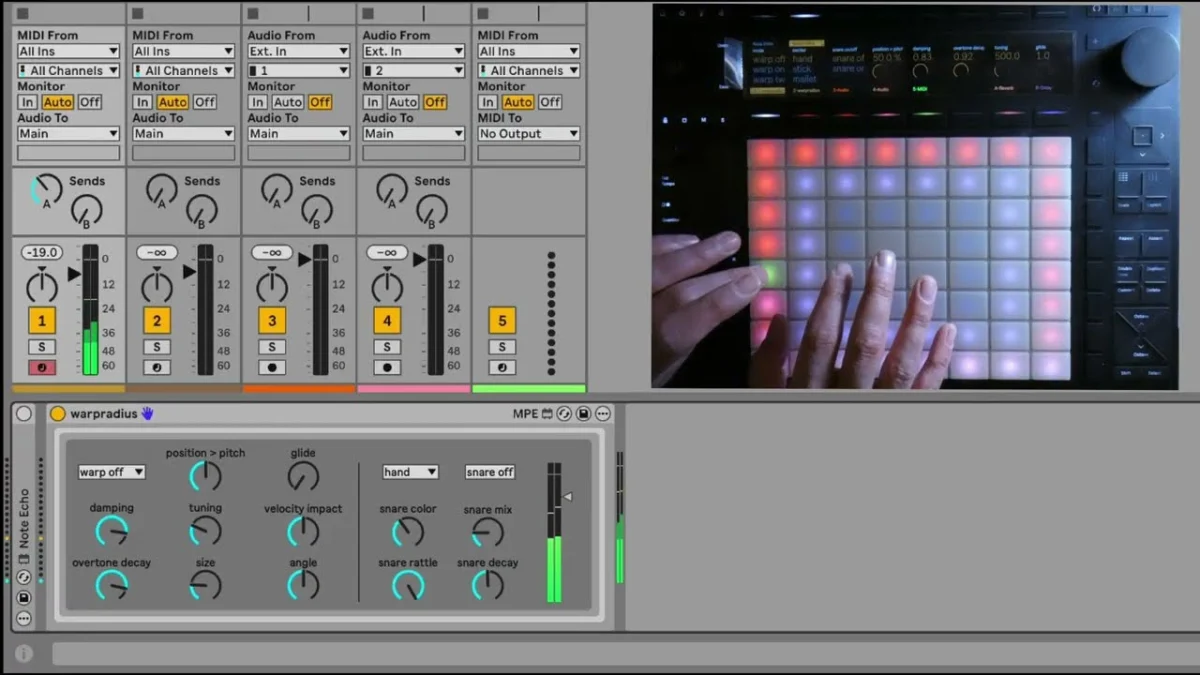
The landscape of digital audio workstations and their accompanying hardware controllers is constantly evolving, with developers pushing the boundaries of creative expression. This spring, a significant advancement in sonic manipulation has emerged, not from a direct Ableton product update, but from an ingenious Max for Live device named "Warpradius." Developed by Jon Doe One, this free tool redefines the Ableton Push 3’s grid, transforming its array of pads into a singular, highly expressive percussion surface. At its core, Warpradius leverages a sophisticated Bessel membrane resonator model, a modal synthesis technique that generates remarkably realistic and dynamically varied percussion sounds.
The Genesis of Warpradius and its Push 3 Integration
The development of Warpradius is intrinsically linked to the capabilities of the Ableton Push 3, particularly its MPE (MIDI Polyphonic Expression) equipped strike location. This advanced feature allows for a granular understanding of touch, reporting not only which pad is activated but also the precise X and Y coordinates of the strike across the entire 8×8 grid. This level of detail is crucial for Warpradius’s innovative approach. Instead of treating each pad as an independent trigger, the device unifies the entire grid into a continuous, virtual drum head. When a user strikes the surface, Warpradius interprets the position and pressure, translating this data into the complex vibrational patterns of its Bessel membrane model. This results in a fluid, organic percussive experience that mimics the nuances of striking a physical drum.
While the Push 3’s MPE capabilities are central to Warpradius’s full potential, the underlying technology is accessible to a broader range of users. Jon Doe One has meticulously engineered a gen~ port for the Bessel functions, a testament to his deep understanding of audio processing within the Max/MSP environment. The gen~ compiler allows for the creation of highly optimized, low-level code for audio processing, ensuring efficient and high-quality sound generation. This technical achievement is further built upon prior work and research in modal synthesis, with specific acknowledgement of the influence of "Ersatz Ben" and the contributions of Philip Meyer to the gen~ implementation.
The Science Behind the Sound: Bessel Functions and Modal Synthesis
To understand the sonic richness of Warpradius, it’s essential to delve into the principles of modal synthesis and the role of Bessel functions. Modal synthesis is a physical modeling technique that simulates the sound of an object by modeling its natural resonant frequencies, or "modes." When an object is struck, it vibrates at these specific frequencies, producing a complex harmonic spectrum that defines its timbre.
Bessel functions, a class of solutions to Bessel’s differential equation, are particularly well-suited for modeling the vibrational characteristics of membranes and other elastic surfaces. These mathematical functions describe wave propagation and oscillations in circular or cylindrical geometries, making them ideal for simulating the complex sound of striking a stretched membrane, akin to a drumhead. By employing a Bessel membrane resonator model, Warpradius can accurately predict and reproduce the intricate acoustic behaviors that give percussion instruments their distinct character. This approach moves beyond simple waveform generation, instead simulating the physics of sound production, leading to a more realistic and dynamic sonic output.
The efficiency of the gen~ port for these Bessel functions means that this sophisticated modal synthesis engine can be run within Max for Live with minimal performance overhead. This is a significant feat, as physical modeling can often be computationally intensive. The ability to achieve such realistic percussion sounds with a free Max for Live device, especially one that leverages cutting-edge MPE technology on the Push 3, represents a notable contribution to the electronic music production community.
Expanding the Possibilities: Beyond Push 3
While Warpradius is optimized for the Push 3, its underlying architecture as a Max patch opens doors for broader application. The core sound-generating engine, the gen~ port of the Bessel functions, can potentially be ported to other environments or controllers. This means that producers who do not own a Push 3, or who prefer to use alternative controllers, can still harness the power of Bessel function-based percussion synthesis. The "sound guts" of Warpradius can be integrated into custom patches or different software environments, allowing for a more widespread adoption of this innovative sonic technology.
The flexibility of Max/MSP as a development platform is highlighted by the community’s engagement with these concepts. The development of Warpradius is not an isolated event but rather part of a lineage of exploration into modal synthesis with Bessel functions within the Max environment. For instance, Ben Johnson’s creation, which showcases sequenced Bessel sounds, demonstrates the compelling musical results achievable through this method.
Further expanding this research, Philip Meyer has provided a publicly available patch, inspired by the work of others, that offers a practical implementation of modal synthesis using Bessel functions in Max MSP. This resource, accessible via a GitHub repository, allows aspiring sound designers and developers to dissect, learn from, and build upon these foundational concepts. The availability of these patches and the collaborative spirit within the Max community underscore the power of open sharing and peer-to-peer learning in driving technological innovation.
The Interplay of Collaboration and AI in Creative Development
The development and dissemination of Warpradius and related Bessel function patches offer a valuable case study in the collaborative nature of creative technology. The exchange of ideas, the building upon prior work, and the sharing of code are fundamental to progress in this field. This dynamic is particularly relevant in the current discourse surrounding the impact of AI coding tools on creative workflows.
The author of the original piece raises a pertinent concern: if AI tools generate code that is not thoroughly understood or reviewed line by line by human developers, it can lead to "unreadable" codebases. This lack of transparency can hinder collaboration and the deep understanding of how a system functions. In fields like modal synthesis, where the intricacies of sound production are paramount, a superficial understanding of generated code could undermine the very purpose of the endeavor. The collaborative process, involving direct human interaction and detailed code review, fosters a deeper comprehension of the underlying principles, enabling further innovation and the ability to troubleshoot and adapt.
While acknowledging the potential benefits of AI in coding, the emphasis remains on the indispensable value of human collaboration. The ability to discuss, share, and build upon each other’s work, as seen in the development of Warpradius and its related projects, is crucial for the advancement of creative technologies. Maintaining open communication channels and defending the practice of talking to other humans about creative processes, even when incorporating AI assistance, is presented as a vital strategy for ensuring continued progress and innovation.
The Enduring Relevance of Max for Live Amidst New Technologies
In recent discussions within the Ableton Live user community, there has been speculation about whether new technologies like Ableton Extensions might render Max for Live obsolete. However, current technical limitations of Extensions suggest that Max for Live will continue to play a significant role in extending the functionality of Ableton Live. As of now, Extensions do not have the capability to access live audio and MIDI input and output, a core feature of Max for Live devices. There has been no indication from Ableton that this functionality is on the immediate development roadmap for Extensions.
This distinction means that complex, real-time audio manipulation and interactive MIDI processing, as exemplified by Warpradius, will likely remain within the domain of Max for Live for the foreseeable future. The ability to create sophisticated instruments, effects, and controllers that deeply integrate with Live’s audio engine and MIDI stream is a testament to the power and ongoing relevance of the Max for Live platform. The development of Warpradius serves as a strong example of the innovative possibilities that continue to emerge from this environment.
Furthermore, the choice of development tools is not inherently a zero-sum game. Beyond Ableton Live’s internal APIs, developers have a spectrum of options, including languages like TypeScript, often coupled with WebAssembly for performance-critical tasks. The existence of multiple powerful development platforms and languages, each with its own strengths, allows for a diverse and dynamic ecosystem of creative tools. This plurality ensures that innovation can occur across various technological fronts, benefiting the broader creative community.
Conclusion: A Resonant Future for Percussion Synthesis
The emergence of Warpradius, a free Max for Live device for Ableton Push 3, marks a significant moment for percussion synthesis. By employing a Bessel membrane resonator model and leveraging the advanced MPE capabilities of the Push 3, it offers an unprecedented level of expressive control and sonic realism. The underlying technical achievements, particularly the efficient gen~ implementation of Bessel functions, highlight the depth of innovation possible within the Max/MSP environment.
Moreover, the collaborative spirit that underpins the development and sharing of these technologies, from Jon Doe One’s initial creation to the contributions of Ersatz Ben and Philip Meyer, underscores the importance of human connection and open knowledge exchange in the advancement of creative tools. As the digital audio landscape continues to evolve, with new technologies like Ableton Extensions entering the fray, the enduring power and flexibility of Max for Live, exemplified by projects like Warpradius, remain vital for pushing the boundaries of musical expression. The exploration of modal synthesis and physical modeling continues to yield exciting sonic possibilities, promising a rich and resonant future for percussion synthesis.