
 Reynand Wu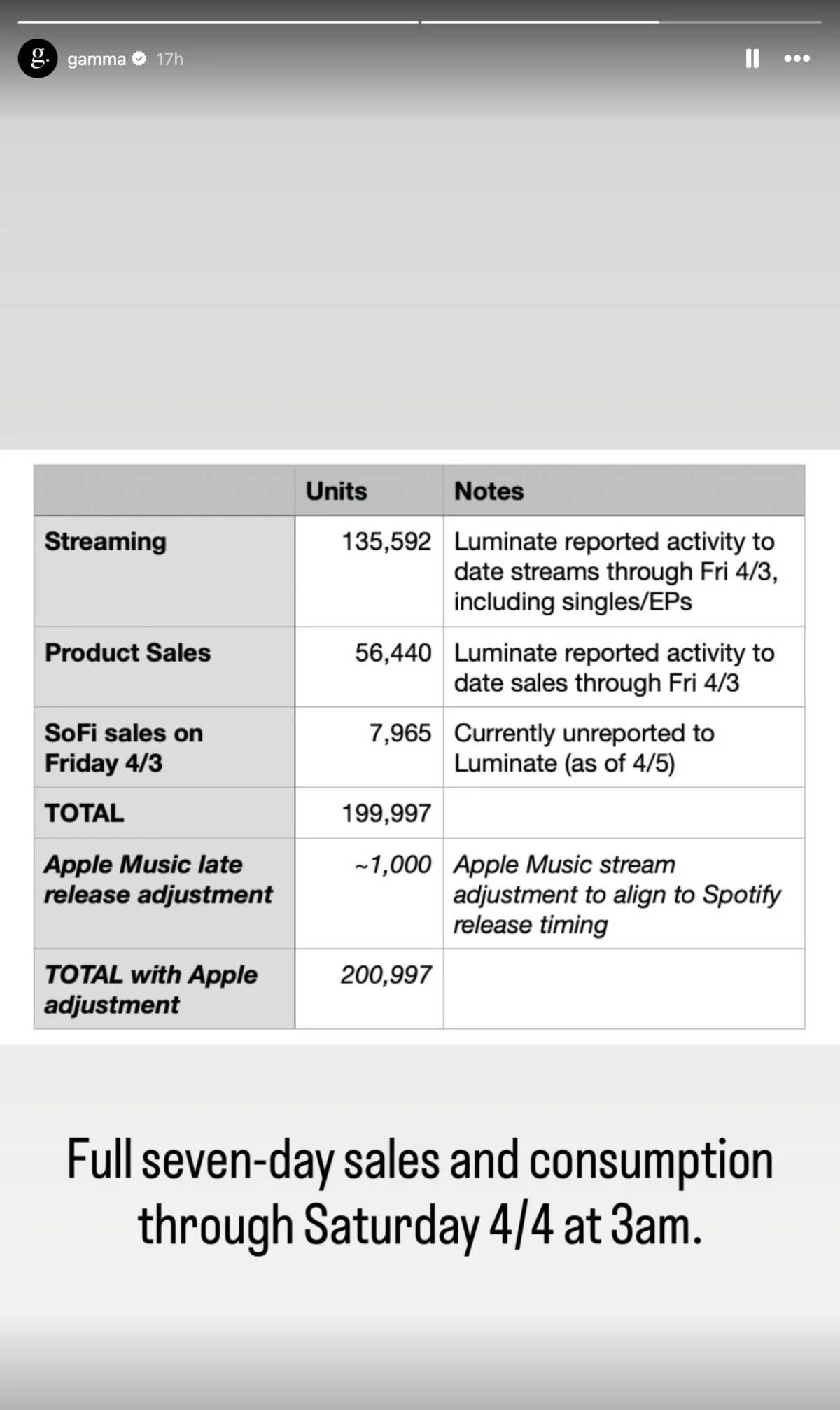
The music industry is currently embroiled in a high-stakes dispute regarding the validity of chart data following the release of Kanye West’s latest studio album, Bully. The project, which arrived amidst a turbulent period for the artist, debuted at number two on the Billboard 200 chart. According to official data provided by Luminate and reported by Billboard, the album accrued 152,000 equivalent album units during its first week of release. This total was comprised of 96,000 streaming-equivalent units—derived from 98.43 million on-demand official streams—and 56,000 in pure traditional sales.
However, the official chart placement has been sharply contested by Gamma., the distribution company founded by former Apple Music executive Larry Jackson, which oversaw the release of Bully. In a public challenge to the industry-standard metrics, Gamma. released an internal breakdown on social media asserting that the album’s actual consumption reached 200,997 units. If verified, this figure would have surpassed the 187,000 units earned by BTS’s ARIRANG, which secured the number one spot in its second week on the chart. As of this writing, neither Billboard nor Luminate has issued a formal response to the discrepancy, leaving the industry to grapple with questions regarding how data is aggregated, audited, and finalized in the streaming era.
A Historic Shift in Chart Performance
The placement of Bully at number two carries significant historical weight for West’s career. The result effectively terminates a 21-year streak during which every solo studio album released by the Chicago-born artist claimed the top spot on the Billboard 200. Since his seminal 2004 debut, The College Dropout—which also peaked at number two—West has enjoyed an unprecedented run of commercial dominance.
For the better part of two decades, West’s ability to secure the number one position was viewed as a barometer of his cultural relevance and fan loyalty. The fact that Bully fell short of this benchmark, even before the emergence of the dispute regarding the 200,000-unit figure, signals a potential inflection point in his career trajectory. The competition against K-Pop powerhouse BTS further highlights the shifting demographics of global music consumption, where international acts with highly mobilized fanbases are increasingly capable of outperforming domestic superstars on U.S. charts.
The Gamma. Data Dispute: Methodology and Implications
The tension between Gamma.’s reported figures and the official Billboard count underscores a long-standing point of friction between independent distributors and the legacy chart-tracking infrastructure. Luminate, the company responsible for providing the data that powers Billboard’s charts, utilizes a complex, multi-layered methodology to count "equivalent album units," which combines physical sales, digital downloads, and on-demand audio and video streaming.
Industry analysts suggest that discrepancies often arise when distributors utilize different definitions of "on-demand" engagement or include international streams that may not meet the specific criteria for the Billboard 200, which focuses primarily on consumption within the United States. Gamma.’s decision to publicize their own internal report on Instagram Stories—claiming 200,997 units—is an unconventional move that challenges the authority of the industry’s central clearinghouse.
Whether or not the discrepancy is a result of differing audit protocols or a fundamental disagreement over data interpretation, the incident has highlighted the lack of transparency in how streaming numbers are audited for chart purposes. If a distribution company can bypass official channels to claim a "true" sales figure, it complicates the narrative of commercial success and raises questions about how artists and labels will choose to frame their milestones moving forward.
Future Expansion and Commercial Strategy
In conjunction with the chart debate, Gamma. has signaled that the rollout for Bully is far from complete. Through a brief announcement on their official Instagram account, the company confirmed that a "Bully deluxe" edition is currently in development. While specific details remain scarce—including the tracklist, the number of bonus songs, and the official release date—this strategy is a common industry tactic designed to bolster long-term consumption and provide a secondary wave of interest.
The decision to move toward a deluxe version shortly after the initial release suggests that West and his team are focused on maximizing the commercial longevity of the project. Given the current chart performance, an expanded edition could serve as a vehicle to drive additional streaming numbers and potentially push the album toward higher long-term sales targets, regardless of the initial controversy surrounding the debut week.
The Wireless Festival Controversy
While the chart dispute dominates the conversation regarding his music, West’s public image faces intense scrutiny due to his upcoming headlining performances at London’s Wireless Festival. The decision to book West has triggered a widespread backlash, rooted in the artist’s well-documented history of antisemitic comments and his public expressions of admiration for Nazi ideology.
The fallout has been swift and systemic. In recent days, a coalition of corporate sponsors, including major entities such as Pepsi, PayPal, and the spirits conglomerate Diageo, have withdrawn their financial support from the festival. The withdrawal of these sponsors marks a rare instance where corporate entities have actively disassociated themselves from a music event due to the specific ideology of a headlining artist.
The protest has transcended the music industry, reaching the highest levels of the British government. Prime Minister Sir Keir Starmer has publicly condemned the booking, labeling it "deeply concerning" and questioning the decision-making process behind inviting an artist with such a history of hate speech to headline a major public event. Similarly, London Mayor Sadiq Khan has expressed strong disapproval, reflecting a growing consensus among public officials that the commercial interests of festival promoters should not supersede the societal values of the communities they serve.
Institutional Challenges and the Future of Touring
The situation surrounding the Wireless Festival serves as a case study in the evolving relationship between controversial performers and the live music ecosystem. For years, the industry operated under the assumption that an artist’s commercial draw was independent of their personal conduct. However, the mass exodus of sponsors from Wireless suggests a new era of accountability.
When major corporations withdraw funding, the financial viability of a festival is put at risk. This creates a difficult dilemma for promoters: whether to prioritize the massive ticket sales that a star like Kanye West generates, or to preserve institutional reputation and corporate relationships by distancing themselves from polarizing figures. The fact that West recently completed two sold-out shows at the SoFi Stadium in Los Angeles demonstrates that he maintains a highly dedicated core fanbase capable of selling out massive venues. This creates a divergence between his commercial performance, which remains strong, and his institutional viability, which is increasingly under threat.
Conclusion: A Career in Transition
Kanye West’s current position in the music industry is defined by this duality: he remains a massive commercial force capable of generating 150,000-plus units in a single week, yet he is simultaneously the subject of an unprecedented degree of social and political isolation. The controversy surrounding the chart performance of Bully and the subsequent boycott of his live appearances suggest that the mechanisms of fame are shifting.
The coming months will be critical in determining the impact of these events. If the dispute with Billboard remains unresolved, it may lead to a broader conversation about how independent distributors engage with the charts. Simultaneously, the pressure exerted on the Wireless Festival may set a precedent for how future concert promoters handle artists whose personal behavior conflicts with the expectations of sponsors and the public. As the industry watches the release of the deluxe version of Bully and the potential fallout from his summer tour, it is clear that West’s career has entered a phase where commercial success is no longer a shield against the consequences of his public life.