Lana Akmaluna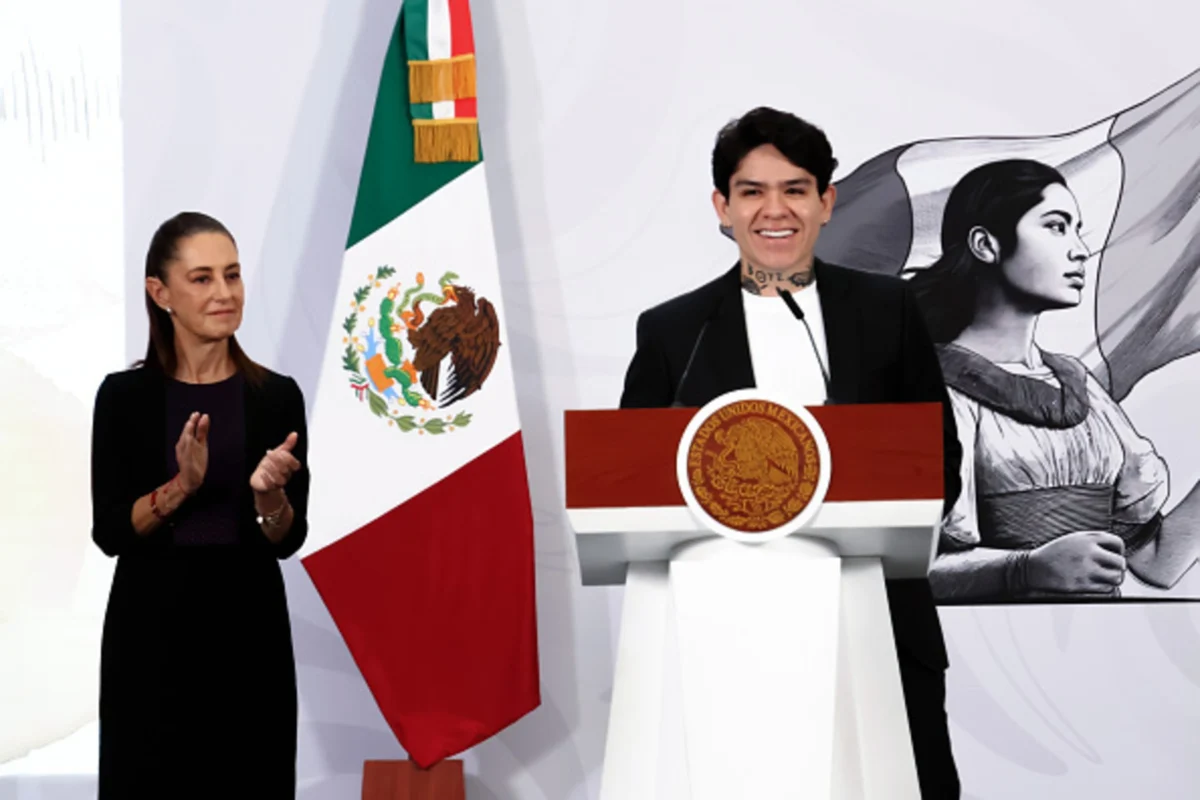
In an event that marks a significant pivot in the ongoing dialogue between the Mexican government and the exponents of the "corridos tumbados" genre, regional Mexican superstar Junior H appeared alongside President Claudia Sheinbaum during a morning press conference at the National Palace on May 11, 2026. The appearance served as the official launch for the second edition of "México Canta," a high-profile binational initiative designed to steer musical narratives away from the glorification of violence and drug culture. The collaboration signifies a surprising reconciliation between the administration and an artist who has previously been at the center of censorship debates and legal penalties.
Dressed in a somber black suit and a plain white T-shirt, a departure from the lavish jewelry and streetwear typically associated with his public persona, Junior H—born Antonio Herrera—addressed the nation from the presidential podium. His speech focused on the weight of artistic influence and the evolution of his own perspective regarding the impact of his lyrics on a global audience. The singer-songwriter, who rose to prominence as a leading figure in the urban-infused corrido movement, acknowledged that his earlier works did not always align with the positive social message he now seeks to champion.
A Transformation of Perspective and Performance
The presence of Junior H at the National Palace was not merely symbolic; it included a live performance of his hit "Y Lloro," a song that focuses on themes of heartbreak rather than the "narcocorrido" tropes that defined his early career. During his address, Herrera emphasized that his growth as an individual has necessitated a growth in his art. He noted that in the infancy of his career, he was largely unaware of how the stories he told could influence the psyche of his listeners.
"I want to share that in the early days of my career, some of the stories I told in my songs didn’t contribute to the positive message that my current compositions reflect," Herrera stated, reading from a prepared message. "As I grew, I came to understand that music, beyond being a form of expression, also comes with responsibility when millions of people around the world are listening."
This admission is particularly poignant given Herrera’s history. The artist, originally from Guanajuato before emigrating to Utah, became a household name through tracks that often touched upon the darker realities of organized crime. His 2023 collaboration with Peso Pluma, "El Azul," was criticized for its references to Juan José Esparragoza Moreno, a notorious figure in the Sinaloa cartel. Similarly, his 2022 track "El Hijo Mayor" was widely interpreted as a tribute to the late son of Joaquín "El Chapo" Guzmán. By standing with President Sheinbaum, Herrera appeared to be signaling a definitive break from that lyrical past, embracing a role as a cultural role model for the youth of both Mexico and the United States.
The Evolution of México Canta
The "México Canta" competition, organized by Mexico’s Ministry of Culture, represents the centerpiece of the government’s "soft power" approach to public safety and cultural health. Rather than relying solely on prohibition, the initiative seeks to incentivize young artists to explore themes of love, resilience, and Mexican identity. The second edition, announced during the Monday briefing, continues to target binational talent, recognizing that the cultural exchange between Mexico and the U.S. is the primary engine behind the global explosion of regional Mexican music.
President Sheinbaum has consistently maintained that her administration does not seek to "ban" genres, a stance she reiterated during the press conference. Instead, the government is leveraging competitions like México Canta to promote "deeper narratives of Mexico’s values." In an interview conducted in April 2025, Sheinbaum clarified that the goal is to support music that reflects "what moves us as Mexicans," moving away from the "narcocultura" that has historically dominated certain segments of the industry.
The competition offers recording opportunities and financial support to winners, providing a viable alternative for emerging artists who might otherwise feel pressured to adopt violent themes to gain traction in a crowded market. By involving a star of Junior H’s magnitude, the Ministry of Culture aims to prove that commercial success and social responsibility are not mutually exclusive.
A Chronology of Conflict and Censorship
The path to this collaboration has been fraught with legal and political tension. For years, regional and municipal governments in Mexico have struggled to balance freedom of expression with the need to curb the influence of cartels. Junior H himself has been a direct target of these measures.
In early 2025, Herrera was fined 400,000 pesos (approximately $23,000 USD) by the municipality of Zapopan in Jalisco after a performance of "El Azul." The municipal president, Juan José Frangie Saade, went a step further by banning the artist from performing within the city limits for the remainder of his term, which extends to September 2027. This local crackdown is part of a broader trend; currently, at least ten of Mexico’s 32 states—including hotspots for violence like Michoacán, Baja California, and Guanajuato—have implemented various forms of restrictions on the public performance of narcocorridos.

The tension reached a boiling point in March 2025 during the SXSW festival in Austin, Texas. At a Billboard-hosted event, Junior H voiced his frustration with these restrictions, famously telling the audience, "It’s the government against us, or us against the government." This statement reflected a widespread sentiment among corridos tumbados artists that they were being unfairly scapegoated for systemic security failures.
The international dimension of this issue became evident in April 2025, when the U.S. State Department took the unprecedented step of canceling the work and tourist visas of the group Los Alegres del Barranco. The action followed a concert at the University of Guadalajara where the band displayed images of Nemesio Oseguera Cervantes ("El Mencho"), the leader of the Jalisco New Generation Cartel (CJNG). This move signaled that the U.S. government was willing to align with Mexican efforts to de-glamorize cartel leaders, adding a diplomatic layer to the cultural debate.
Data and the Socio-Economic Impact of Corridos
The stakes of this cultural shift are immense, given the economic power of the regional Mexican genre. In the last three years, corridos tumbados and related subgenres have dominated global streaming platforms like Spotify and YouTube. Junior H, Peso Pluma, and Natanael Cano have collectively garnered billions of streams, turning what was once a niche regional sound into a global juggernaut.
Supporting data suggests that the "narcocultura" aesthetic has a measurable impact on youth aspirations in high-conflict areas. Sociological studies cited by the Ministry of Culture during the México Canta launch indicate that the glamorization of the "narco-lifestyle"—characterized by fast money, luxury vehicles, and high-caliber weaponry—can serve as a recruitment tool for organized crime.
However, the industry also provides a massive economic engine. The "Sad Boy" movement, pioneered by Junior H, has shown that there is a massive market for more emotional, introspective content within the regional Mexican framework. By pivoting toward these themes, artists like Herrera are not just complying with government wishes; they are tapping into a sustainable and less controversial revenue stream that allows for easier touring in both Mexico and the United States.
Official Responses and Public Reaction
The reaction to Junior H’s appearance at the National Palace has been polarized. On social media, fans have expressed a mix of support for his growth and skepticism regarding his alignment with the government. Critics of the administration have accused the move of being a PR stunt, while some purists of the genre argue that the "rebellion" inherent in corridos is being diluted by state intervention.
Representatives for Junior H in Mexico were reached for comment regarding the online backlash but did not respond by the time of publication. However, Herrera’s previous comments to Billboard in late 2025 offer some insight into his current stance. "It’s a delicate subject, but we respect the authorities and the government," he said at the time. "We’re not against anything; we’re singers, we sing, and that’s how we make a living."
President Sheinbaum’s administration views the participation of Junior H as a major victory for their cultural policy. By bringing a former "outlaw" artist into the fold, they hope to demonstrate that the state is not an enemy of the music, but a partner in its positive evolution.
Broader Implications for the Music Industry
The success of the second edition of México Canta and the "rehabilitation" of Junior H’s public image could serve as a blueprint for other artists in the genre. If Herrera can maintain his status as a chart-topping artist while adhering to the "conscious" guidelines promoted by the Ministry of Culture, it may encourage others to follow suit, potentially leading to a permanent shift in the lyrical landscape of regional Mexican music.
Furthermore, this development may influence how local governments handle bans. If the federal government can successfully collaborate with these artists, municipal leaders in places like Zapopan may find themselves under pressure to reconsider their restrictive stances in favor of a more integrated, educational approach.
As the second edition of México Canta gets underway, the eyes of the music industry and the political world remain fixed on the National Palace. The partnership between a "Sad Boy" superstar and a reformist President represents a bold experiment in cultural engineering—one that seeks to prove that while the beat of the corrido remains the same, the story it tells can change to reflect a more hopeful future for Mexico.