Aveline Kirana
The traditional operatic supertitle—that static, often jarring band of white text hovering above a proscenium arch—is undergoing a radical transformation. Earlier this year, the Boston Lyric Opera (BLO) entered a collaborative partnership with the multidisciplinary design firm MASARY Studios to dismantle the long-standing divide between narrative translation and scenic design. By integrating animated, emotionally resonant typography directly into the visual fabric of the stage, this initiative marks a departure from the "utility-first" model that has defined international opera production for decades.
A History of the Utility Model
To understand the significance of this shift, one must look at the evolution of operatic translation. The concept of supertitles—or "surtitles"—was first introduced to the North American opera scene in 1983 by the Canadian Opera Company during a production of Richard Strauss’s Elektra. Before this, audiences were largely expected to rely on printed libretti or their own familiarity with the source language, a barrier that often alienated casual listeners and hampered the accessibility of the art form.
For over forty years, the technological standard remained largely stagnant: a simple projection of text, usually in a high-contrast font, placed where it would not interfere with the stage action. While this solved the issue of comprehension, it created a cognitive disconnect. Viewers were forced to constantly shift their gaze between the live performers—who were conveying raw emotion—and the text above, which often felt detached from the staging. The BLO and MASARY Studios project aims to resolve this dichotomy by treating the words themselves as artistic elements that move, pulse, and react in tandem with the vocal performances.
The Technical Execution: Das Lied von der Erde
The pilot for this experimental approach occurred during the March 2024 production of Gustav Mahler’s Das Lied von der Erde (The Song of the Earth). This production, which leaned heavily into abstract, modern aesthetics, provided an ideal canvas for the integration of kinetic typography.
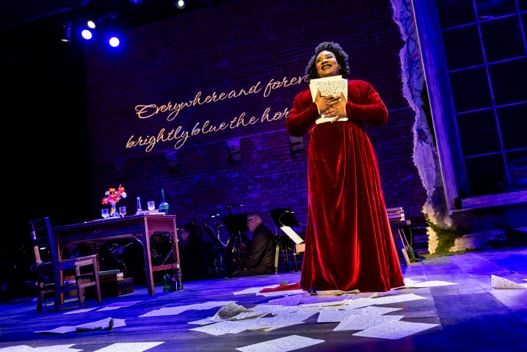
The technical requirements were significant. MASARY Studios utilized a sophisticated projection mapping rig, employing two high-lumen 4K projectors converged into a single, seamless image. This allowed for the typography to be mapped onto the complex geometries of the set rather than a flat surface. A third projector was dedicated specifically to a rear-projected window built into the scenery. This window functioned as both a light source and a digital canvas, allowing singers to interact with the text as it appeared, creating an immersive feedback loop between the performer’s physical presence and the translated meaning of their lyrics.
The pacing of the text was not automated by a static rhythm track; instead, it was calibrated to match the nuances of the vocal delivery. By adjusting the weight, speed, and trajectory of the characters, the design team sought to mirror the "breath" of the music, ensuring that the visual experience remained subordinate to the singer’s intent.
Artistic Intent and Design Philosophy
Sam Okerstrom-Lang, the cofounder of MASARY Studios, emphasized in official communications that the objective was to move away from translation as a "utility" and toward translation as an "experience." The traditional approach treats the text as an instructional manual, something the audience reads to "understand" the plot. The MASARY approach treats the text as an extension of the orchestra and the staging.
"Operas are sung in Italian, German, and French, and translation has always been treated as a utility, something to be read rather than experienced," Okerstrom-Lang stated. By embedding the words into the scenery, the production team successfully shifted the audience’s focal point. When the text appears on the surface of a character’s environment, the audience does not have to "look away" from the drama to grasp the dialogue; the drama and the dialogue become a single, unified visual event.
Industry Implications and Future Prospects
The implications for the wider opera world are substantial. Many opera companies globally have been struggling to remain relevant to younger, digital-native audiences who are accustomed to high-fidelity, interactive, and fast-paced visual storytelling.
The Data Gap
While there is no universal metric for how supertitles impact audience retention, internal surveys from regional opera companies suggest that "translation fatigue" is a common complaint. As production budgets tighten, companies are looking for ways to maximize the impact of their scenic design. By merging projection mapping with translation, organizations like the BLO are effectively killing two birds with one stone: they are fulfilling the accessibility requirement of providing subtitles while simultaneously enhancing the production value of the set.
Economic and Logistical Challenges
However, the integration of such technology is not without challenges. The capital expenditure for 4K projection systems, specialized rendering software, and the intensive hours required for real-time projection mapping represents a significant investment. Furthermore, it requires a new level of collaboration between the stage director, the lighting designer, and the projection mapping team. In a traditional production, these roles might operate with some level of independence; here, they must act in perfect synchronization.
Broader Impact on the Operatic Canon
If this technology scales, it could change how directors approach the staging of classic works. Works that are notoriously difficult to stage due to their length or density—such as Wagner’s Ring Cycle or the sprawling operas of Verdi—could benefit from text that acts as a visual guide, guiding the audience’s eye toward specific thematic motifs embedded in the scenery.
Furthermore, this approach invites a new generation of digital artists into the opera house. Traditionally, opera has been a bastion of analog craft—wood, paint, and fabric. Integrating digital typography requires a fusion of these worlds. It creates a space for "scenic programmers," a new breed of technician who understands both the architectural constraints of the stage and the fluid dynamics of motion graphics.
The Path Forward
The Boston Lyric Opera’s experiment with Das Lied von der Erde acts as a proof of concept. Moving forward, the industry will likely observe how this technology performs in larger, more traditional venues with proscenium arches that are less conducive to integrated projection mapping.
Critics of the approach have occasionally voiced concerns that overly stylized typography could distract from the singers’ facial expressions or the nuances of the stagecraft. Maintaining the balance between "expressive" and "distracting" will be the primary challenge for future productions. However, early audience feedback from the March production indicated a high degree of satisfaction, with many patrons noting that the text felt less like a separate entity and more like an integral part of the stage’s atmosphere.
As opera companies continue to navigate the dual pressures of preserving tradition and fostering innovation, the MASARY Studios model provides a compelling template. It suggests that the future of the art form does not lie in abandoning the text, but in elevating it—moving it from the periphery of the stage to the very heart of the storytelling process. By embracing modern digital tools, the Boston Lyric Opera has demonstrated that even a 400-year-old art form can find new ways to speak directly to a 21st-century audience, ensuring that the emotion of the music is not just heard, but fully seen.