 Johan Budi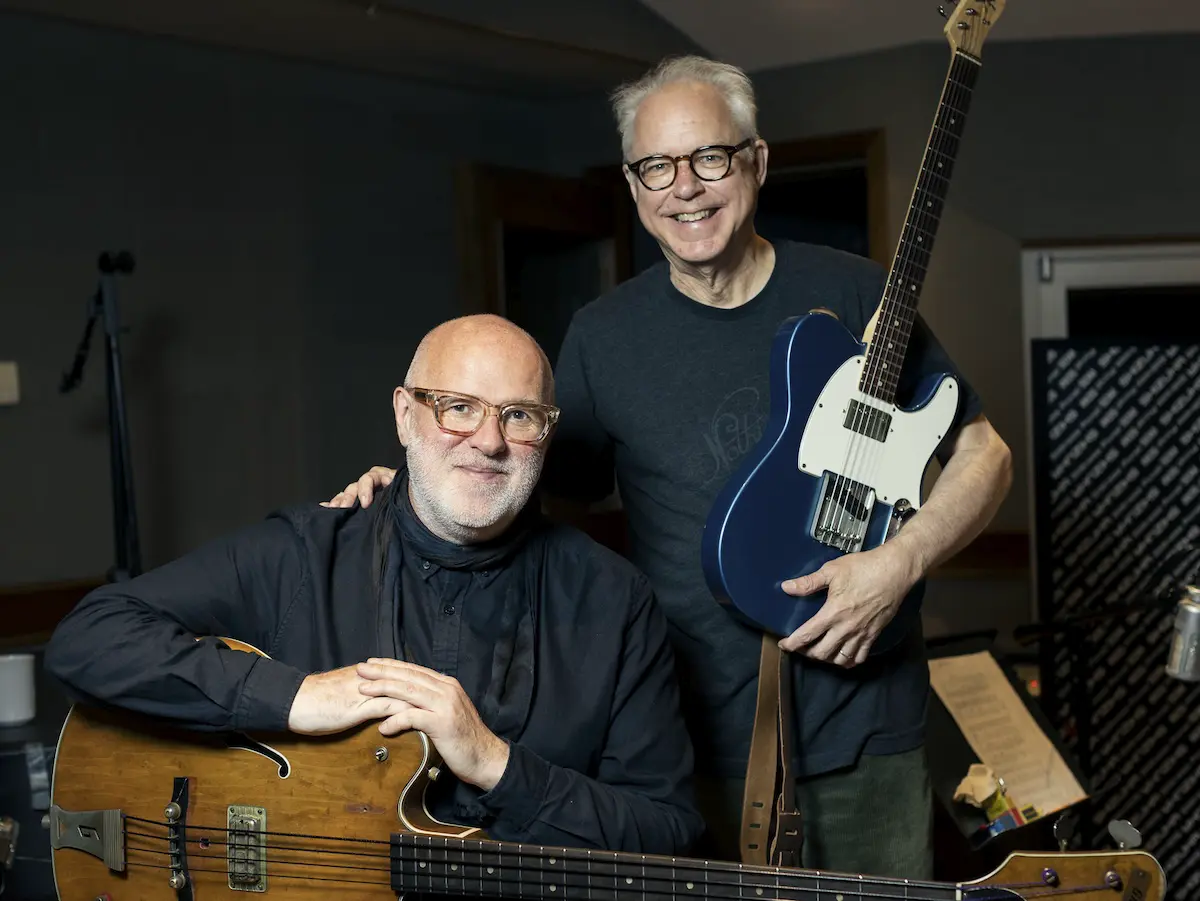
Recent months have witnessed an extraordinary convergence of technical brilliance and compositional ambition within the contemporary guitar world, marked by major new releases from veteran innovators and rising international talents alike. Spanning atmospheric acoustic-electric dialogues, post-bop virtuosity, and progressive fusion infused with Hindustani classical elements, three distinct projects have captured the attention of critics and aficionados. Leading this wave is the subtle yet profound collaboration between Icelandic bassist Skúli Sverrisson and American guitar luminary Bill Frisell on Newvelle Records’ anniversary series. Meanwhile, Czech-born virtuoso Kamila Csenge makes a striking international debut with her quartet, and South London-raised, Sweden-based composer Jay Matharu bridges progressive rock and North Indian microtonality on his latest independent release.
A Dialogue of Elegance: Skúli Sverrisson and Bill Frisell Reconnect
The partnership between Skúli Sverrisson and Bill Frisell represents a masterclass in modern chamber jazz, characterized by an intimate interplay that borders on telepathic. Recorded in New York City in June 2025 and released on Newvelle Records as part of their prestigious Ten Collection—a landmark five-album series pressed on 180-gram vinyl to celebrate the label’s tenth anniversary—For All Your Flowers serves as a testament to the enduring chemistry between the two musicians. The duo previously collaborated eight years prior on the 2017 New York sessions that yielded the acclaimed album Strata, released via Newvelle in 2018.
Reflecting on the unique dynamic of working in a stripped-down duo format, Frisell has frequently emphasized the immediate feedback loop inherent to the setup. Playing alone, the guitarist has noted, offers no return, whereas the presence of even a single responsive collaborator creates an electrical current that immediately pushes the creative process forward like a two-stroke engine. This exact kinetic principle defines For All Your Flowers, where every melodic gesture is met with an instantaneous, complementary reaction.
While Frisell’s iconic status in contemporary jazz is universally acknowledged, Sverrisson brings a staggering resume to the collaboration. Having contributed to over 100 records, the bassist has worked across myriad genres with avant-garde and rock legends alike, including Wadada Leo Smith, Derek Bailey, Lou Reed, Laurie Anderson, David Sylvian, and Ben Monder. Notably, Sverrisson’s extensive discography includes his performance on Allan Holdsworth’s seminal 1993 fusion release, Hard Hat Area.
The tracklist of For All Your Flowers is composed entirely by Sverrisson, with a single exception: Frisell’s own irresistibly lyrical composition, Baby. The resulting compositions—spanning pieces such as Thank You For Taking Me There & Back, A Little Closer, Nowhere To Go, Further Down The Road, Here We Are, Always Late, Always Listening, Please Continue, and Behind The Mountain—are uniformly dreamlike and captivating. A Little Closer evokes a distinct baroque sensibility, while Further Down The Road offers a slow, ruminative sojourn marked by a fragile sonic landscape where the bass and guitar languidly meld into one. The title track provides a rare instance of Frisell employing jangly, lustrous chords, departing from the deft fingerpicking and single-note plucking that anchor tracks like Always Late, Always Listening. Throughout the 36-minute runtime, a sharp sense of counterpoint persists, most notably on the limpid Please Continue, showcasing an album whose primary strength lies in elevating Frisell’s lithe fretwork without ever eclipsing Sverrisson’s warm, resonant low end.
The International Rise of Kamila Csenge on Behind The Universe
Shifting from meditative chamber jazz to high-octane modern electric guitar exploration, Czechia-born Kamila Csenge has delivered an assertive debut statement with Behind The Universe, released via Fat Banshee Records. Csenge’s path to her debut has been defined by rigorous academic and performance credentials. After completing her high school education, she enrolled at the prestigious Jaroslav Ježek Conservatory in Prague, initially focusing on classical and Latin guitar before earning a professional diploma in electric guitar with a specialization in jazz under the tutorship of Lubomír Kocvara.
Seeking to expand her global footprint, Csenge relocated to the United States to attend the Berklee College of Music in Boston, graduating summa cum laude in 2017 with a major in guitar performance. Her academic tenure at Berklee was distinguished by consistent placement on the Dean’s List every semester and the receipt of the John LaPorta Award for outstanding achievement in guitar performance. Prior to recording her debut album, Csenge built a robust performance profile, appearing in international concert halls across New York, Boston, Berlin, and Czechia, while performing at notable grassroots venues such as the Williamsburg Music Center, ShapeShifter Lab, and the New England Guitar Festival.
Behind The Universe introduces Csenge as a player of formidable technical execution and incisive compositional vision. The 37-minute album—comprising The Void, Against The Wall, Music Forever, Guardians Of The Garden, The Metamorphosis, This World, and The Point Of No Return—balances virtuosic pyrotechnics with structural depth. The opening track, The Void, begins with an almost diffident demeanor before erupting into rapid-fire guitar lines. Similarly, Against The Wall relies on a robust, bass-driven opening riff that bridges bright, crystalline chords with volleys of single-note articulation. On Music Forever, an ostinato bass line provides the foundation for Csenge to venture into the upper registers of the fretboard, eliciting a timbre reminiscent of an electric mandolin.
Supported by a dynamic ensemble featuring a second electric guitarist, Yamirah Gercke, bassist Kateřina Vacková, and drummer Ivo Hermanovský, Csenge creates a dense, layered sonic architecture. While the distribution of rhythm and lead duties between the two guitars occasionally creates ambiguity—as heard in the stereo panning on This World—live documentations such as the group’s performance of The Metamorphosis clarify their intricate interplay. The resulting project firmly establishes Csenge as a compelling new voice in contemporary guitar-driven jazz-fusion.
Jay Matharu Blends Progressive Fusion and Hindustani Roots on Disillusion
Exploring the intersection of progressive rock, contemporary jazz, and North Indian classical music, South London-born guitarist and composer Jay Matharu has unveiled his latest independent release, Disillusion. Born in 1981, Matharu’s musical journey has been defined by a sustained commitment to higher education in the arts. He graduated from The Academy of Contemporary Music in Guildford in 2000, subsequently earning a Bachelor of Music (Honours) in Popular Music Performance from the Guitar Institute in London in 2005.
Matharu’s academic pursuits eventually led him to Scandinavia. In 2022, he earned a bachelor’s degree in music pedagogy from the Stockholm Music Pedagogy Institute, culminating in a Master of Fine Arts in Music Performance from Luleå Technical University in 2025. This deep academic background informs the sophisticated structures found across Disillusion, which was recorded across various locations in Sweden and France during the summer and autumn of 2025.
The stylistic breadth of the album is immediately apparent on the opening track, Atrophy. Beginning with a deceptively brief neo-classical solo guitar introduction, the piece quickly pivots into a progressive rock landscape anchored by Christine Lanusse’s sonorous electric bass and Jacob Johnson’s crisp, crackling drum work. The track is further invigorated by Erik Brandell’s searing tenor saxophone, though Matharu’s stentorian guitar remains the focal point. Throughout the album—which features tracks such as Bare, Cog, Deluge, Shruti, Butterflies, Chalo, and the seven-minute blues-infused closer Bittersweet—Matharu demonstrates a rare facility for marrying dense compositional frameworks with visceral execution.
A defining characteristic of Matharu’s musical identity is the incorporation of Eastern influences, cultivated during his upbringing surrounded by Bollywood cinema and further refined in 2009 under the tutelage of Pandit Sanjay Guha, a direct disciple of legendary sitar maestros Deepak Choudhary and Ravi Shankar. This background manifests explicitly on the brief track Shruti, which opens with a sitar-like guitar timbre before seamlessly transitioning into Chalo. The latter track features a rising and falling opening riff propelled by dynamic solos from Matharu and Brandell, subtly honoring the musical traditions of the Indian subcontinent within a modern European fusion context.
Broader Implications and Industry Impact
The simultaneous release of these three works highlights a vibrant, cross-pollinating ecosystem within contemporary guitar music. While major boutique labels like Newvelle continue to invest in high-fidelity vinyl packages celebrating foundational partnerships like Sverrisson and Frisell, independent artists such as Csenge and Matharu are leveraging rigorous international training and cross-cultural influences to push the boundaries of genre.
From the hushed, minimalist interplay of New York’s jazz underground to the progressive fusion laboratories of Scandinavia and the modern academic-performance hubs of Boston and Prague, the guitar remains a vital vehicle for sophisticated artistic expression. These releases collectively demonstrate that whether operating within acoustic-electric intimacy or high-gain progressive complexity, contemporary instrumentalists are continuing to expand the expressive lexicon of the instrument for a discerning global audience.