Aveline Kirana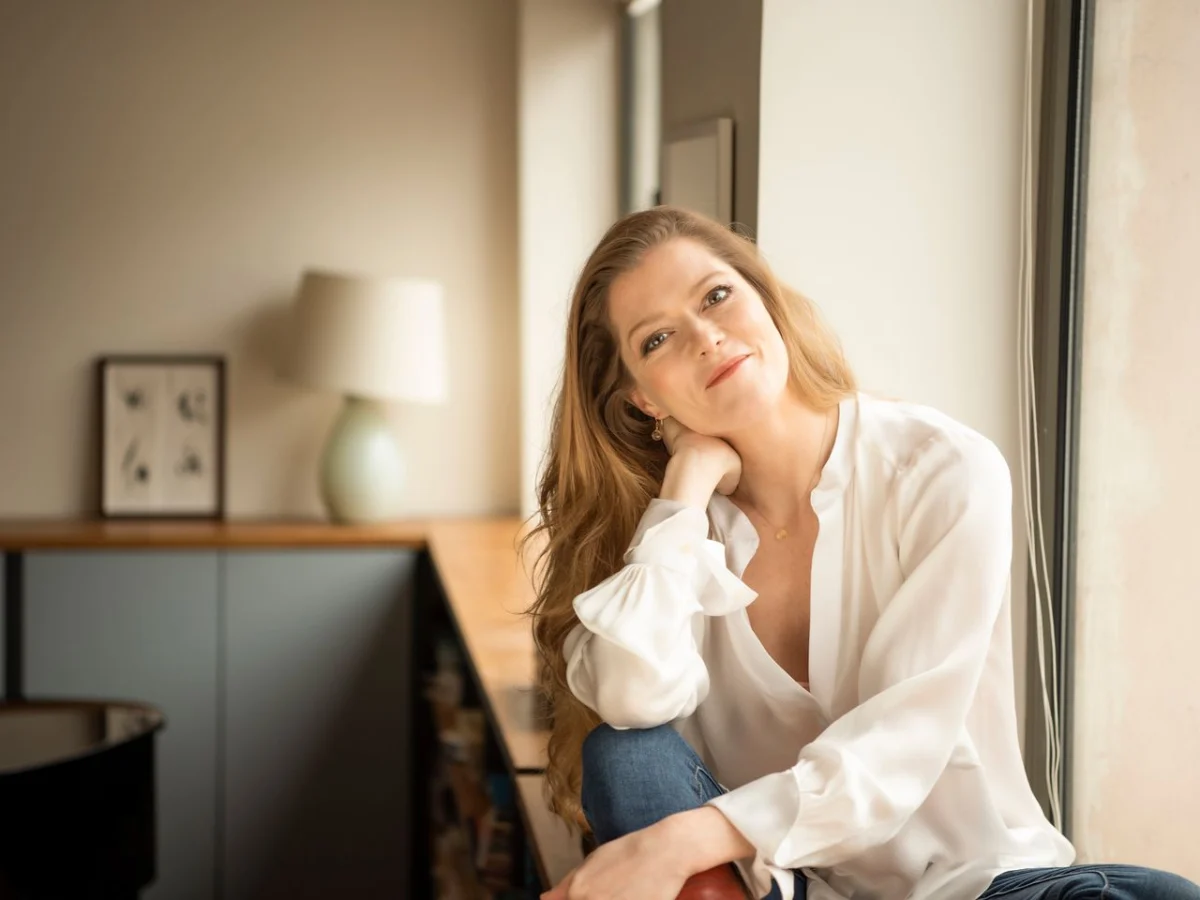
New York, NY – The hallowed stage of Lincoln Center’s David Geffen Hall will witness a singular artistic convergence this weekend as Barbara Hannigan, a luminary of the contemporary opera scene, returns to the New York Philharmonic not merely as a celebrated soprano, but as a multifaceted artist wielding both voice and baton. This highly anticipated engagement features Hannigan at the helm, both vocally and orchestrally, for Francis Poulenc’s psychologically charged one-act opera, “La Voix Humaine” (The Human Voice). The production promises a profound exploration of isolation, obsession, and the fractured nature of modern communication, amplified by Hannigan’s unique approach to performance.
Hannigan’s career, spanning over three decades, has been characterized by an unwavering commitment to artistic innovation and a remarkable ability to forge deep, collaborative relationships with leading figures across the musical spectrum. Her trajectory has seen her ascend to the pinnacle of operatic performance as a soprano renowned for her interpretive depth and vocal agility, particularly in challenging 20th and 21st-century repertoire. Simultaneously, she has emerged as a distinguished conductor, commanding some of the world’s most prestigious orchestras. This dual mastery positions her as one of the most distinctive and influential artists in classical music today, capable of bridging the often-separate worlds of vocal and orchestral direction with unparalleled authority.
The New York Philharmonic holds a significant place in Hannigan’s artistic history. Her previous appearances with the esteemed ensemble include a memorable 2010 performance of György Ligeti’s seminal opera "Le Grand Macabre," under the direction of Alan Gilbert. This was followed by another collaboration with the Philharmonic for Gerard Grisey’s haunting "Quatre Chants pour Franchir le Seuil," also conducted by Gilbert. These prior engagements underscore a developing artistic dialogue between Hannigan and the New York Philharmonic, a relationship now poised to reach a new zenith with this ambitious undertaking.
The Dual Artistry: A Conductor on the Podium, a Soprano in the Narrative
The act of singing and conducting simultaneously presents a formidable artistic challenge, one that Hannigan navigates with an approach she describes as feeling "natural." This demanding synthesis requires a profound bifurcation of cognitive and physical faculties. The artist must maintain an acute awareness of the orchestra’s sonic landscape, anticipating its needs and guiding its collective breath, while simultaneously embodying the complete vocal and theatrical demands of a demanding operatic role.
"To do this, it needs to look and feel natural, which it does, to me," Hannigan explained in a recent interview with OperaWire. "One needs to, in a way, be able to split the brain into seeing/hearing and anticipating what the orchestra needs, as well as maintaining the complete vocal and theatrical delivery of the role." She further posited that this integrated approach can, in fact, streamline the performance process. "I think in one way, it can actually makes everything easier, to eliminate ‘the middle man’ (no offense to conductors, because I love singing with other conductors!), in this particular production." This sentiment highlights her deep understanding of the score and her intrinsic connection to its dramatic arc, allowing for a more immediate and unified artistic expression.
"La Voix Humaine": A Psychological Vortex of Emotion
Poulenc’s "La Voix Humaine," based on Jean Cocteau’s poignant 1930 play, is a masterpiece of dramatic concision. The opera centers on a solitary woman, identified only as "Elle" (She), engaged in a desperate, one-sided telephone conversation with her former lover, who is in the process of leaving her for another. The entire dramatic weight rests on her shoulders, with the orchestra providing a rich, often turbulent, commentary on her unraveling emotional state.
Hannigan’s vision for this production is far from a conventional staging. While she remains stationary on the conductor’s podium, the performance is conceived as a fully staged psychological drama. The presence of three video cameras strategically placed within the orchestra, with which Hannigan interacts, and whose feeds are projected onto a large screen behind the ensemble, transforms the performance space into a dynamic canvas of inner turmoil. This innovative approach creates a "Gesamtkunstwerk" – a total work of art – where the visual, aural, and emotional dimensions are inextricably intertwined.
"This is a fully staged version, except that I stay in one place. On the podium," Hannigan elaborated. "It is a kind of psychological thriller, a vortex that this character goes through as she is dealing with the deep emotions that come with the end of an affair. Because I have the 3 video cameras placed within the orchestra, and am interacting with them (which is seen on the large screen behind the orchestra), as well as interacting with the orchestra…this is, in a very unique way, a full production."
The libretto, drawn from Cocteau’s masterful text, probes the complexities of illusion and reality. Hannigan suggests that "Elle" may be deeply immersed in fantasy, perhaps even imagining the entire scenario, including her performance. "From the text (by the incredible French writer Jean Cocteau), we understand that it may very well be possible that ‘Elle’ is addicted to fantasy. She may be living out this relationship exclusively in her imagination. She speaks about the importance of lies, of fantasy, of living in an imaginary world. She may even imagine she is playing this role while conducting New York Philharmonic!" This layer of meta-theatricality adds a compelling dimension to an already profound work.
The orchestral score itself presents significant challenges, characterized by Poulenc’s signature blend of romantic lyricism and biting wit. Hannigan describes it as "very romantic and lush orchestration," a sonic tapestry that underscores the emotional extremes of "Elle’s" monologue. The vocal demands on the soprano are equally immense, requiring an artist capable of conveying a vast spectrum of human emotion with nuance and power, from desperate longing to incandescent rage.
A Legacy of Collaboration and Artistic Growth
Hannigan’s history with the New York Philharmonic is one built on mutual respect and shared artistic endeavors. "I worked with New York Philharmonic on two occasions," she recalled. "One was in the iconic production of Ligeti’s ‘Le Grand Macabre’ conducted by Alan Gilbert and directed by Doug Fitch. The other was a special event with members of the orchestra with a haunting piece by French composer Gerard Grisey called ‘Quatre Chants pour Franchir le Seuil,’ which Alan also conducted. Both times, working with them was a joy."
Her connection to the orchestra extends beyond these specific performances, representing a lifelong engagement with its musical legacy. "As far as learning from them, this has been life-long, as I have been listening to their recordings since I was a kid." This deep familiarity undoubtedly informs her current role, allowing for an even more profound and intuitive collaboration.
Navigating Repertoire: From Contemporary Avant-Garde to Poulenc’s Emotional Landscape
While widely celebrated for her advocacy and premiere performances of contemporary music, Hannigan’s artistic palate is remarkably broad, encompassing key works from the early 20th century and beyond. Her celebrated interpretations of Alban Berg’s "Lulu" and Claude Debussy’s "Mélisande" stand as testaments to her affinity for psychologically rich and vocally demanding roles. Her previous performance of "La Voix Humaine" at the Paris Opera further solidifies her deep connection to this particular work.
Her conducting repertoire also defies rigid categorization, often juxtaposing established masters with contemporary innovators. "In the case of a score like ‘La Voix Humaine,’ I think Poulenc and Cocteau together were a dream team: the role truly has a very deep dramaturgical insight in the human experience." This appreciation for the profound humanistic qualities within Poulenc’s score, despite its modern context, speaks to Hannigan’s ability to find universal truths in diverse musical languages.
A Thematic Resonance: Strauss’s "Metamorphosen" and Poulenc’s "La Voix Humaine"
The pairing of Richard Strauss’s monumental tone poem "Metamorphosen" with Poulenc’s "La Voix Humaine" is a deliberate and insightful programming choice by Hannigan. Both works, though stylistically disparate, grapple with profound themes of loss, isolation, and the human condition in the aftermath of profound societal upheaval.
Strauss’s "Metamorphosen," composed in the twilight of his life and in the shadow of World War II, is a deeply elegiac work reflecting on the destruction of culture and the weight of memory. Hannigan interprets it as a collective lament. "The Strauss on a collective level. It asks: how did we get here? How did this happen? It looks to the past, and the present (I would not say, to the future)."
In contrast, Poulenc’s opera offers an intensely personal and individual exploration of loss. "The Poulenc is much more individual," Hannigan observes. "The character of ‘Elle’ experiences runs the gamut of raw emotional experience: anger, loss, frustration, madness, and also humour…just as humans sometimes laugh hysterically or make jokes at the most inappropriate times, Elle finds herself being coy or silly in one second, sarcastic or cynical in another, and absolutely heartbroken in the next." This juxtaposition creates a powerful dramatic arc, moving from the grand, elegiac reflections of Strauss to the raw, intimate despair of "Elle," highlighting the pervasive nature of human suffering and resilience.
A Calculated Evolution: The Dual Path of Soprano and Conductor
Hannigan’s emergence as a conductor was not an immediate trajectory but rather a considered evolution that unfolded organically as her established career as a soprano matured. "When I started, no, I didn’t imagine this," she admitted. "I was concentrating on singing. It was not until I was in my 30s, once my vocal career was well and truly established and I had developed trust and relationship on an international scale, that other conductors, musicians and orchestral managers were suggesting that I ‘try my hand’ literally."
The pivotal moment came with an invitation to conduct at the Chatelet in Paris in 2011. This initial foray proved successful and illuminated a new artistic avenue. "After that, it was clear that it was something to be explored further, so I began to make time for it, in tandem with an already-full calendar as a soprano soloist." Today, Hannigan has achieved a remarkable balance, allowing her to dedicate her time to conducting, singing, or a combination of both, depending on the artistic imperative. "Now I divide my time as I wish. Sometimes I only conduct. Sometimes I only sing. Sometimes…I do both. And only with pieces where I feel it makes absolute sense, from both a musical and dramatic perspective." This deliberate approach ensures that each artistic endeavor, whether as soprano or conductor, is rooted in a profound understanding of its dramatic and musical integrity.
The Advantage of Self-Conducting: An Adventure in Collaboration
The unique act of conducting oneself on stage is, for Hannigan, an exercise in continuous artistic challenge and exhilarating discovery. It fosters a heightened sense of awareness and an intensified level of collaboration with the orchestra. "It is always an adventure, it is an enormous challenge not just for me but for my colleagues in the orchestra, it is fun, it makes us listen and collaborate in a different way than we are used to."
This approach pushes the boundaries of conventional performance, demanding a greater degree of mutual listening and responsiveness between the conductor-soprano and the orchestral musicians. It is a testament to Hannigan’s philosophy that every artistic undertaking, from the most intimate vocal warm-up to a grand orchestral performance, presents an opportunity for growth and exploration. Her return to the New York Philharmonic in this dual capacity is not merely a performance but a bold statement about the evolving possibilities of artistic expression in the 21st century.