Johan Budi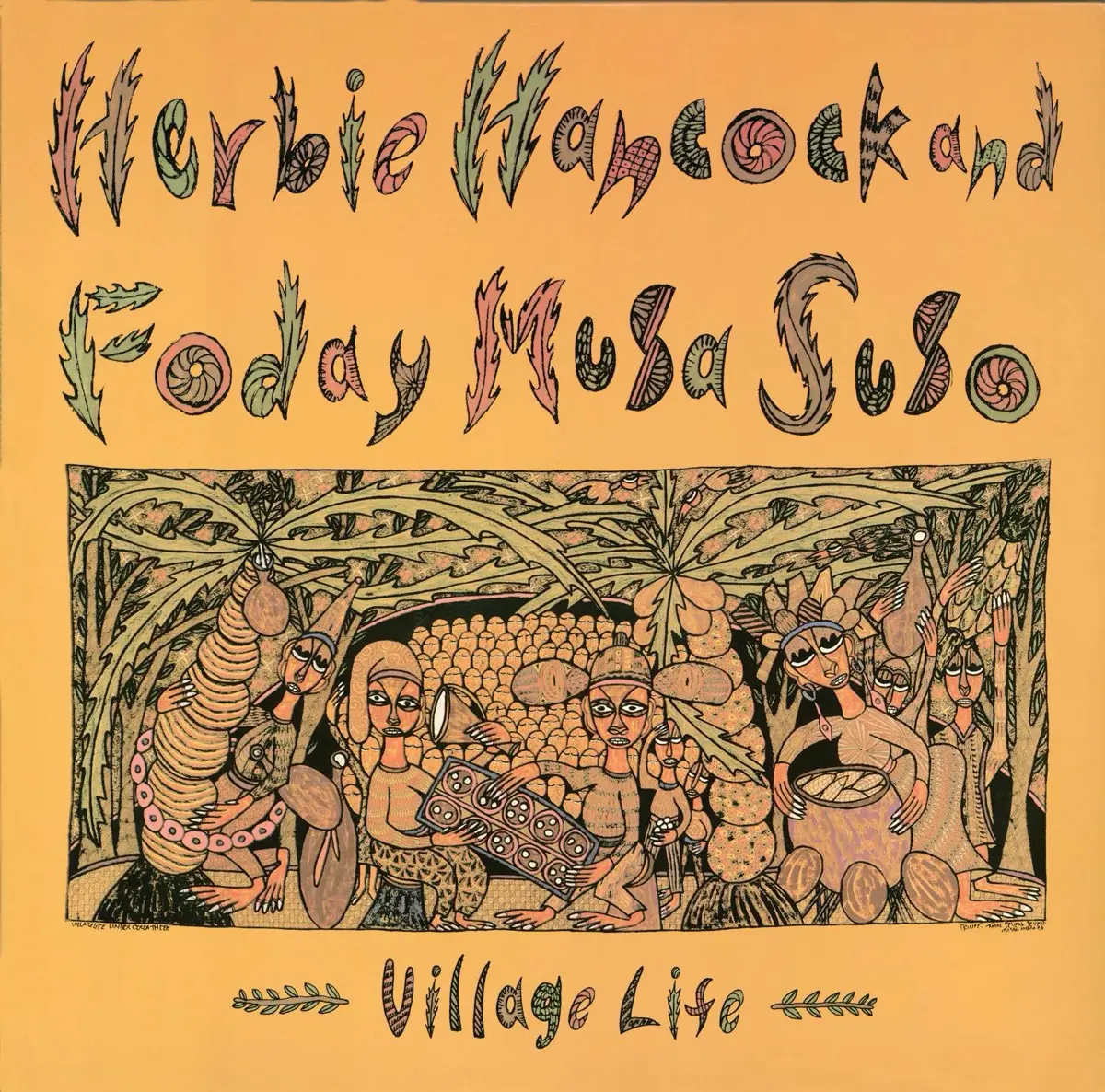
Village Life, the 1985 collaborative album between American jazz visionary Herbie Hancock and Gambian kora virtuoso Foday Musa Suso, stands as a significant, if polarizing, milestone in the evolution of cross-cultural musical synthesis. Released on the CBS label, the project arrived during a period of intense technological transition in the music industry, capturing a unique dialogue between the ancient traditions of the Mandinka griots and the burgeoning digital capabilities of mid-1980s synthesizers. Recorded over three days in August 1984 at CBS/Sony Studios in Tokyo, Japan, the album consists of four extended tracks that eschew the aggressive funk and high-speed fusion of Hancock’s previous work in favor of a minimalist, consonant exploration of rhythm and melody.
The Socio-Technical Context of 1984
To understand the production of Village Life, one must examine the state of Herbie Hancock’s career and the global music landscape in the mid-1980s. Following the massive commercial success of the 1983 album Future Shock and its hit single "Rockit," Hancock had become a central figure in the integration of electronic music and popular culture. While "Rockit" introduced the world to "scratching" and hip-hop aesthetics through a jazz lens, Village Life saw Hancock pivoting toward a more contemplative and acoustic-digital hybrid.
During this era, the "World Music" marketing category was beginning to solidify in the West. Audiences were increasingly exposed to non-Western instruments through collaborations facilitated by producers like Bill Laswell, who had introduced Hancock to Suso. Foday Musa Suso, a hereditary griot from Gambia and founder of the Mandingo Griot Society, brought the kora—a 21-stringed harp-lute—into a contemporary setting. The kora’s complex, cascading arpeggios provided a rhythmic and melodic framework that differed fundamentally from the Western tempered scale and traditional jazz harmonies.
Chronology of the Recording and Production
The recording of Village Life took place between August 7 and August 9, 1984. This short window reflects the improvisational nature of the collaboration. Unlike the meticulously layered productions of Hancock’s Sound-System (released the same year), Village Life was a more direct interaction between two performers.
- Preparation (Early 1984): Hancock and Suso began performing together in live settings, testing the compatibility of the Yamaha DX7 synthesizer with the kora.
- The Tokyo Sessions (August 1984): The duo utilized the advanced facilities of CBS/Sony in Tokyo. Hancock focused on the Yamaha DX7 and the RX-11 drum machine, attempting to program sounds that complemented the kora’s organic timbre.
- Post-Production and Release (1985): The album was mixed and released globally, marketed as a sophisticated blend of "Third World" tradition and high-tech futurism.
The technical setup was remarkably sparse for a Hancock production. The Yamaha DX7, a digital synthesizer that defined the sound of the 80s through Frequency Modulation (FM) synthesis, allowed Hancock to mimic bell-like tones and percussive textures. By pairing this with Suso’s kora and talking drum, the duo created a sonic environment that was almost entirely devoid of the "grit" found in Hancock’s earlier Blue Note or Headhunters-era recordings.
Technical Analysis of the Compositions
The album is structured around four pieces: "Moon/Light," "Ndan Ndan Nyaria," "Early Warning," and "Kanatente." These tracks are characterized by their length and their reliance on repetitive, interlocking patterns.
The Kora as a Lead Instrument
In tracks like "Moon/Light" and "Ndan Ndan Nyaria," Suso’s kora is the dominant voice. The instrument is traditionally played using only the thumb and index finger of each hand, allowing for a continuous stream of notes that function as both melody and accompaniment. On Village Life, Suso utilizes the kora’s diatonic nature to create a "shamelessly consonant" soundscape—one that avoids the chromaticism and dissonance typically associated with Hancock’s jazz background.
Hancock’s Synthesized Accompaniment
Hancock’s role on the album is largely supportive, a departure from his reputation as a virtuosic soloist. On "Early Warning," the most "grooving" track on the record, Hancock utilizes the Yamaha RX-11 drum machine to provide a steady, albeit rigid, pulse. His synthesizer work often mimics the kora’s patterns, creating a shimmering, layered effect. In the nearly 20-minute "Kanatente," Hancock provides a classically-influenced introduction that briefly suggests his extensive training in Western piano before settling into the elemental vernacular of Suso’s griot style.
Musicological Comparisons: Minimalism and Consonance
The repetitive structures of Village Life have led musicologists to compare the work to the minimalist movement spearheaded by composers such as Steve Reich and Philip Glass. Reich’s "Music for 18 Musicians" and Suso’s kora patterns share a fundamental reliance on "bright consonance" and rhythmic displacement.
However, critical analysis often points to a key distinction: while Reich’s minimalism relies on the evolution of patterns through mathematical shifting, the patterns on Village Life are more static. This has led to a divided reception. Some listeners find the lack of "drama" or "dissonance" to be a refreshing departure into a meditative state, while others, accustomed to the tension and release of jazz, have characterized the sound as "insipid" or "flat."
The album’s adherence to a single emotional and harmonic register challenges the traditional art-music dictate that monotony is a "sin." Instead, it leans into the West African tradition where repetition serves a communal and narrative purpose, rather than a purely structural one.
Industry and Critical Reception
Upon its release, Village Life received a spectrum of reviews that highlighted the growing pains of the burgeoning "World Music" genre.
- Positive Reception: Many critics praised the album for its transparency and for Hancock’s willingness to cede the spotlight to a non-Western tradition. It was seen as a respectful collaboration that did not "Westernize" the African elements but rather "Africanized" the electronic elements.
- Critical Skepticism: Conversely, some jazz purists and critics felt the album lacked the intellectual rigor of Hancock’s previous work. The "strong Third World connection" was viewed by some as a marketing tactic that appealed to a certain "exoticism" in the mid-80s listener, rather than a genuine musical breakthrough.
Data from the era suggests that while the album did not reach the chart-topping heights of Future Shock, it performed well within the jazz and "New Age" charts, a testament to its crossover appeal. The collaboration also solidified Foday Musa Suso’s reputation in the West, leading to his further work with Philip Glass and the Kronos Quartet.
Broader Impact and Historical Implications
The legacy of Village Life is found in its role as a precursor to the "global fusion" movement. It demonstrated that electronic instruments could be used to enhance, rather than replace, traditional acoustic instruments from non-Western cultures.
Bridging the Digital-Acoustic Divide
The album was one of the first high-profile examples of MIDI (Musical Instrument Digital Interface) technology being used to interact with traditional music. Although the kora was not MIDI-equipped, Hancock’s ability to synchronize his digital pulse with Suso’s manual performance set a template for future experiments in world-fusion production.
Cultural Exchange vs. Appropriation
Village Life is often cited as a model for ethical cultural exchange. By listing Suso as an equal collaborator and focusing the album’s sound around the kora, Hancock avoided the pitfalls of "musical tourism." The project was a dialogue between two masters of their respective crafts, rather than a superstar using a "foreign" sound as mere window dressing.
Influence on Hancock’s Future Work
The minimalist and global sensibilities found in Village Life would eventually resurface in Hancock’s later projects, such as The Imagine Project (2010), where he collaborated with artists from across the globe. It marked the beginning of Hancock’s transition from a "jazz-funk" innovator to a "global musical ambassador."
In conclusion, Village Life remains a unique artifact in the discography of Herbie Hancock. While it may lack the aggressive complexity of his early jazz-rock or the intellectual density of his post-bop era, its value lies in its stillness and its commitment to a shared musical language. It serves as a reminder of a period when the digital future and the ancestral past met in a Tokyo studio to explore the possibilities of a "village" without borders. For the collector and the historian, the album represents a bold experiment in consonance that continues to inform the way Western and non-Western musics interact today.