Johan Budi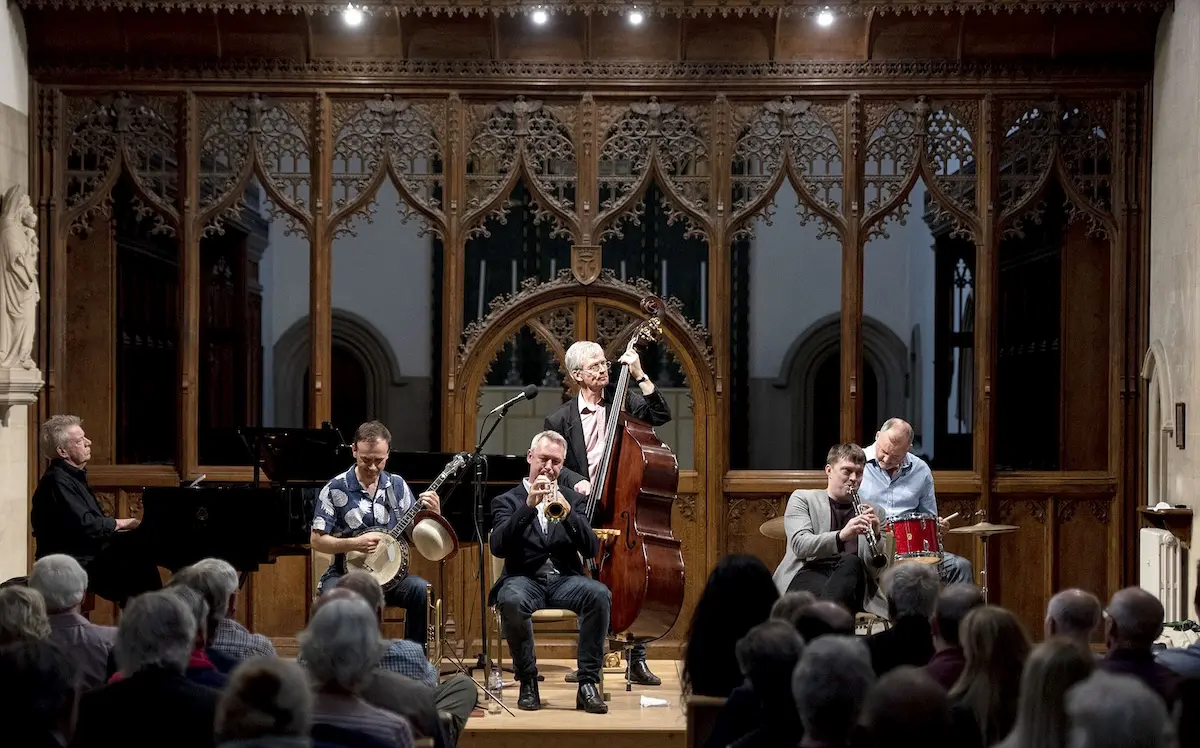
The Preservation of the New Orleans Sound: Alyn Shipton and the George Lewis Legacy
The recording of Alyn Shipton’s New Orleans Friends at the Church of St. Giles in Oxford on May 11, 2024, is more than a mere concert document; it is a deliberate exercise in musicological reconstruction. The ensemble was founded seven years ago by Shipton, a renowned jazz historian and BBC Radio 3 broadcaster, with the specific intent of honoring the musical language of George Lewis. Lewis, a clarinetist who became a central figure in the New Orleans jazz revival of the 1940s and 50s, represented a style of playing that was already considered "traditional" during his own lifetime.
The New Orleans Friends operate within a specific niche, focusing almost exclusively on material associated with Lewis’s repertoire. This dedication to a singular influence allows the ensemble to achieve a level of stylistic cohesion rarely found in modern "trad" groups. The ensemble consists of a two-piece frontline and a four-piece rhythm section, a configuration that mirrors the small-group dynamics of the early "jass" era.
Chronology of the Oxford Performance and Historical Roots
The Oxford concert captures a specific moment in the timeline of the New Orleans revivalist movement. To understand the significance of this recording, one must look back to 1895, the year often cited as the birth of jazz in New Orleans. While modern jazz has evolved through bebop, cool jazz, and fusion, the New Orleans Friends seek to replicate the "time-capsule" sound of the Crescent City.
- 1895–1920: The formative years of New Orleans jazz, characterized by collective improvisation and a rhythmic foundation influenced by ragtime and blues.
- 1940s: The "New Orleans Revival" brings musicians like George Lewis and Bunk Johnson to international prominence, reacting against the perceived commercialization of the Swing Era.
- 2017: Alyn Shipton forms the New Orleans Friends to preserve the specific technical nuances of the Lewis sound.
- May 11, 2024: The ensemble records "The Oxford Concert" at St. Giles, utilizing the natural acoustics of the historic venue to capture the unamplified warmth of the instruments.
Technical Analysis of the Ensemble
The authenticity of the recording is bolstered by the pedigree of its members. Tom Sancton, the group’s clarinetist, provides a direct link to the source material. A native of New Orleans and a former editor for Time magazine, Sancton actually studied the instrument under George Lewis himself. His playing reflects the woody, emotive tone that Lewis was famous for, particularly on tracks like "Jerusalem Blues" and "Precious Lord."
The rhythm section—comprising Shipton on bass, Simon Picton on banjo, Martin Litton on piano, and Trevor Richards on drums—eschews the modern tendency toward complex polyrhythms in favor of the steady, driving "four-to-the-bar" pulse essential to the genre. The inclusion of the banjo is a specific nod to the pre-electric guitar era, providing a percussive harmonic foundation that defines the New Orleans aesthetic.
Jack Wood and the Revival of the Mid-Century Vocal Tradition
Parallel to the traditionalist efforts of Shipton’s ensemble is the work of Jack Wood, a vocalist whose latest release, For Ev’ry Man There’s A Woman, continues his exploration of the Great American Songbook. With eleven albums now to his credit, Wood has established a reputation for unearthing "lost" standards—songs that were popular during the first half of the 20th century but have since fallen out of the common jazz rotation.
Supporting Data: The Songbook and Cinema History
Wood’s repertoire on this album is heavily informed by the golden age of Hollywood and Broadway. The title track, "For Ev’ry Man There’s A Woman," was composed by Harold Arlen and Leo Robin for the 1948 film Casbah. Despite its initial popularity, the song has seen few contemporary recordings, making Wood’s rendition a significant archival contribution.
Other notable inclusions on the album provide a data-rich map of mid-century popular music:
- "Ruby": Originally the theme from the 1953 film Ruby Gentry, the song was a hit for instrumentalists Les Baxter and Richard Hayman, but Wood’s vocal version draws inspiration from the soulful interpretation popularized by Ray Charles.
- "Two For The Road": A 1967 composition by Henry Mancini and Leslie Bricusse, representing the later end of the traditional pop spectrum.
- "The More I See You": A Harry Warren and Mack Gordon classic from 1945, which has transitioned from a film song (Billy Rose’s Diamond Horseshoe) to a jazz standard.
Production and Personnel
The album For Ev’ry Man There’s A Woman features a rotating cast of 28 musicians, a scale of production that is increasingly rare in the independent jazz market. The recording sessions, likely taking place in California circa 2024–2026, utilize a variety of configurations, from intimate trios to the full-scale Jerry Floor Salt Lake Jazz Orchestra.
While the album credits a wide array of talent—including notable names like guitarist John Pisano and saxophonist Pete Christlieb—the core of the sound is built around the Lenore Raphael Trio. Raphael’s piano work provides a sophisticated, harmonically rich backdrop for Wood’s baritone, which critics have described as being "out of the right bottle"—a reference to the classic, well-aged quality of his vocal delivery.
Comparative Analysis: Two Approaches to Jazz History
While the New Orleans Friends and Jack Wood operate in different sub-genres, they share a common objective: the rejection of "jazz" as a purely abstract or academic exercise.
Authentic "Jass" vs. Sophisticated Standard
The New Orleans Friends focus on "jass" (the original spelling), which is communal, raw, and rooted in the spirituals and marches of the 19th century. Their discography on the Oxford album includes "Just A Closer Walk" and "The Old Rugged Cross," highlighting the deep connection between New Orleans jazz and the church. The recording is live, capturing the spontaneity and the imperfections that contribute to the "authentic" experience.
In contrast, Jack Wood’s work is a product of the studio, where precision and arrangement take precedence. His focus is on the "Standard," a form of music that was designed for mass consumption via radio and film but possessed enough harmonic depth to be adopted by jazz musicians. Wood’s approach is scrupulous, treating the lyrics and melodies with a reverence that avoids the over-embellishment often found in contemporary jazz singing.
Broader Impact and Implications for the Jazz Industry
The release of these two albums suggests a "quiet revolution" within the jazz community. As major festivals and labels increasingly pivot toward genre-bending acts that incorporate hip-hop, electronic, and world music elements, there remains a dedicated infrastructure for traditionalism.
Market Trends and Audience Demographics
Data from streaming platforms and physical sales indicates that while "Modern Jazz" (including sub-genres like Jazz-Hop) commands a younger demographic, "Traditional Jazz" and "Vocal Standards" maintain a loyal, older audience that prioritizes high-fidelity recordings and physical media (CDs and Vinyl). Labels like Jazz Hang Records and BCLB cater to this market, which values the historical lineage of the music.
The Role of Broadcasters and Historians
The involvement of figures like Alyn Shipton is crucial for the survival of these genres. By leveraging his platform at the BBC, Shipton ensures that the history of musicians like George Lewis is not relegated to archives but remains a living, performing tradition. Similarly, vocalists like Jack Wood act as curators, ensuring that the work of composers like Harold Arlen and Harry Warren remains in the public consciousness.
Conclusion: The Continuity of the Jazz Spectrum
The Oxford concert by Alyn Shipton’s New Orleans Friends and Jack Wood’s For Ev’ry Man There’s A Woman provide a comprehensive look at the state of traditional jazz in the mid-2020s. One captures the heat and collective energy of a live performance in a sacred space, while the other offers a polished, cinematic journey through the history of American song.
Both recordings argue that the future of jazz is inextricably linked to its past. By respecting the pioneers of 1895 and the masters of the mid-century, these artists provide an essential service to the musical landscape. They remind listeners that before jazz was a subject of academic study or a platform for experimentalism, it was a music of celebration, storytelling, and profound cultural connection. As these albums circulate among enthusiasts and historians, they reinforce the idea that the "jazz spectrum" is wide enough to accommodate both the radical new and the timeless old.