Johan Budi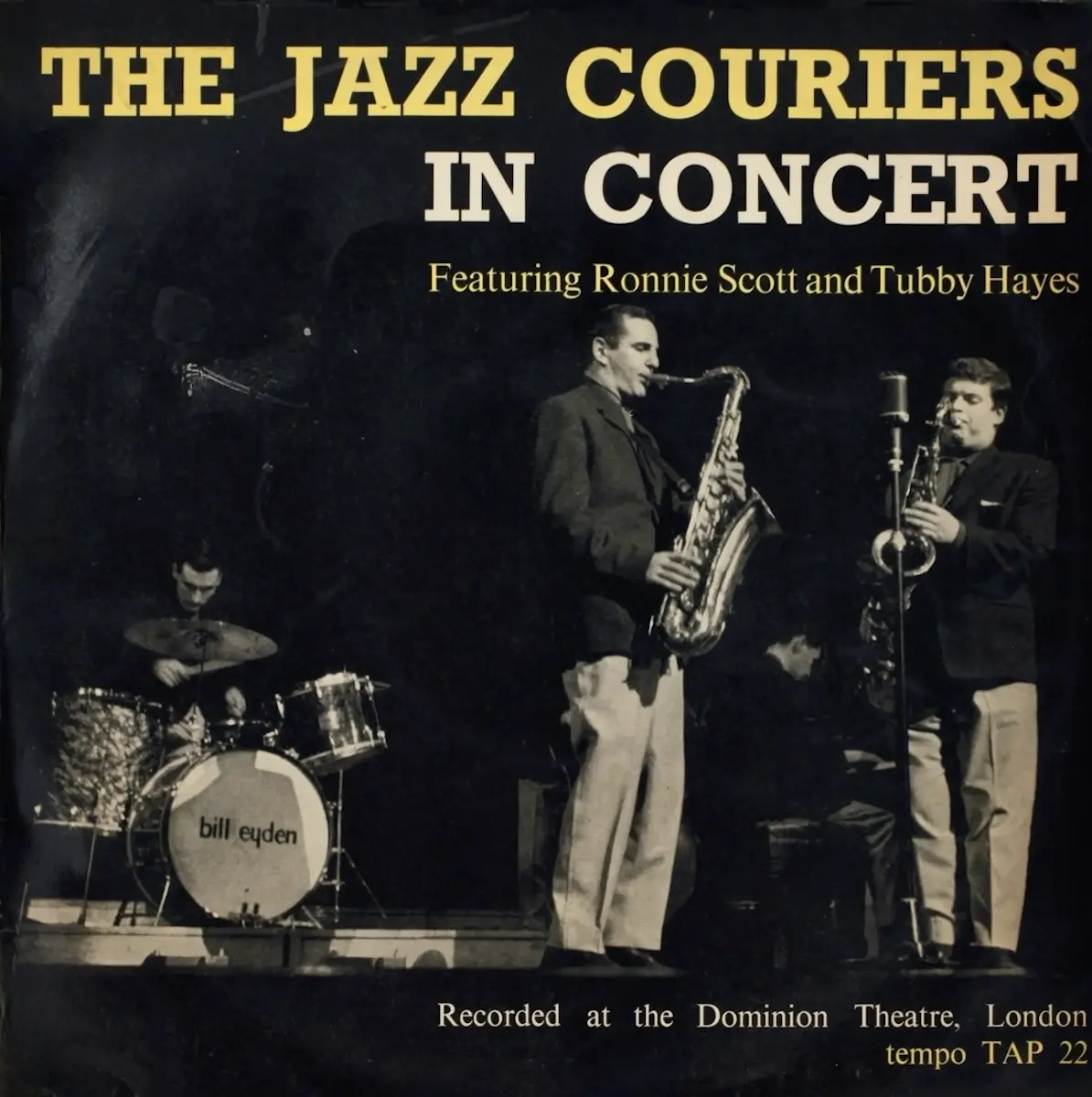
The recording of The Jazz Couriers in concert on February 16, 1958, remains a landmark documentation of what is widely considered one of the most musically proficient ensembles in the history of British jazz. Captured during a high-profile tour where the group shared the billing with the Dave Brubeck Quartet, the performance serves as a testament to the technical virtuosity and creative synergy of the quintet led by tenor saxophonists Tubby Hayes and Ronnie Scott. Released on the Music For Pleasure (MFP 1072) label, the album comprises seven tracks that highlight the group’s command of the hard bop idiom, a style that was then dominating the American jazz landscape.
The ensemble featured a formidable lineup: Tubby Hayes and Ronnie Scott on tenor saxophones (with Hayes also doubling on vibraphone), Terry Shannon on piano, Phil Bates on double bass, and Bill Eyden on drums. The 1958 recording caught the band at the height of its powers, demonstrating an agility and harmonic sophistication that many contemporary critics noted was equal to, if not greater than, that of the American musicians touring Europe at the time.
Historical Context: The 1958 British Jazz Landscape
To understand the significance of this recording, one must look at the state of British jazz in the late 1950s. For decades, a restrictive agreement between the British Musicians’ Union and the American Federation of Musicians had severely limited the ability of American jazz artists to perform in the United Kingdom. This "ban" was finally eased in the mid-1950s, leading to a series of "exchange" tours.
The 1958 tour featuring the Dave Brubeck Quartet and The Jazz Couriers was a pivotal moment in this era of cultural exchange. While Brubeck was an international superstar, the Jazz Couriers represented the vanguard of the "Modernist" movement in London. Formed in April 1957, the Couriers were a deliberate attempt to move away from the traditional "trad" jazz that had dominated British airwaves and toward the more aggressive, intellectually stimulating sounds of bebop and hard bop.
The partnership between Ronnie Scott and Tubby Hayes was the central pillar of the group. Scott was already an established figure and a veteran of the "Geraldo’s Navy" era, where British musicians worked on transatlantic liners to visit New York and hear the latest jazz developments firsthand. Hayes, a decade younger, was a child prodigy whose technical speed and stamina were becoming legendary. Together, they created a "two-tenor" front line inspired by American pairings like Al Cohn and Zoot Sims, but with a uniquely British intensity.
Chronology of the Recording and Performance
The performance documented on this album took place on February 16, 1958, in London. This date fell during the middle of the Brubeck tour, a period when the Couriers were playing nightly to large, expectant audiences. The pressures of sharing a stage with a world-renowned American act served to sharpen the group’s execution.
Observers of the 1958 tour frequently reported that the Jazz Couriers often "carved"—or outperformed—the American headliners in terms of sheer energy and improvisational fire. The recording balance of the era, while sometimes favoring the front line, successfully captures the "crackling form" of the quintet. The setlist chosen for the concert was a mix of standards and original arrangements, designed to showcase the diverse talents of the individual members, particularly Hayes’s ability to switch between saxophone and vibraphone.
Following the conclusion of the tour and the release of subsequent recordings, the Jazz Couriers continued to perform until 1959. The dissolution of the band coincided with Ronnie Scott’s decision to open his own jazz club in Soho, an establishment that would become the epicenter of the genre in Europe.
Track-by-Track Analysis and Musical Composition
The album is divided into two distinct halves, totaling approximately 40 minutes of music. The repertoire reflects the sophisticated yet accessible nature of the band’s programming.
Side One: Technical Precision and Harmonic Depth
The opening track, "What Is This Thing Called Love?", serves as a high-speed vehicle for the two tenors. The interplay between Scott and Hayes is characterized by rapid-fire exchanges and a shared sense of timing. This is followed by "Some Of My Best Friends Are Blues," a track that allows for a deeper exploration of blues phrasing and melodic development.
The third track on the first side, "The Serpent," is a 19-minute sprawling epic (as presented in some discographies of the session) that showcases the group’s ability to maintain tension and narrative flow over an extended duration. It highlights the rhythm section’s role in providing a stable yet flexible foundation for the soloists.
Side Two: Versatility and Featured Solos
The second half of the recording begins with "Guys And Dolls," a track frequently cited as a standout performance. The arrangement breathes new life into the show tune, transforming it into a sophisticated hard bop anthem. "Time Was" follows, serving as a feature for Tubby Hayes on the vibraphone. Hayes’s transition to the vibes was more than a mere novelty; he played the instrument with a percussive clarity that provided a textural contrast to the heavy tenor front line, preventing the "monotony" that often plagued other two-tenor groups.
"Speak Low" offers a showcase for Ronnie Scott’s tenor work. Scott’s style was often described as more measured and lyrical compared to Hayes’s more exuberant approach, and this track highlights his ability to navigate complex chord changes with grace. The set concludes with "Cheek To Cheek," a blistering finale that reinforces the band’s reputation for technical agility.
Personnel and Technical Performance Data
The effectiveness of the Jazz Couriers was not solely dependent on the two leaders; the rhythm section played a critical role in the group’s success.
- Terry Shannon (Piano): Shannon was a cornerstone of the 1950s London jazz scene. His playing on this album is characterized by a strong rhythmic pulse and a "funky" sensibility influenced by Horace Silver. His solos are concise and harmonically inventive.
- Phil Bates (Bass): Bates provided the necessary "walking" bass lines that anchored the fast tempos favored by Hayes and Scott. His intonation and timing were essential for the band’s cohesive sound.
- Bill Eyden (Drums): Eyden’s performance on this recording has been the subject of some debate among jazz historians. While his drive was undeniable, some contemporary reviews noted that the drumming occasionally seemed "busy" or "over-done." However, modern analysis suggests this may have been a result of the recording balance and the placement of microphones in a live concert setting rather than a deficiency in Eyden’s technique. Eyden would later go on to achieve mainstream fame as the drummer on Procol Harum’s "A Whiter Shade of Pale."
Critical Reception and Industry Impact
Upon its release and in subsequent reissues, The Jazz Couriers In Concert received high praise for its preservation of a peak moment in British music. At the time of the 1958 tour, the recording was seen as a "fine souvenir" of a group that was rapidly becoming a national pride.
The broader implication of this recording was the realization that British jazz had matured. The Jazz Couriers were not merely imitating American models; they were expanding upon them. The agility shown by Hayes and Scott was often compared favorably to the "newer American tenor players" of the late 50s, many of whom were moving toward a more experimental or "cool" style that lacked the visceral excitement of the Couriers’ hard bop.
The album also served as a calling card for British jazz in the international market. There were frequent calls for the album to be issued in the United States, as critics believed the sheer quality of the musicianship would make a significant impression on American audiences and challenge the assumption of American stylistic hegemony.
Legacy and Influence on the British Jazz Scene
The Jazz Couriers’ existence was relatively brief, lasting only about two years, but their impact was profound. The 1958 concert recording remains one of the few high-quality live documents of the group. It captured a specific cultural moment when the British "modernists" successfully asserted their identity on the world stage.
The group’s legacy is twofold. First, it established Tubby Hayes as an international star. Hayes would later go on to record in New York with American legends like Clark Terry and Roland Kirk, proving that the technical standards set during the Jazz Couriers era were world-class. Second, the group’s success provided Ronnie Scott with the momentum and capital to establish his jazz club in 1959. Ronnie Scott’s Jazz Club would eventually host nearly every major figure in jazz history, but its roots were firmly planted in the success of the Jazz Couriers.
The Music For Pleasure release (MFP 1072), though a budget-priced record at the time (retailing for 12s. 6d.), ensured that this music reached a wide audience, cementing the Jazz Couriers’ place in the canon of great British bands. Today, the recording is analyzed by musicologists as a quintessential example of the 1950s "London Sound"—a blend of high-speed technical proficiency, deep blues feeling, and a sophisticated approach to the Great American Songbook.
In conclusion, The Jazz Couriers In Concert is more than just a live album; it is a historical document of a period when British jazz came of age. Through the virtuosic playing of Hayes and Scott and the unwavering support of Shannon, Bates, and Eyden, the recording proves that in February 1958, some of the most vital jazz in the world was being played not in New York or Chicago, but on the concert stages of London.