 Johan Budi
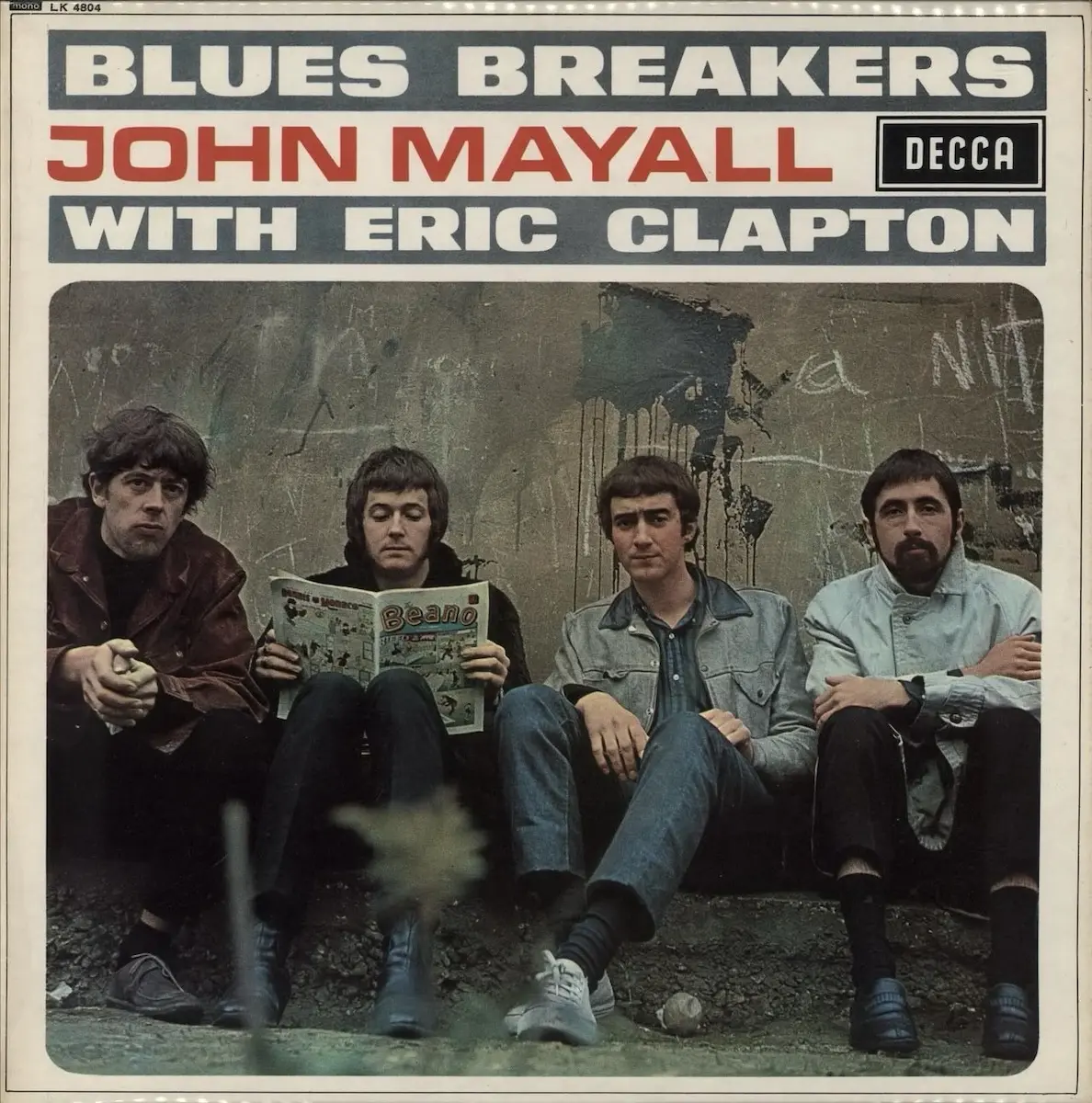
Sixty years have passed since the original publication of David Illingworth’s October 1966 review in Jazz Journal, a critique that evaluated John Mayall, Eric Clapton, and their landmark Decca release against the towering legacy of American blues originators. At the time of its release, Blues Breakers with Eric Clapton—frequently referred to as the "Beano" album due to the comic book Clapton is reading on the cover—was assessed by contemporary critics as a competent, if derivative, entry in the burgeoning British blues boom. Looking back from a modern vantage point, the initial skepticism captured in 1966 highlights a fascinating disconnect between contemporary critical reception and the subsequent historical canonization of what would become one of the most influential guitar albums in rock history.
The Main Facts Surrounding the 1966 Release
Released in the United Kingdom in July 1966 on the Decca Records label (catalog number LK 4804), Blues Breakers with Eric Clapton was recorded between March and May 1965 at Decca Studios in West Hampstead, London, under the production guidance of Mike Vernon and engineering by Gus Dudgeon. The core lineup featured bandleader John Mayall on vocals, organ, piano, and harmonica; Eric Clapton on lead guitar; John McVie on bass guitar; and Hughie Flint on drums. Select tracks expanded the ensemble to include horn players John Almond on baritone saxophone, Alan Skidmore on tenor saxophone, and Dennis Healey on trumpet.
The album’s repertoire consisted primarily of high-energy covers of American blues standards, including Otis Rush’s "All Your Love," Freddie King’s instrumental "Hideaway," Ray Charles’s "What’d I Say," and Robert Johnson’s "Ramblin’ On My Mind," alongside original compositions penned by Mayall. Notably, the recording served as Clapton’s primary vehicle for showcasing a searing, aggressive guitar tone achieved by plugging a Gibson Les Paul Standard into a cranked Marshall model JTM45 combo amplifier. This technical pairing produced a warm, overdriven sustain that fundamentally reshaped the sonic expectations of electric guitar playing in popular music.
Chronology of the British Blues Explosion and the Making of the Album
The genesis of the album can be traced to the vibrant, subterranean rhythm-and-blues club circuit of early-1960s London. Alexis Korner’s Blues Incorporated, formed in 1961, established the template for white British musicians to interpret the Chicago and Mississippi Delta blues traditions pioneered by Chess Records artists. John Mayall, a seasoned multi-instrumentalist from Manchester, relocated to London in 1963 and formed the Bluesbreakers, establishing his ensemble as a revolving finishing school for ambitious young blues instrumentalists.
Eric Clapton joined Mayall’s Bluesbreakers in April 1965 following his departure from The Yardbirds, a band that was beginning to embrace a more commercial pop-oriented sound on singles like "For Your Love." Dissatisfied with this shift away from purist blues orthodoxy, Clapton sought out Mayall, whose uncompromising dedication to authentic Chicago blues provided an ideal platform.
The recording sessions in the spring of 1965 captured a transient moment in British music history. Shortly after completing the album sessions, Clapton briefly left the band in the summer of 1965 to travel to Greece, returning later that year before permanently exiting in July 1966 to form Cream alongside Jack Bruce and Ginger Baker. Consequently, by the time David Illingworth’s review appeared in the October 1966 issue of Jazz Journal, Clapton had already moved on to psychedelic and hard blues-rock experimentation, leaving the Bluesbreakers behind to continue their tradition of rotating personnel, which would soon introduce guitarists Peter Green and Mick Taylor to the public eye.
Supporting Data and Contemporary Critical Perspectives
To understand the context of Illingworth’s 1966 critique, one must examine the prevailing critical attitudes of jazz and blues journalists during the mid-1960s. British music criticism was heavily anchored in jazz journalism, where authenticity was frequently measured by direct lineage to African American originators. Reviewers often viewed white British practitioners as enthusiastic mimics rather than genuine innovators.
Illingworth’s original assessment reflected this critical orthodoxy. Comparing Mayall’s group to contemporary American bluesmen such as Otis Rush, Buddy Guy, and B.B. King, the reviewer argued that the Bluesbreakers lacked the structural originality and jazz sensibility of Alexis Korner’s ensemble, while falling short of the raw intensity demonstrated by the Paul Butterfield Blues Band from Chicago.
Furthermore, the review took specific aim at Clapton’s guitar work, describing it as a "creditable, if overamplified, synopsis of the styles of the aforementioned Messrs. King, Guy and Rush." Illingworth noted that the solos merely prompted a desire to listen to original 78 rpm and 45 rpm recordings by American artists, concluding that while the band served a practical purpose as solid dance music for London clubs, its recorded output was primarily suited for audiences yet to experience authentic American blues.
Official Responses and Industry Implications
While print critics in specialist jazz publications maintained cautious skepticism regarding the artistic independence of white British blues acts, the commercial and industrial reality told a different story. Decca Records recognized a burgeoning youth market eager for high-fidelity recordings of the visceral live sounds emanating from venues like the Marquee Club, the Ealing Jazz Club, and the 100 Club.
The album achieved immediate commercial resonance within the UK music scene, peaking at number six on the official UK Albums Chart—a remarkable achievement for a heavy blues record at a time when pop and beat groups dominated the mainstream charts. The record’s success validated Decca’s investment in the genre and paved the way for subsequent releases by blues-rock acts, establishing London as a secondary global capital for blues performance.
Broader Impact and Historical Re-evaluation
Decades removed from its initial release, historical consensus has completely inverted the cautious tone of 1966 contemporary reviews. Blues Breakers with Eric Clapton is now universally regarded by music historians, guitarists, and critics as a foundational pillar of modern rock music.
The primary catalyst for this re-evaluation centers on Eric Clapton’s guitar tone and execution. By pairing the humbucking pickups of a Gibson Les Paul with a high-gain Marshall valve amplifier pushed to its physical limits, Clapton generated an organic distortion and vocal-like sustain that revolutionized electric guitar timbre. This technological and artistic breakthrough directly influenced subsequent rock guitar icons, including Jimi Hendrix, Jimmy Page, Jeff Beck, and Paul Kossoff. The graffiti scrawled on an Islington wall during that era—proclaiming "Clapton is God"—underscored the cultural mythology that quickly enveloped the guitarist’s work on this specific recording.
Beyond Clapton’s contributions, the album cemented John Mayall’s role as an essential talent scout and bandleader. Mayall’s insistence on rigorous rehearsal, disciplined arrangements, and stylistic purity provided a masterclass for a generation of British musicians. The rhythm section of John McVie and Hughie Flint laid down a driving, understated foundation that prioritized groove over flash, establishing a benchmark for British blues rhythm sections.
In retrospect, David Illingworth’s 1966 review in Jazz Journal serves as a valuable primary document, capturing the exact moment when traditionalist critics attempted to measure a revolutionary modern artifact against historical benchmarks. Time has demonstrated that while the Bluesbreakers may have drawn heavily from Chicago blueprints, the synthesis they achieved on Decca LK 4804 did not merely imitate the past; it created a loud, mean, and electrifying template that permanently altered the trajectory of popular music.