Johan Budi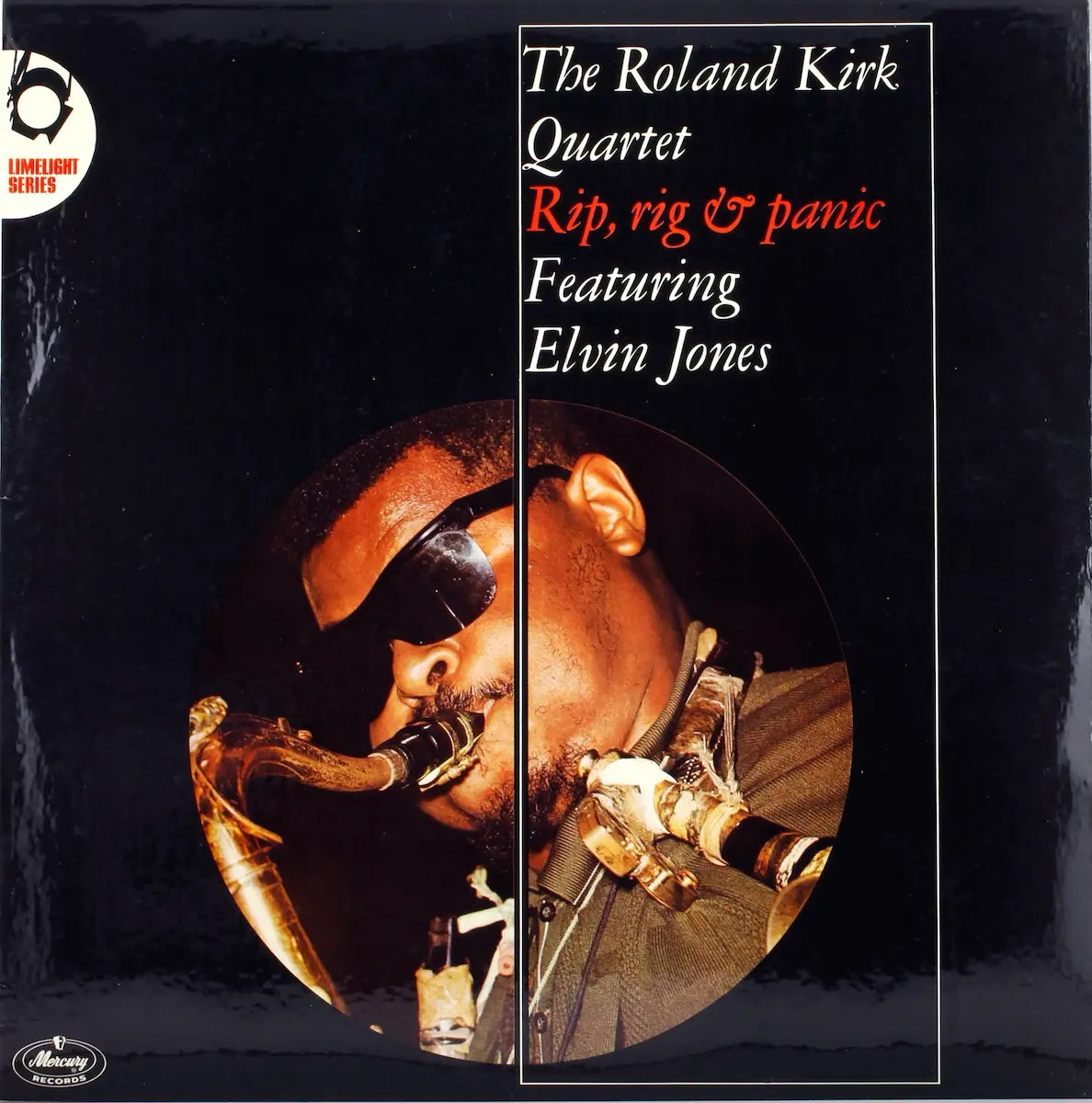
The mid-1960s represented a period of profound transformation within the jazz landscape, characterized by a tension between the established structures of hard bop and the emerging abstractions of the avant-garde. At the center of this stylistic intersection stood Roland Kirk—later known as Rahsaan Roland Kirk—a multi-instrumentalist whose technical virtuosity and historical reverence allowed him to navigate these disparate worlds with unparalleled ease. His 1965 release, Rip, Rig and Panic, recorded for the Limelight label, remains a landmark achievement, capturing a musician at the height of his creative powers, supported by a rhythm section of extraordinary caliber.
Recorded on January 13, 1965, the album serves as a testament to Kirk’s unique philosophy of "Black Classical Music," a term he preferred over "jazz" to describe the vast continuum of African American musical expression. While many of his contemporaries were moving toward complete atonality and the abandonment of traditional rhythm, Kirk chose to deepen his engagement with the past while simultaneously experimenting with the futuristic. The result was a recording that improved upon his previous efforts, refining his "jam session" style into a sophisticated, cohesive statement.
The 1965 Session: A Confluence of Virtuosity
The personnel assembled for the Rip, Rig and Panic session contributed significantly to its enduring reputation. Kirk, performing on tenor saxophone, manzello, stritch, siren, castanets, and oboe, was joined by a rhythm section that could arguably be described as one of the most formidable of the era.
Jaki Byard, the pianist, was a musician of immense historical breadth, capable of shifting from the stride piano of the 1920s to the angular clusters of the 1960s avant-garde within a single phrase. Bassist Richard Davis provided a flexible, muscular foundation, while drummer Elvin Jones, then a pivotal member of the John Coltrane Quartet, brought a polyrhythmic intensity that pushed Kirk to new heights of improvisation.
The synergy between these four men allowed the session to transcend the "gimmickry" often associated with Kirk’s ability to play three horns simultaneously. Instead, the multi-instrumentalism became a tool for harmonic density and orchestral texture. The recording captured a "free and easy" atmosphere that masked the technical difficulty of the arrangements, creating a sense of spontaneous discovery that remains palpable decades later.
Track-by-Track Analysis: Tradition and Innovation
The album’s repertoire is divided between explorations of the jazz canon and experimental forays into new sonic territories. On the more traditional numbers, Kirk’s mastery of the tenor saxophone is undeniable.
Honoring the Masters
In tracks like "No Tonic Pres" and "From Bechet, Fats and Byas," Kirk pays explicit homage to the architects of jazz. "No Tonic Pres" is a tribute to Lester Young, whose light, airy "Pres" style is filtered through Kirk’s more robust, modern sensibility. Kirk does not merely imitate his predecessors; rather, he uses their stylistic hallmarks as a point of departure. As Kirk famously noted, copyists make no progress, remaining trapped in a style until they can find the courage to abandon it.
"From Bechet, Fats and Byas" serves as a triptych of influence. Kirk’s use of the manzello—a modified soprano saxophone—evokes the piercing, vibrato-heavy sound of Sidney Bechet, while Jaki Byard provides a masterclass in stride piano, channeling the spirit of Fats Waller. The nod to Don Byas highlights Kirk’s appreciation for the transition from swing to bebop, emphasizing the continuity of the jazz tradition.
The Balladry of "Once In A While"
The inclusion of the standard "Once In A While" showcases Kirk’s exceptional command of the ballad idiom. Using a full, warm tenor tone, he explores the melodic possibilities of the tune with a "hot" intensity that avoids sentimentality. This track serves as a grounding force on the album, proving that despite his eccentricities and experimental leanings, Kirk remained a premier saxophonist in the conventional sense.
Experimentalism and "Slippery, Hippery, Flippery"
The more controversial aspects of the album involve Kirk’s use of tape-recorded sounds and early computer-generated concepts. In the title track, "Rip, Rig and Panic," and the closing "Slippery, Hippery, Flippery," Kirk incorporates musique concrète elements—shattering glass, sirens, and electronic noise.
While some critics of the time dismissed these elements as pointless gimmicks, they can now be viewed as early examples of sound design in a jazz context. Kirk’s description of the melody for "Slippery" as being "written off a computer" was particularly forward-thinking for 1965. By utilizing a cycle of notes derived from early computing experiments he had encountered, Kirk was bridging the gap between human intuition and machine-generated logic, a theme that would become central to experimental music in the decades to follow.
Technical Prowess: The "Kirk Battery"
The most striking aspect of the album remains Kirk’s physical ability to manipulate multiple instruments. On "Mystical Dream," he combines the oboe with the tenor saxophone and stritch. The oboe is notoriously difficult to play due to its "fiendish" and dissimilar embouchure compared to the saxophone family. Kirk’s ability to incorporate the double-reed instrument into his arsenal while maintaining intonation and rhythmic precision led contemporary observers to marvel at his physical coordination.
This multi-instrumental approach was not merely for show; it allowed Kirk to function as a one-man reed section, providing his own harmonies and creating a wall of sound that would otherwise require three separate musicians. This "Kirk battery" was essential to the album’s unique sonic profile, giving it a density that distinguished it from the standard quartet recordings of the time.
Contextual Timeline: Kirk’s Evolution in the 1960s
To understand the significance of Rip, Rig and Panic, one must view it within the chronology of Kirk’s career and the broader cultural shifts of the 1960s:
- 1961: Kirk releases We Free Kings, establishing himself as a major force in jazz and showcasing his ability to blend blues, gospel, and hard bop.
- 1963-1964: Kirk experiments with a wider variety of instruments and begins incorporating more social commentary into his live performances.
- January 1965: The recording of Rip, Rig and Panic. This period marks the peak of his collaboration with the Limelight label, a subsidiary of Mercury Records known for high-quality production and experimental packaging.
- Late 1965-1967: Kirk continues to tour internationally, gaining a reputation as a "blind seer" of jazz.
- 1968: Kirk signs with Atlantic Records and releases The Inflated Tear, an autobiographical masterpiece that further solidifies his status as a jazz visionary.
Broader Impact and Legacy
The influence of Rip, Rig and Panic extended far beyond the jazz community. In the late 1970s and early 1980s, the album’s title was adopted by the British post-punk and avant-funk band Rip Rig + Panic, featuring a young Neneh Cherry. This cross-genre adoption highlighted the album’s appeal to musicians who valued boundary-pushing experimentation and rhythmic intensity.
Critically, the album is often cited as Kirk’s most balanced work. It successfully manages the tension between his desire to entertain and his need to innovate. While the tape loops and computer-derived melodies may have seemed jarring to 1960s purists, they are now recognized as precursors to the sampling and electronic integration common in modern jazz and hip-hop.
Furthermore, the album solidified the reputation of Jaki Byard and Richard Davis as the premier "musician’s musicians" of the era. Their ability to follow Kirk through his rapid stylistic shifts demonstrated a level of musical telepathy that remains a benchmark for rhythm section interplay.
Conclusion: A Masterpiece of Curated Chaos
Roland Kirk’s Rip, Rig and Panic remains a vital document of a specific moment in American music history. It is an album that refuses to be categorized, existing simultaneously as a tribute to the past and a blueprint for the future. By bringing together the polyrhythmic power of Elvin Jones, the historical encyclopedism of Jaki Byard, and his own singular vision, Kirk created a work that challenges the listener while providing "more than adequate compensation" through its sheer musicality.
Though Kirk’s career would continue to evolve until his untimely death in 1977, Rip, Rig and Panic stands as perhaps the purest distillation of his genius. It serves as a reminder that in the hands of a master, tradition and innovation are not opposing forces, but rather two sides of the same creative coin. For the modern listener, the album offers a window into a world where the only limit to musical expression was the physical capacity of the performer—a limit that Rahsaan Roland Kirk pushed further than perhaps any other musician in the history of the genre.