 Johan Budi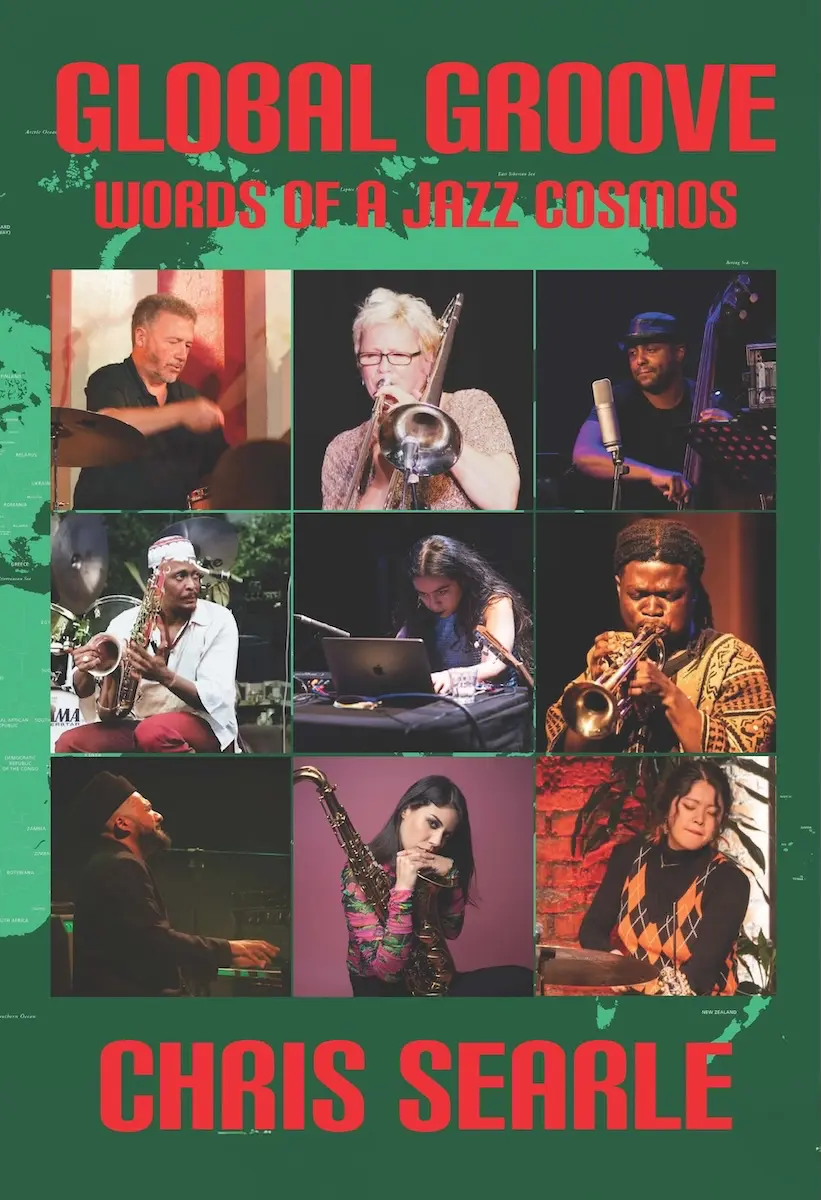
The publication of Global Groove: Words of a Jazz Cosmos by Chris Searle marks a significant addition to the contemporary literature surrounding jazz, documenting the genre’s evolution from a localized American art form into a pervasive global phenomenon. Published by Jazz In Britain, this 492-page volume serves as an extensive compendium of over 300 essays, reviews, and interviews conducted by Searle over a period of approximately thirty years. The work functions as a thematic sequel or companion to Gary Giddins’ seminal 1998 volume, Visions of Jazz: The First Century, but shifts the focus toward the multifaceted, internationalist developments that have defined the music in the new millennium. While Giddins provided a historical survey of the first hundred years of jazz, Searle’s work concentrates on the last quarter-century, positioning the music as a vibrant, ongoing political and social dialogue that transcends national borders.
The Ideological Framework of Global Jazz
Chris Searle, a veteran writer whose work has frequently appeared in the socialist newspaper Morning Star, approaches jazz not merely as an aesthetic pursuit but as a profound vehicle for social change. In Global Groove, Searle explicitly frames the music as an expression of internationalism, racial and political justice, and gender equality. His writing suggests that jazz is inherently a rejection of authoritarianism and a celebration of peace. This ideological lens distinguishes the book from more traditional, formalist jazz critiques. For Searle, the "groove" is not just a rhythmic foundation but a collective movement toward a more equitable world.
The book argues that jazz remains a campaigning music, rooted in a quest for freedom and popular justice. This perspective is rooted in the historical reality of jazz as an African American creation born out of the struggle against oppression. Searle extends this narrative to include the struggles of miners in the Andes, victims of police violence in the United States, and the diverse cultural identities of musicians from over 100 different countries. By documenting these connections, the book provides a socio-political map of the jazz world that emphasizes the music’s role as a "global cosmos."
A Chronology of Modern Jazz Criticism
The contents of Global Groove are organized to reflect a timeline of musical evolution starting from the late 20th century and moving through the first two decades of the 21st. The essays and reviews capture the shift from the traditional "American Century" of jazz toward a more decentralized era.
- The Early 2000s: The book includes reflections on established masters and the preservation of the jazz tradition. For instance, Searle recounts a 2005 trip to Canada for a concert featuring Michael Brecker and Roy Hargrove. These entries serve to bridge the gap between the legendary figures of the 20th century and the innovators of the 21st.
- The Mid-2010s: This period marks an increase in the documentation of jazz as a response to contemporary social crises. A 2017 review of Robert Glasper’s "I’m Dying Of Thirst" highlights the album’s commemoration of victims of police violence in America, illustrating how jazz continues to function as a frontline commentary on systemic injustice.
- The 2020s and Beyond: More recent entries, such as a 2025 review of Peruvian trumpeter Gabriel Alegría’s album El Muki, showcase the fusion of jazz with regional mythologies and environmental themes. Alegría’s work, which celebrates the protector of Andean miners, is used by Searle to demonstrate how the music now arises from "earth, rock, and minerals" in a global context.
Geographic Scope and the Centrality of London
While the book’s title emphasizes a global scope, the primary geographic focus of the live reviews remains London. This reflects the city’s status as a premier international hub for jazz performance. The reviews frequently center on iconic venues such as:
- Café Oto in Dalston: Known for avant-garde and experimental performances.
- The Vortex Jazz Club: A staple for both emerging and established improvisers.
- Pizza Express Jazz Club and Ronnie Scott’s: Historical venues that attract top-tier international talent.
By focusing on these venues, Searle illustrates how the "capital as magnet" allows for a convergence of global styles. However, the book also ventures outside the London bubble, recalling historic performances such as Art Blakey’s Jazz Messengers in Manchester in 1961. This historical depth provides context for the current state of the British jazz scene, showing that the "global groove" has had long-standing roots in the United Kingdom’s regional cities as well.
Diversity of Artists and Instrumentation
One of the book’s primary contributions to jazz scholarship is its documentation of musicians who may be overlooked by mainstream, US-centric publications. Searle provides the national origins and specific cultural contexts for every artist he reviews. The diversity of instrumentation mentioned in the text highlights the genre’s expansion:
- Majid Bekkas (Morocco): A virtuoso of the guembri, a bass-plucked lute, who integrates North African traditions with jazz improvisation.
- Rudy Smith (Trinidad): A specialist in the steel pan, bringing Caribbean melodic sensibilities to the jazz ensemble.
- Gabriel Alegría (Peru): Incorporating Afro-Peruvian rhythms and Andean folklore into a contemporary sextet format.
- Hiromi (Japan): Representing the virtuosic piano traditions of East Asia.
The book also pays homage to the "catholic taste" of its author by including appreciations of a wide spectrum of artists, from the traditionalism of Humphrey Lyttelton and Louis Armstrong to the avant-garde explorations of Evan Parker. This inclusivity reinforces the argument that jazz is an "evolving and breathtaking" art form that refuses to be confined to a single style or era.
Critical Analysis and Media Reception
Critical reception of Searle’s work often highlights his unwavering positivity. Unlike many critics who focus on technical flaws or "unfulfilled expectations," Searle’s writing is characterized by an absence of negativity. This has been noted by other critics as both a virtue and a point of contention. Some argue that by eschewing negative reviews, the work risks overlooking the "faults associated with delivery and intent" that are present in any live art form.
However, proponents of Searle’s approach argue that his role is one of "enthusiasm and advocacy." By focusing on the "ideal" rather than the "featureless mundane," Searle elevates the status of the music and the musicians. His reviews are seen not just as evaluations of sound, but as endorsements of the "astonishing boundary-breaking artistry" that he believes defines the genre. This advocacy is particularly significant for artists from the Global South or those working in niche genres who might otherwise lack visibility in the Western press.
Broader Implications for the Jazz Canon
Global Groove: Words of a Jazz Cosmos serves as a vital record of how much the jazz landscape has changed in the last 30 years. It suggests that the future of the music lies in its ability to incorporate "extra-musical considerations" such as social justice and environmentalism. The book challenges the notion that jazz is a "museum piece" or a strictly American heritage project. Instead, it presents a vision of a "jazz cosmos" that is teeming, international, and multicultural.
For the British jazz community, the book reinforces the importance of the UK as a site where the global relevance of the music can be appreciated and evaluated. The work of Searle, alongside publishers like Jazz In Britain, ensures that the contributions of international musicians to the local scene are documented for future generations.
Technical Details and Availability
Global Groove: Words Of A Jazz Cosmos is published by Jazz In Britain, a label and publisher known for its dedication to documenting the history and contemporary state of jazz within the UK. The book is a paperback edition consisting of 492 pages and is priced at £15. It is identified by the ISBN 978-1-0683644-2-6.
The volume includes a comprehensive index of musicians and venues, making it an essential reference for researchers, critics, and enthusiasts. Its release comes at a time of renewed interest in jazz among younger, more diverse audiences, further solidifying its relevance in the current cultural climate. By chronicling the "technicolour splendour" of the music, Searle has provided a roadmap for understanding the complex, interconnected world of modern jazz.