Johan Budi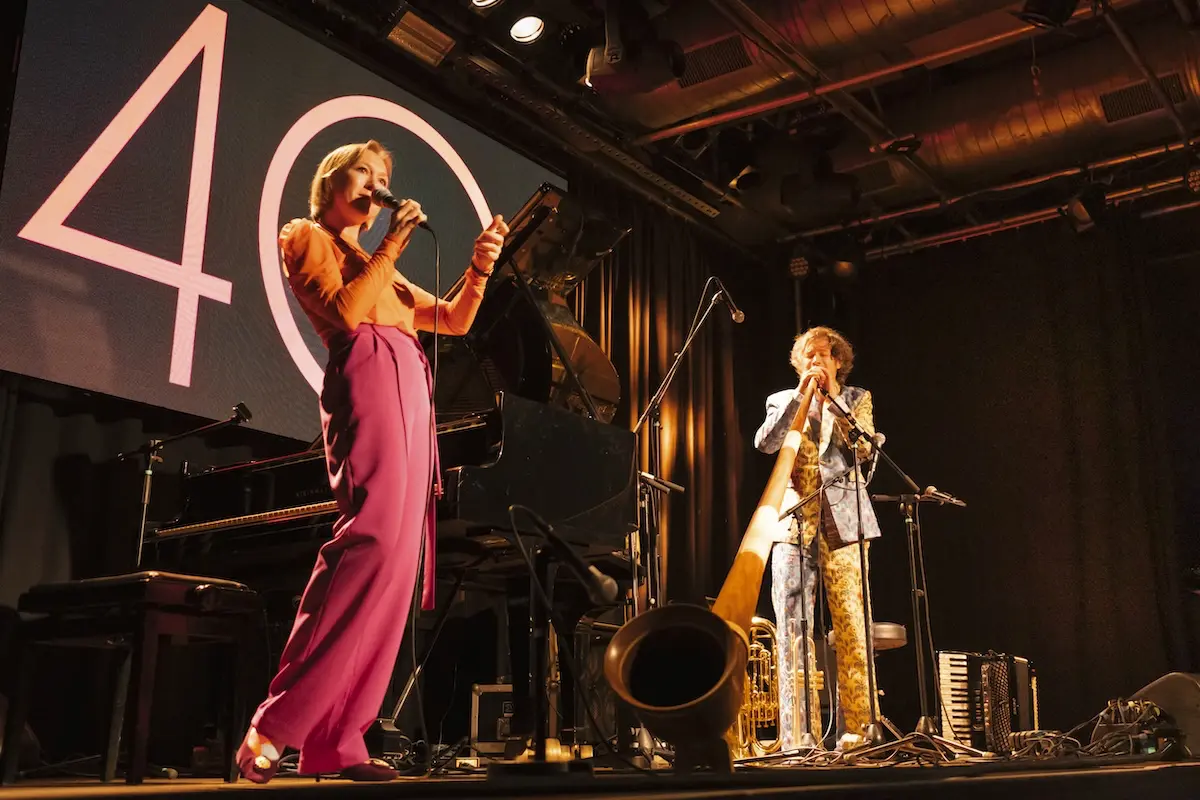
While Berlin often captures the mainstream spotlight as Germany’s cultural powerhouse, the city of Cologne quietly lays claim to an even more deeply entrenched musical heritage: that of the nation’s true jazz capital. Boasting a rich history that spans decades of post-war avant-garde experimentation, Cologne maintains an unmatched network of performance spaces, grassroots organizations, and dedicated audiences that allow adventurous improvised music to continually flourish. At the heart of this enduring ecosystem is the Cologne Jazzweek. Though inaugurated as recently as August 2021, the festival has rapidly matured into an essential fixture on the European cultural calendar, seamlessly weaving contemporary innovation with the city’s proud historical foundations.
The 2025 iteration of the festival arrived against a backdrop of monumental civic and cultural celebration. Just days prior to the official opening, one of Cologne’s crown jewels—the legendary Stadtgarten concert hall—marked its 40th anniversary. For four decades, the Stadtgarten has served as the epicenter of western Germany’s jazz movement, nurturing local talent while hosting international luminaries. To honor this milestone, organizers kicked off the festivities with an ambitious, multi-venue marathon on the evening of Friday, September 4, offering a full night of complimentary indoor and outdoor performances that set an energetic tone for the week ahead.
Opening Night: A Citywide Celebration at the Stadtgarten
As dusk fell over North Rhine-Westphalia on September 4, inclement weather failed to deter the crowds. Thousands of jazz enthusiasts converged on the Stadtgarten complex, where roughly 20 distinct concerts were ingeniously integrated into the indoor stages and surrounding parklands. The curatorial vision for the evening reflected a deliberate synthesis of international acclaim and regional prowess, highlighting both visiting Nordic masters and homegrown innovators.
Outdoors, Norwegian trumpet pioneer Nils Petter Molvær captivated attendees with his signature blend of acoustic lyricism and electronic ambient textures, cutting cleanly through the misty evening air. Indoors, audiences were treated to the complementary stylings of fellow Norwegians Arve Henriksen and Stian Westerhus, whose exploratory sonic architecture filled the intimate performance rooms.
Yet, the beating heart of the opening night remained firmly rooted in the local Cologne scene. Saxophonist Niels Klein presented a compelling set alongside his long-standing trio, featuring double bassist Robert Landfermann and drummer Jonas Burgwinkel. Adding a distinct textural layer to the ensemble, harpist Kathrin Pechlof joined the group as a special guest, filling the acoustic space typically occupied by a traditional piano and signaling the boundary-pushing ethos that defines the local community.
The Green Walk: Merging Alpine Tradition with Urban Landscape
The following afternoon, the festival embraced Cologne’s urban geography by inviting audiences to experience music on the move. The afternoon’s centerpiece was the festival’s signature "green walk," an inventive concept that pairs physical exploration with sonic discovery.
On a temporary outdoor stage, brass virtuosos Matthias Schriefl and Johannes Bär challenged conventional perceptions of Alpine instrumentation. Armed with traditional alphorns—as well as a versatile arsenal of trumpets, tubas, and accordions—the duo delivered a dynamic performance that defied geographical expectations. Schriefl, outfitted in a theatrical clown persona, performed simultaneously on multiple instruments, generating a playful yet technically demanding soundscape. The performance possessed such kinetic energy that festival technicians jokingly struggled to keep the floating notes tethered to the stage.
As the set progressed, vocalist and pianist Tamara Lukasheva joined the brass players, infusing the compositions with intricate yodeling techniques that echoed the distant peaks of the Alps. Though Cologne lacks natural mountainside topography, the city’s urban planners have long maintained rolling green spaces. The procession naturally migrated to a nearby park hill, where the audience gathered in the sunshine to receive their musical reward following the brisk walk.
Architectural Resonance: Churches and Alternative Venues
Cologne Jazzweek has consistently utilized the city’s diverse architectural landscape to shape its acoustic identity, and the weekend’s programming underscored this symbiotic relationship. At the historic Neu St Alban church, Damian Dalla Torre’s trio presented a meditative, atmospheric set that merged contemporary jazz tropes with live electronics and field recordings of bird song. Accompanied by harpist Babett Niclas and electric guitarist Markus Rom, Dalla Torre pushed the performance toward ambient sound art, prompting a deeply contemplative atmosphere among the pews.
In a striking stylistic contrast, a separate church venue hosted the trio of Kathrin Pechlof, saxophonist Christian Weidner, and bassist Robert Landfermann. Framed against a stark white architectural backdrop and dressed entirely in black, the ensemble performed a masterclass in pure chamber jazz. Their restrained, deliberate phrasing translated into an almost ecclesiastical experience, with acoustic notes rising toward the vaulted ceiling like traditional liturgical hymns.
Meanwhile, back at Neu St Alban, organist Janne Nicolas engaged in a spatial dialogue with Luxembourgish vibraphonist Arthur Clees and Ukrainian vocalist Kateryna Kravchenko, who performed from an elevated side balcony. By scattering performers across different architectural tiers, the festival successfully transformed the physical building into an active participant in the musical arrangement.
Cathedral Altitudes and the Ascent to the Loft
Sunday morning broke under clear skies, framing Cologne Cathedral—the city’s majestic Gothic landmark—as a natural waypoint for cultural tourists and music lovers alike. While the cathedral’s monumental presence anchors the cityscape, its immediate surroundings reflect the ongoing compromises of modern urban planning, surrounded as it is by intrusive infrastructure that highlights the friction between medieval heritage and contemporary municipal needs.
True to form, the festival disrupted conventional spatial use here as well. Matthias Schriefl and Johannes Bär ascended the historic steps toward one of the cathedral’s soaring towers, projecting brass fanfares high above the pedestrian plazas before embarking on a musical procession along the banks of the Rhine.
As evening descended, the festival’s gravitational pull shifted toward the Loft, another mythical venue deeply embedded in Cologne’s jazz folklore. Reaching the venue requires navigating a seemingly endless stairwell, leading ultimately to a modest, high-altitude performance room. There, British saxophonist Evan Parker and American trumpeter Peter Evans delivered a masterclass in extended techniques and acoustic stamina.
Parker, globally renowned for his pioneering circular breathing methods, found an ideal foil in Evans. Together, the duo generated dense, hypnotic sonic textures so complex that audience members occasionally mistook the acoustic interplay for live electronic manipulation. The intense cognitive and sensory focus demanded by the performance manifested in a brief, dramatic pause when an audience member fainted, prompting an ambulance call and a temporary halt to the proceedings—a testament to the uncompromised, physically demanding nature of avant-garde improvisation.
Closing Hours: Guitar Mastery and Late-Night Intimacy
The brief medical interruption at the Loft allowed swift-footed attendees to migrate back to the Stadtgarten just in time to catch the final thirty minutes of guitarist Peter Bernstein’s performance. Performing with an elite quartet that featured the rising-star pianist Sullivan Fortner, Bernstein delivered a polished set balancing original compositions with sophisticated standards. Although Fortner’s improvisational footprint was occasionally constrained by the tight schedule, the ensemble culminated their main set with Dissipation Blues. The track failed to dampen the audience’s enthusiasm, drawing a vocally persistent crowd demanding an encore. Bernstein obliged with a rare rendition of Newark News, a calypso piece composed by the late jazz legend Sonny Rollins, with whom Bernstein had shared the stage decades prior.
The night’s final chapter unfolded inside Jaki, the intimate basement venue housed within the Stadtgarten complex. Bassist Roger Kintopf led an understated, highly focused trio featuring drummer Sun-Mi Hong and guitarist Emmanuel Michael. Positioned casually on the stage level alongside the guitarist—who was dressed as though still performing in the afternoon fresh air—the ensemble fostered an atmosphere of profound communal focus. Complex original compositions unfurled seamlessly as midnight approached, drawing the formal weekend programming to a close.
Institutional Resilience and Future Outlook
Behind the celebratory atmosphere of the 40th-anniversary events lies a pressing infrastructural reality: the Stadtgarten itself is now in urgent need of comprehensive modernization. Municipal authorities have scheduled major structural renovations to begin in 2028. Local cultural stakeholders have expressed cautious optimism that the upcoming capital projects will proceed with greater efficiency than the city’s most famous historical construction project—the Cologne Cathedral, which famously required 632 years to reach completion.
Despite impending infrastructural transitions, the Stadtgarten remains an indispensable pillar of civic life, acting as an intergenerational nexus for musicians, theorists, and audiences. Meanwhile, Cologne Jazzweek has proven that its rapid ascent is no fluke. By honoring local institutional heritage while aggressively commissioning adventurous, site-specific performances across urban landscapes, the young festival has established deep roots. Rather than feeling like an imported cultural product, Cologne Jazzweek operates as a natural, breathing extension of a jazz culture that has cultivated generations of sonic explorers—ensuring that the city’s reign as Germany’s true capital of improvised music remains unchallenged for decades to come.