 Lana Akmaluna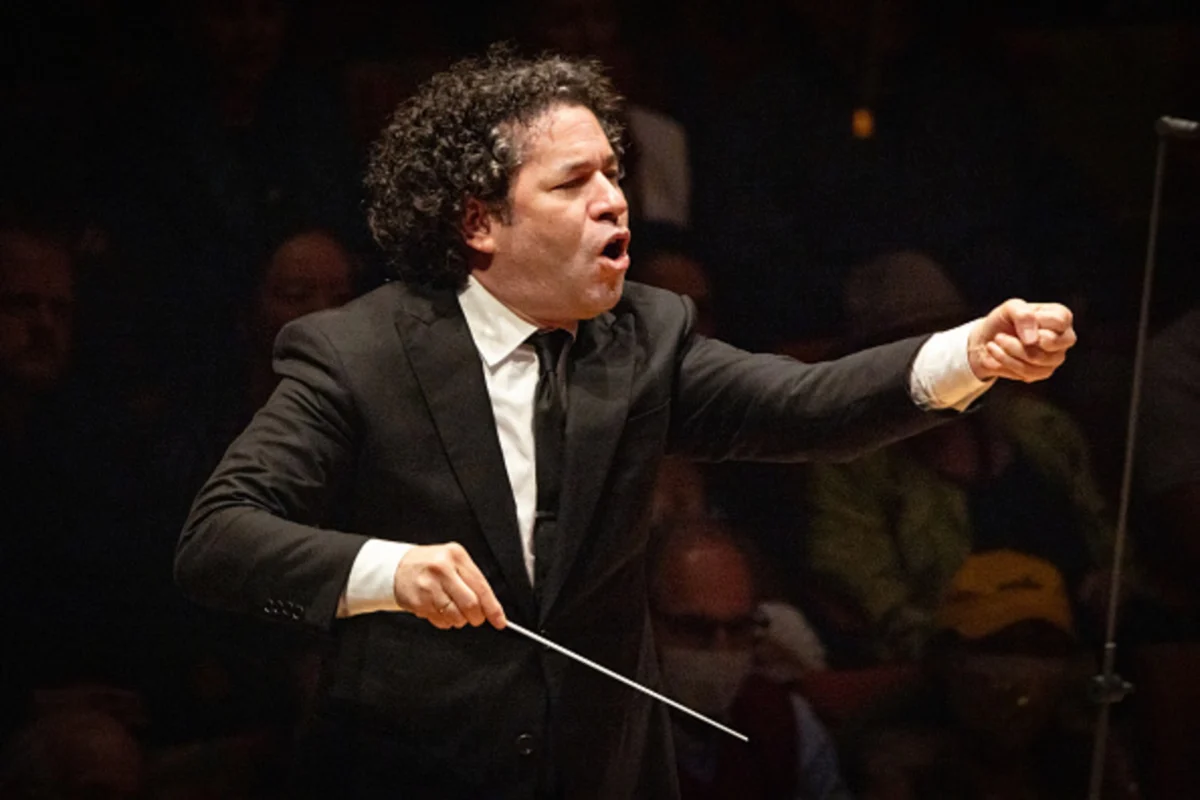
The New York Philharmonic officially raised the curtain on its landmark 2026-27 concert season on Thursday night, September 10, bringing a vibrant, genre-spanning gala to the legendary stage of Radio City Music Hall. The evening marked the highly anticipated inaugural performance of Gustavo Dudamel as the orchestra’s new music and artistic director. The acclaimed Venezuelan maestro, widely recognized for his tireless advocacy of classical music as an accessible fundamental human right, curated an eclectic, multigenerational program. By bridging the gap between traditional orchestral masterpieces and contemporary popular music, Dudamel signaled a bold, forward-looking vision for one of the world’s most prestigious cultural institutions.
From the moment Dudamel walked onto the stage, greeted by thunderous, sustained applause and a giant backdrop reading "Welcome Gustavo!", the energy within the historic venue was electric. The maestro, whose signature dynamic presence and expressive curls were on full display, launched immediately into a spirited program that bridged decades of musical history.
An Eclectic Musical Journey
The evening’s musical narrative began with a soaring, high-octane rendition of George Gershwin’s 1927 overture "Strike Up the Band." Setting an immediate tone of theatricality and grandeur, the performance demonstrated the Philharmonic’s adaptability under its new leadership.
The classical-pop synthesis continued as American alternative rocker St. Vincent took the stage. Clad in a striking black balloon skirt, a matching leather jacket, and wielding a bright red electric guitar, she delivered a haunting, cinematic performance of her track "Smoking Section," imbuing the concert hall with a distinct James Bond-esque atmosphere. She seamlessly transitioned into her acclaimed homage "New York," taking a moment to address the audience and express the city’s enthusiasm for Dudamel’s arrival.
Liev Schreiber, a native New Yorker and acclaimed actor who served as the evening’s master of ceremonies, captured the maestro’s unique cultural footprint with a humorous introduction. Blending local flavor with affectionate hyperbole, Schreiber joked to the delighted crowd: "Imagine if you added a teaspoon of Billy Joel, an ounce of Jean-Michel Basquiat, a cup of Tito Puente to a dash of Barbra Streisand, and absolutely nothing of Leo Messi. Then, add several thousand volts of electricity, an unreasonable amount of hair… bake the whole thing into a giant musical arepa, and give it a baton."
The concert further explored diverse soundscapes with the inclusion of Philip Glass’s 2012 "Anniversary Concert Overture," followed by a crowd-pleasing vocal performance from Tony Award-winning actor and singer Aaron Tveit. Venezuelan singer-songwriter Joaquina later took the spotlight, radiant in a long red dress, delivering impassioned performances of her songs "Pesimista" and "El Alquimista." Her soaring vocals were underscored by the rich textures of the Philharmonic and accompanied by her longtime producer, Colombian musician Julio Reyes Copello, on piano.
Speaking to Billboard prior to the event, the Latin Grammy-winning artist reflected on the historic nature of the evening. "I am eternally grateful to the New York Philharmonic and, above all, to Gustavo Dudamel for placing their trust in me. It is a vote of confidence that I do not take lightly," Joaquina shared. "As a Venezuelan, I feel very proud to be part of such a momentous night. Gustavo is one of the greatest musicians our land has produced, and it inspires me greatly to see a Venezuelan at the helm of one of the world’s most important philharmonic orchestras."
The program also incorporated contemporary classical compositions, including Jessie Montgomery’s evocative 2017 piece "Banner" and Mexican composer Arturo Márquez’s lively 2017 work "Danzón No. 9." The evening culminated in a blockbuster finale featuring pop superstar Lizzo. Arrayed in a body-hugging white gown, Lizzo captivated the audience not only with powerful vocal deliveries of her chart-topping hits "Cuz I Love You" and "Truth Hurts," but also through virtuosic flute playing, all amplified by the symphonic heft of the full orchestra. During her set, she took a moment to honor both her mother—who was celebrating her birthday—and Dudamel, cementing a celebratory atmosphere that bridged high art and pop culture.

Historical Context and the Dudamel Era
Dudamel’s appointment represents a watershed moment in the storied history of the New York Philharmonic, which was founded in 1842 and stands as the oldest symphony orchestra in the United States. The Venezuelan conductor assumes the role after an acclaimed 17-year tenure as the music and artistic director of the Los Angeles Philharmonic, where he successfully redefined the relationship between a major American orchestra and its surrounding community through educational initiatives like Youth Orchestra Los Angeles (YOLA).
In taking the helm at Lincoln Center and its temporary performance homes, Dudamel steps into a lineage of legendary conductors that includes Gustav Mahler (1909–1911), Leonard Bernstein (1958–1969), and Zubin Mehta (1978–1991). He succeeds maestro Jaap van Zweden, who held the position from 2018 through 2024, steering the institution through the challenges of the COVID-19 pandemic and the extensive renovation of David Geffen Hall.
Chronology of Leadership Transitions at the NY Philharmonic
The transition of musical leadership over the past century highlights the orchestra’s shifting artistic priorities:
- Gustav Mahler (1909–1911): Focused on Germanic Romanticism and expanding the symphonic repertoire.
- Leonard Bernstein (1958–1969): Championed American music, popularized classical performance through televised educational concerts, and cemented the orchestra’s global cultural footprint.
- Zubin Mehta (1978–1991): Brought international scope and stability during one of the longest tenures in modern history.
- Jaap van Zweden (2018–2024): Modernized performance spaces, prioritized contemporary American composers, and navigated the organization through unprecedented global disruptions.
- Gustavo Dudamel (2026–Present): Enters with a mandate to democratize classical music, integrate multidisciplinary pop and Latin American influences, and engage diverse, multigenerational audiences.
Implications and Future Outlook
The opening night gala at Radio City Music Hall offers clear insight into the strategic direction of the New York Philharmonic under Dudamel. By intentionally moving away from strictly traditional opening-night galas—which historically relied entirely on standard European classical repertoires—the institution is actively courting younger, more diverse demographics.
Industry analysts note that classical music institutions globally face the dual challenge of aging donor bases and shifting entertainment consumption habits among younger generations. Dudamel’s programming strategy directly addresses this challenge by treating genres as fluid. Pairing works by Philip Glass and George Gershwin alongside performances by St. Vincent, Joaquina, and Lizzo demonstrates a calculated effort to position the orchestra not as a museum of historical European works, but as a dynamic cultural hub relevant to contemporary life.
Furthermore, Dudamel’s platform provides a significant global spotlight for Latin American classical and contemporary artists, a hallmark of his career thus far. The inclusion of works by Arturo Márquez alongside the prominent feature of emerging Venezuelan talent like Joaquina underscores a broader industry push toward global inclusivity and cross-cultural dialogue within symphonic programming.
As the 2026-27 season unfolds across New York City, attention will turn to how this high-profile collaborative energy translates into the Philharmonic’s core subscription series at David Geffen Hall. However, if Thursday night’s launch at Radio City Music Hall is any indication, the Dudamel era promises to be defined by bold artistic risks, community-centric engagement, and an expansive definition of what a 21st-century symphony orchestra can achieve.