 Nayara Elvina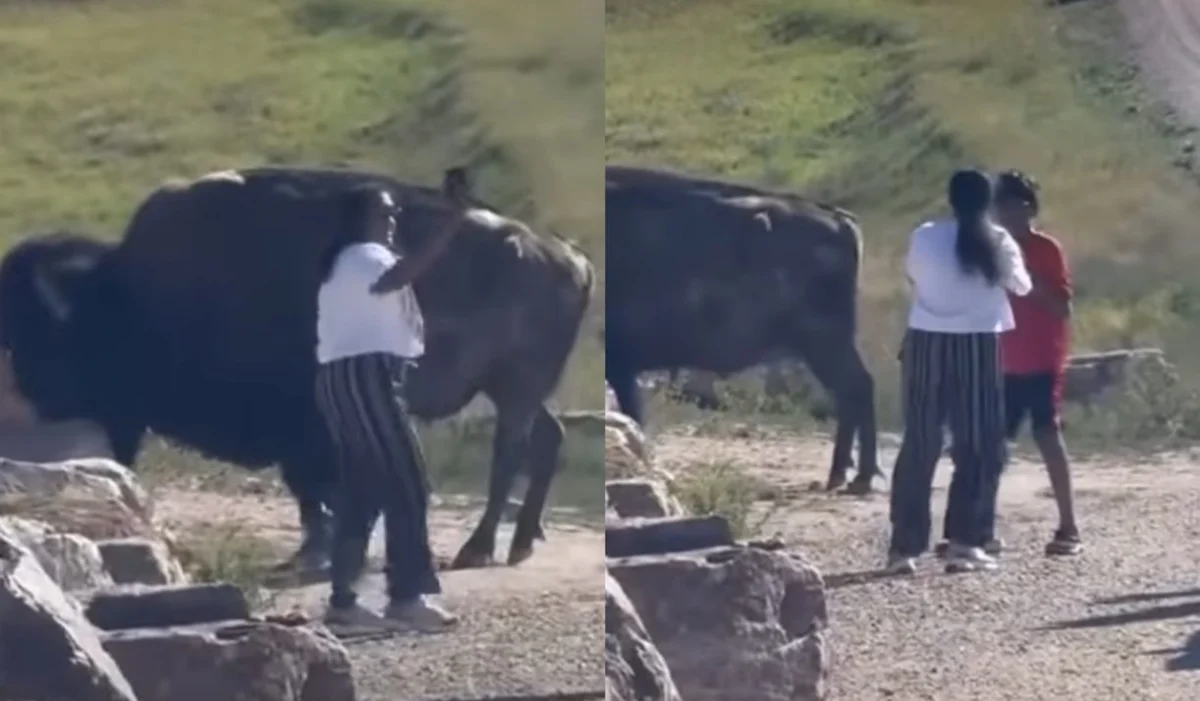
A recent incident in Badlands National Park has reignited a national conversation regarding visitor safety and the ethics of wildlife photography in the United States National Park System. A viral video, which has circulated widely across social media platforms, depicts a female tourist and her family approaching a mature American bison to capture a selfie. The footage shows the individual standing mere feet from the animal, which can weigh up to 2,000 pounds, and turning her back to the creature to frame the shot. This behavior directly violates federal regulations and National Park Service (NPS) safety guidelines, highlighting a growing trend of "tourons"—a portmanteau of "tourist" and "moron"—who prioritize social media engagement over personal safety and animal welfare.
The incident occurred in the rugged landscape of South Dakota’s Badlands National Park, a region known for its dramatic geological formations and its thriving population of American bison (Bison bison). In the footage, the bison appears stationary and calm, a state that experts warn is often misinterpreted by visitors as a sign of domestication. By approaching the animal within such a close range and subsequently turning her back to it, the tourist ignored fundamental principles of wilderness safety. This specific encounter is part of a broader, more systemic issue within the National Park System, where the desire for "the perfect shot" frequently leads to high-risk interactions with unpredictable megafauna.
The Physicality and Unpredictability of the American Bison
To understand the gravity of the risk taken by the tourists in Badlands National Park, it is necessary to examine the biological and physical capabilities of the American bison. As the largest land mammal in North America, a mature bull can stand six feet tall at the shoulder and weigh approximately one ton. Despite their bulky appearance, bison are remarkably agile and fast. They are capable of running at speeds up to 35 miles per hour—nearly three times faster than the average human—and can jump over fences reaching six feet in height.
Wildlife biologists categorize bison as unpredictable animals that can transition from a state of perceived docility to aggressive defense in a matter of seconds. Unlike domesticated cattle, bison retain their wild instincts. Agitation in a bison is often signaled by subtle physical cues that the untrained eye might miss, such as a raised tail, pawing at the ground, or a series of low grunts. When a human enters an animal’s "flight or fight" zone, the animal may perceive the intrusion as a threat, leading to charging, goring, or trampling.
National Park Service Regulations and the 25-Yard Rule
The National Park Service maintains strict regulations regarding the distance visitors must maintain from wildlife to ensure both human safety and the protection of the animals. According to federal guidelines, visitors are required to stay at least 25 yards (75 feet) away from large herbivores, including bison, elk, bighorn sheep, and deer. For apex predators such as bears and wolves, the mandatory distance increases to 100 yards (300 feet), or the length of a professional football field.
These distances are not arbitrary; they are calculated based on the animal’s typical comfort zone and the reaction time required for a human to retreat in the event of a charge. In the Badlands incident, the tourist was estimated to be within five to ten feet of the bison, a distance that leaves zero margin for error. The NPS frequently utilizes the "rule of thumb" as a visual guide for visitors: if a person holds their thumb at arm’s length and cannot completely cover the animal with it, they are too close.
A Chronology of Increasing Human-Wildlife Conflict
The rise of the "selfie culture" has coincided with a measurable increase in dangerous wildlife encounters across the United States. While the concept of the selfie has historical roots dating back to the 19th century, its modern iteration—driven by high-speed mobile internet and platforms like Instagram and TikTok—has fundamentally altered how people interact with nature.
In 2023 alone, multiple high-profile incidents were recorded in Yellowstone National Park and Badlands National Park. In December 2023, a tourist was filmed being pursued by a bison after attempting to take a photograph at close range. Earlier that year, in November, a similar incident involved a visitor attempting to photograph a mountain goat, resulting in the animal "squaring up" for a headbutt. Perhaps most notably, a viral incident involving an elderly visitor, referred to as "Carl" in social media circles, resulted in the man being launched into the air by a bison, leading to multiple broken bones and a prolonged hospital stay.
These events follow a pattern: a visitor approaches a stationary animal, the animal eventually reacts to the encroachment of its personal space, and the visitor is forced to flee or suffers injury. The frequency of these events has led to the creation of dedicated social media accounts, such as "Tourons of National Parks," which aim to shame reckless behavior and educate the public through the documentation of what not to do.
The Psychological and Sociological Drivers of "Touron" Behavior
Sociologists and park rangers have noted a psychological phenomenon where visitors perceive national parks as "outdoor museums" or "theme parks" rather than wild ecosystems. The presence of paved roads, visitor centers, and gift shops can create a false sense of security, leading tourists to believe that the animals within the park boundaries are managed or "tame."
Furthermore, the "Gram" culture—the drive to post unique, high-stakes content on Instagram—incentivizes risky behavior. For many, the social capital gained from a "brave" or "close-up" photo with a wild animal outweighs the perceived physical risk. This disconnect from the reality of nature is exacerbated by the lack of situational awareness. As noted by critics in the comment sections of the Badlands video, many tourists exhibit the "situational awareness of a worm," failing to recognize the lethal potential of the 2,000-pound herbivore standing directly behind them.
Ecological and Legal Consequences
The impact of these encounters extends beyond human safety. When animals become habituated to human presence or are repeatedly harassed by tourists, their natural behaviors are disrupted. Stress from human encroachment can affect an animal’s feeding habits, mating cycles, and overall health. In extreme cases, if an animal injures or kills a human, park officials may be forced to euthanize the animal to prevent future incidents, even if the human was the clear provocateur. This results in the unnecessary loss of wildlife due to human negligence.
From a legal perspective, approaching wildlife too closely is a violation of the Code of Federal Regulations (36 CFR 2.2), which prohibits the "harassing, possessing, hunting, propelling, or trapping of wildlife." Violators can face significant fines, often ranging from $500 to $5,000, and may be banned from National Parks. In some jurisdictions, individuals have faced jail time for particularly egregious acts of wildlife disturbance.
Public Reaction and the Call for Stricter Enforcement
The reaction to the Badlands video has been overwhelmingly critical. Social media users have expressed frustration with the persistent lack of common sense displayed by visitors. Comments on the footage ranged from practical advice—"Always keep your car between you and the bison"—to more cynical observations, with some users admitting they were "rooting for the bison" to teach the tourist a lesson.
There is a growing call among conservationists and frequent park visitors for the NPS to implement stricter enforcement and higher penalties. While the NPS focuses heavily on education through signage, brochures, and ranger talks, the sheer volume of visitors—Badlands attracts over one million people annually—makes it difficult to monitor every interaction. Some suggest that more aggressive patrolling and the publicizing of fines could serve as a more effective deterrent than educational campaigns alone.
Analysis of Broader Implications for National Park Management
As the National Park Service looks toward the future, managing the intersection of high-density tourism and wildlife preservation remains a primary challenge. The Badlands incident serves as a case study for the difficulties of modern park management. To mitigate these risks, the NPS has begun experimenting with digital solutions, such as "geo-fencing" alerts that send safety notifications to visitors’ smartphones as they enter high-wildlife areas.
However, technology cannot replace human judgment. The fundamental issue remains a lack of respect for the boundaries of the natural world. National Parks are some of the few places left where ecosystems operate with minimal human interference; when visitors treat these spaces as stages for personal content creation, they undermine the very purpose of conservation.
In conclusion, the woman in the Badlands video escaped without injury, but her actions represent a dangerous trend that threatens the safety of visitors and the well-being of North America’s iconic wildlife. As the 2024 travel season approaches, the National Park Service continues to emphasize a simple but vital message: wildlife is wild. Respecting the 25-yard boundary is not just a suggestion; it is a necessary requirement for the preservation of the American wilderness experience. The "perfect selfie" is never worth the risk of a life-altering encounter with a 2,000-pound bison.