Nayara Elvina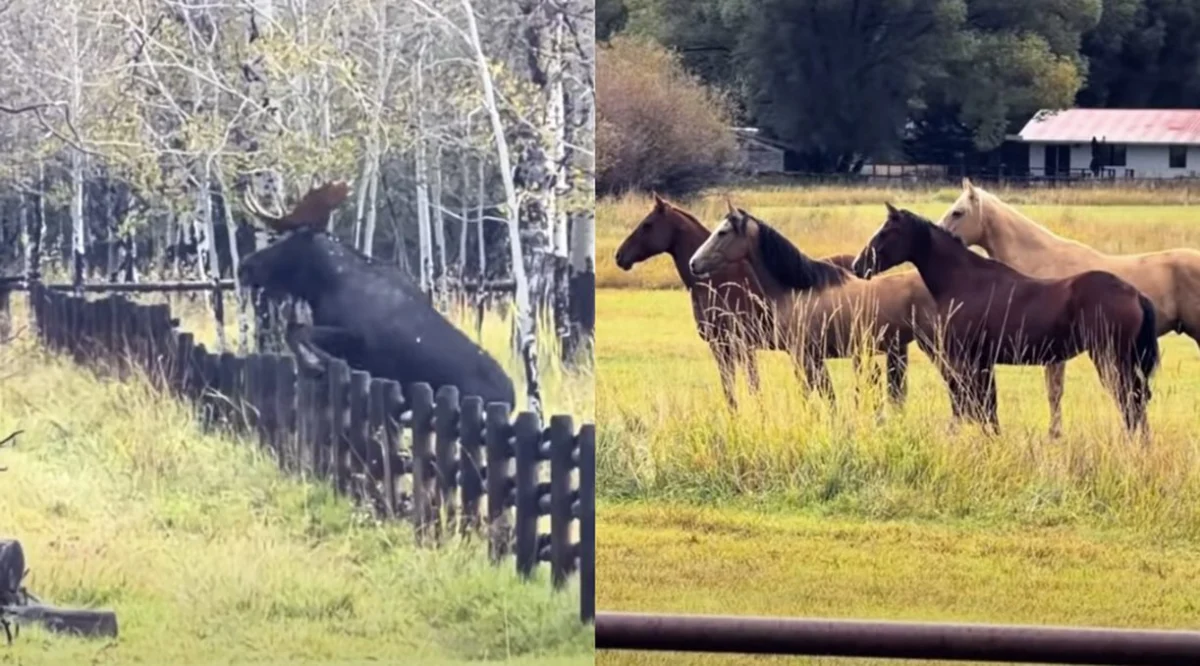
The American West is renowned for its sweeping landscapes, iconic mountain ranges, and vibrant ecosystems where domestic livestock and wild megafauna frequently intersect. However, a recent viral video captured in the picturesque community of Wilson, Wyoming, has provided a uniquely humorous glimpse into wildlife-livestock dynamics. The footage, which has rapidly gained traction across major social media platforms, shows a massive bull moose casually stepping over a residential pasture fence while a bewildered herd of domestic horses looks on, seemingly absorbing a lesson in boundary transgression they never knew was possible.
The incident, recorded in the rural enclave just outside the prominent tourist hub of Jackson Hole, highlights not only the incredible physical capabilities of North America’s largest deer species but also the curious behavioral responses of domestic animals when confronted with the untamed ingenuity of their wild counterparts. While property owners across the Greater Yellowstone Ecosystem are accustomed to managing interactions between domestic animals and native wildlife, this specific interaction has resonated globally, sparking widespread amusement and discussions regarding animal cognition and wildlife fencing protocols.
Main Facts and Geographic Context
The event took place in Wilson, Wyoming, a scenic unincorporated community situated approximately seven miles west of Jackson Hole. Nestled along the base of the Teton Range, Wilson and the broader Jackson Hole valley represent one of the most ecologically diverse regions in the continental United States. This geographic corridor is characterized by dense coniferous forests, riparian willow flats, and expansive meadows that serve as crucial seasonal ranges for a wide variety of indigenous species.
According to regional wildlife management agencies, the Greater Yellowstone Ecosystem supports robust populations of elk, bison, pronghorn, mule deer, grizzly bears, black bears, and a substantial population of the Shiras moose subspecies (Alces alces shirasi). Because human development frequently overlaps with historical wildlife migration routes and seasonal habitats, encounters between local residents, livestock, and large mammals are a routine aspect of daily life in Teton County.
In the recorded video, a property owner’s domestic horse herd is seen grazing peacefully within a fenced enclosure. The tranquility of the scene is disrupted—and subsequently transformed into a moment of pure comedy—when a lone adult moose approaches the perimeter fence. Rather than navigating around the barrier or attempting a traditional, high-velocity leap, the massive cervid simply lifts its long legs and steps over the fencing structure with apparent ease. The surrounding horses immediately halt their grazing, turning their heads toward the visitor with an expression of collective astonishment that viewers have humorously interpreted as the sudden realization of free will.
Biological Profile of the Shiras Moose
To fully appreciate the nonchalant manner in which the Wilson moose bypassed the property’s boundary fence, one must examine the extraordinary physical dimensions and athletic prowess of the species. The moose is the largest extant member of the deer family (Cervidae), with males typically possessing immense palmate antlers that can span several feet across and weigh between 40 and 50 pounds independently.
Adult female moose, known as cows, generally stand between five and seven feet tall at the shoulder and command a body weight ranging from 800 to 1,500 pounds. Adult males, or bulls, are even larger, occasionally exceeding 1,200 to 1,500 pounds and standing upwards of seven feet tall before factoring in the additional height provided by their headgear. In practical terms, a mature bull moose functions as a nearly one-ton living vehicle capable of navigating complex, rugged terrain with surprising grace.
Despite their bulky appearance and massive skeletal structure, moose are remarkably agile. Wildlife biologists note that adult moose can sustain short bursts of running speeds up to 35 miles per hour, making them surprisingly fleet-footed. Furthermore, their long legs and powerful shoulder musculature grant them exceptional jumping and stepping capabilities. While a standard standing jump can easily clear obstacles ranging from six to eight feet high, researchers suggest that an alarmed or motivated moose could feasibly surmount barriers approaching ten feet in height.
In the context of the Wilson video, the fencing in question was clearly designed to contain domestic horses—structures that typically range from four to five feet in height. For an animal standing seven feet tall at the shoulder with a long stride, the barrier posed virtually no physical impediment, reducing what would be a significant leap for a horse into a mundane, high-stepping stride.
Chronology of the Viral Encounter
While exact timestamps for the preliminary approach of the moose remain undocumented, the sequence of events captured in the viral digital reel follows a clear chronological progression observed by the property owner and subsequently analyzed by digital audiences:
- The Approach: The adult moose approaches a standard wire or rail fence enclosing a private residential pasture in Wilson, Wyoming. The pasture is occupied by a domestic herd of horses accustomed to routine containment.
- The Breach: Unfazed by the boundary marker, the moose utilizes its considerable height and long stride to step directly over the fence line without breaking its forward momentum, entering the perimeter or successfully crossing the obstacle with minimal physical effort.
- The Observation: The sudden movement draws the immediate attention of the nearby horses. The entire herd ceases grazing, turning uniformly toward the moose to observe the breach.
- The Reaction: The horses remain motionless for several moments, their body language reflecting intense curiosity and apparent disbelief. The stark contrast between the towering, wild cervid and the captive equids creates a cinematic moment that quickly transitions from an ordinary wildlife sighting to viral entertainment.
- Digital Dissemination: The property owner or an eyewitness captures the interaction on mobile video and uploads the footage to social media platforms via Instagram, where it amasses thousands of views, shares, and commentary within a matter of days.
Social Media Reactions and Public Engagement
The viral nature of the video is largely attributable to the anthropomorphic interpretations projected onto the horses by viewers across the globe. Digital audiences immediately flooded the comment sections of the post with humorous observations, focusing on the cognitive dissonance the horses appeared to experience upon witnessing the effortless disregard for property boundaries.
Common themes among the viral commentary included humorous reflections on equine psychology:
- "Discovering free will exists and they can, in fact, just jump."
- "Those horses are asking, ‘Is that legal?’"
- "Naw they’re saying, ‘Look he ain’t smart, he’s leaving all this free hay and oats.’"
- "Horses are like, ‘I… I didn’t know we could do that?’"
- "Thinking outside of the box."
While horses are inherently capable jumpers—as demonstrated extensively in equestrian sports such as show jumping and cross-country—domestic horses kept in routine pastures rarely attempt to clear standard four-foot fences unless spooked or inadequately fed. The psychological barrier of the fence typically proves sufficient for containment. Witnessing a wild animal completely bypass this artificial construct without hesitation appeared, in the eyes of commenters, to plant the proverbial seed of escape in the minds of the livestock.
Ecological and Practical Implications
Beyond the immediate humor and viral appeal of the video, wildlife and agricultural experts emphasize that interactions between wild ungulates and domestic livestock fencing carry important practical and ecological implications for the Greater Yellowstone Ecosystem.
Property owners in Teton County and surrounding Wyoming jurisdictions frequently utilize various fencing styles, ranging from traditional barbed wire to wooden rail fences. However, these barriers can present significant hazards to wildlife. State wildlife agencies and conservation non-profits, such as the Wyoming Game and Fish Department and local conservation alliances, routinely advocate for wildlife-friendly fencing standards. These designs typically feature a smooth bottom wire set at least 16 to 18 inches above the ground to allow pronghorn and young ungulates to pass underneath, and a top wire or rail no higher than 40 inches to allow adult deer, elk, and moose to jump over safely without becoming entangled.
When wild animals encounter standard livestock fencing that does not meet wildlife-friendly specifications, incidents of entanglement, injury, or property damage often occur. In this specific instance, the moose was fortunate enough to possess the height and agility to step cleanly over the barrier without sustaining injury or damaging the infrastructure. However, smaller or less agile animals frequently suffer severe trauma when attempting to navigate poorly configured fences.
Furthermore, the video underscores the ongoing challenge of wildlife habituation and resource sharing in semi-rural residential areas. As human populations expand into traditional wildlife corridors in western Wyoming, encounters between domestic animals and native species like moose, elk, and large carnivores are expected to increase. While a moose teaching local horses how to jump fences makes for excellent internet humor, wildlife managers continually remind residents to maintain safe distances from all wild megafauna, as stressed or cornered moose can exhibit unpredictable and highly aggressive behavior toward both humans and domestic livestock.
Conclusion
The viral footage from Wilson, Wyoming, serves as a delightful reminder of the unpredictable nature of living in close proximity to North America’s magnificent wildlife. By inadvertently demonstrating that human-made boundaries are merely suggestions in the wild, the local moose provided internet users with a masterclass in mammalian comedy while leaving a lasting impression on a bewildered herd of horses. As the video continues to circulate across digital platforms, it bridges the gap between rural western realities and global entertainment, celebrating the untamed spirit of the Tetons one fence-line crossing at a time.