 Johan Budi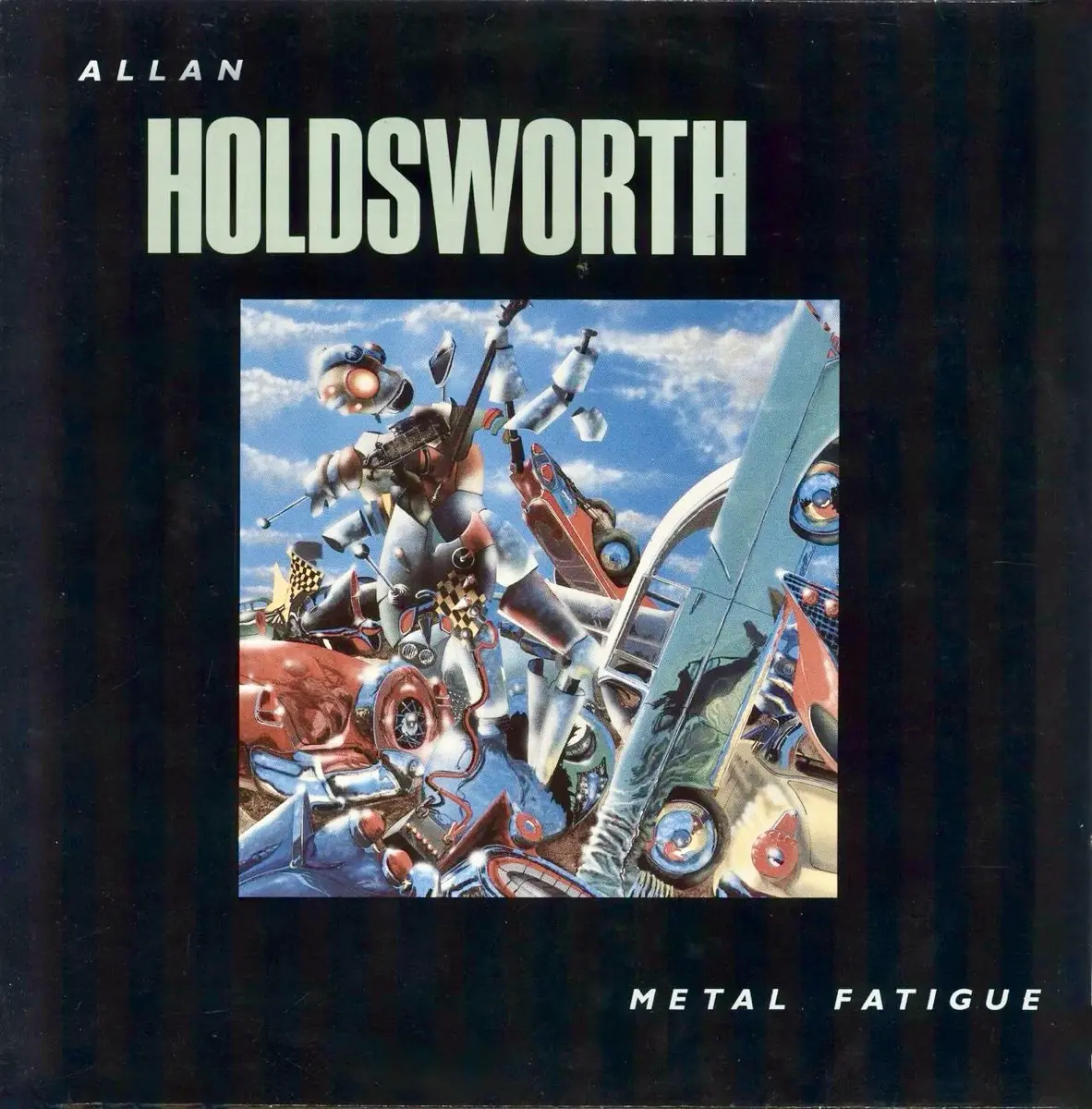
The landscape of contemporary jazz and fusion underwent a seismic shift in the mid-1980s, a period marked by the release of Allan Holdsworth’s seminal work, Metal Fatigue. Originally evaluated in the May 1986 edition of Jazz Journal by critic Mark Gilbert, the album arrived at a pivotal moment when the boundaries between technical virtuosity, progressive rock, and improvisational jazz were increasingly blurred. Holdsworth, a Bradford-born guitarist whose technique defied conventional categorization, had by then established himself as a "guitarist’s guitarist," influencing a generation of players despite remaining largely outside the sphere of mainstream commercial dominance. His 1985 release on Enigma Records represented not only a culmination of his technical maturation but also a distinct bridge between his British art-rock roots and the burgeoning fusion scene of Los Angeles.
The Context of a Virtuoso in Transition
To understand the significance of Metal Fatigue, one must examine the trajectory of Allan Holdsworth’s career leading up to the mid-1980s. Having honed his craft within the crucible of the English progressive scene, Holdsworth’s resume included high-profile tenures with Soft Machine, Gong, and the New Williams’ Lifetime. These collaborations showcased a performer who possessed an "unnatural" talent, characterized by a fluid, legato-heavy style that mimicked the phrasing of a saxophone rather than the percussive attack typical of the electric guitar.
In the early 1980s, Holdsworth relocated from London to Los Angeles, a move driven by both professional necessity and a desire for a fresh creative environment. This transition was initially marked by the 1983 release of the Road Games EP under Warner Bros. Records. While Road Games earned a Grammy nomination, the experience was fraught with industry pressure to conform to more commercial structures, including the integration of vocal-heavy tracks. By the time Metal Fatigue was recorded in 1985, Holdsworth had moved to Enigma Records, an independent label that afforded him greater creative autonomy. This independence allowed him to pursue a vision that was, in the words of contemporary critics, "eccentric and esoteric," yet undeniably potent.
Technical Composition and Track Analysis
Metal Fatigue is frequently cited for its harmonic complexity and the "cut-glass" precision of its production. The album’s title track, "Metal Fatigue," serves as a definitive introduction to Holdsworth’s dualistic approach, utilizing heavy-metal chording that provides a rhythmic foundation for his signature ethereal leads. The opening riffs are characterized by a "crunch" that appealed to the burgeoning rock audience of the 1980s, yet the underlying theory remained firmly rooted in advanced jazz harmony.
The track "Devil Take The Hindmost" remains a cornerstone of the Holdsworth canon. Critics and musicians alike have pointed to the solo on this track as a landmark of modern improvisation. It demonstrates Holdsworth’s peerless technique—specifically his use of wide interval stretches and a four-finger-per-string legato approach that allows for rapid-fire, liquid-smooth melodic lines. The 1986 review in Jazz Journal highlighted this specific solo as the album’s most "typical and lyrical" moment, representing the pinnacle of Holdsworth’s expressive capabilities.
Beyond the electric pyrotechnics, the album explores diverse sonic textures. "Home" features gut-string guitar work, offering a more intimate, acoustic-oriented perspective that contrasts with the "lush symphonic effects" found elsewhere on the record. These symphonic elements have drawn comparisons to the work of Frederick Delius, a fellow Bradford-born composer known for his rhapsodic and impressionistic style. This connection underscores Holdsworth’s identity as a "rhapsodist" of the electric age, blending the emotional depth of 20th-century classical music with the high-gain potential of modern amplification.
Collaborative Dynamics and Personnel
The recording of Metal Fatigue brought together a formidable group of musicians, many of whom would become staples of the fusion genre. The personnel list reflects Holdsworth’s ability to attract top-tier talent who could navigate his complex rhythmic and harmonic demands.
- The Rhythm Section: The album features two highly regarded bassists, Jimmy Johnson and Gary Willis. Johnson, known for his work with Flim & the BB’s and James Taylor, provided a steady, five-string foundation that allowed Holdsworth to soar. Gary Willis, a pioneer of the fretless bass, contributed a more fluid, interactive low-end presence.
- Percussion: The drumming duties were shared among Chad Wackerman, Gary Husband, and Mac Hine. Wackerman, fresh from his tenure with Frank Zappa, brought a mathematical precision to the complex time signatures, while Gary Husband—a multi-instrumentalist who would become one of Holdsworth’s most frequent collaborators—provided a more intuitive, muscular energy.
- Keyboards and Vocals: Alan Pasqua’s keyboard work added the necessary atmospheric layers that defined the album’s "symphonic" feel. The vocal tracks, featuring Paul Korda and Paul Williams, served as a nod to Holdsworth’s art-rock influences, specifically the "English school" epitomized by bands like King Crimson and Genesis.
While some purists in the jazz community occasionally bristled at the inclusion of rock-oriented vocals, they served as a vital link to the progressive rock tradition that informed Holdsworth’s compositional style.
Chronology of Release and Market Reception
The mid-1980s were a period of intense competition for instrumental music. The rise of the "shred" era, led by guitarists such as Yngwie Malmsteen and Joe Satriani, saw a renewed interest in technical proficiency. However, Holdsworth occupied a unique niche. While his speed was comparable to the rock virtuosos of the day, his harmonic language was far more sophisticated, drawing from Coltrane-esque sheets of sound rather than standard blues-rock scales.
The timeline of Metal Fatigue’s impact can be summarized as follows:
- 1982-1983: Holdsworth settles in Southern California, seeking a stable recording environment after years of industry instability in the UK.
- 1984: The release of Road Games establishes his presence in the US market but leaves Holdsworth dissatisfied with major-label interference.
- 1985: Recording and release of Metal Fatigue on Enigma Records. The album is immediately recognized by guitar aficionados for its revolutionary "liquid" sound.
- 1986: Mainstream jazz and guitar publications, including Jazz Journal, begin to solidify Holdsworth’s reputation as an "unsung hero" whose influence had begun to permeate the Top 40, often via disciples who simplified his techniques for commercial pop contexts.
Analytical Perspective: The "Unsung Hero" Paradox
One of the most persistent narratives surrounding Allan Holdsworth is the irony of his commercial standing. As noted in the 1986 Jazz Journal assessment, Holdsworth’s disciples—ranging from Eddie Van Halen to Frank Zappa—often enjoyed greater financial success and wider recognition. This was largely due to Holdsworth’s refusal to "mellow" his individuality. Where other artists might have grafted fusion elements onto a pop-friendly structure, Holdsworth remained committed to his "eccentric vision."
From a technical standpoint, Holdsworth’s influence on the Top 40 was subtle but pervasive. The use of "chorused" guitar tones and complex, non-diatonic chord voicings in 1980s pop production can often be traced back to the innovations Holdsworth pioneered. Yet, his own music remained challenging, characterized by "Panic Station" and "The Un-Merry-Go-Round"—tracks that pushed the boundaries of standard song structure through extended durations and intricate arrangements.
Broader Implications and Legacy
In the decades following the release of Metal Fatigue, the album has come to be viewed as a definitive statement of the fusion genre. It demonstrated that the electric guitar could be used as a tool for high-level jazz improvisation without losing the raw power of rock and roll.
The 1986 suggestion by Mark Gilbert—that Holdsworth should be paired with jazz giants such as Chick Corea, Jack DeJohnette, and Dave Holland—reflects a long-standing desire within the jazz community to see Holdsworth fully integrated into the highest echelons of the acoustic jazz world. While Holdsworth did eventually collaborate with a wide array of jazz masters, Metal Fatigue remains the purest distillation of his unique "third way"—a path that bypassed both traditional bebop and standard rock to create something entirely new.
Today, the implications of Metal Fatigue are felt in the work of modern progressive metal and "djent" guitarists, as well as in the continued evolution of jazz-fusion. The album proved that technical mastery did not have to come at the expense of emotional resonance. Whether through the "rhapsodic" acoustic passages or the "potent individuality" of his electric leads, Allan Holdsworth’s 1985 masterpiece remains a vital document of a musician who changed the language of his instrument forever. The record stands as a testament to the fact that even in the "sunny LA" environment, a true artist’s vision remains unyielding, focused perpetually on the pursuit of the "extraordinary."