Johan Budi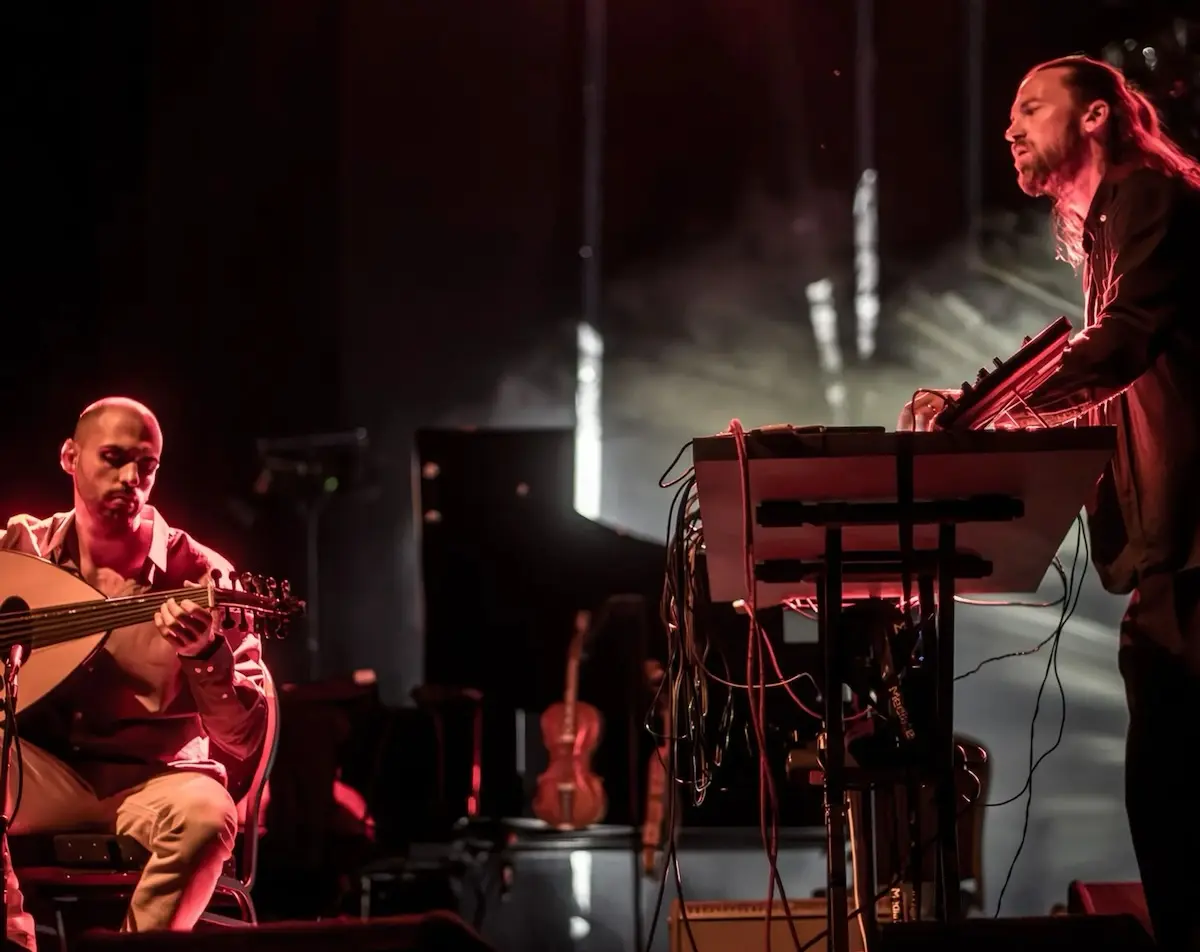
The contemporary jazz and improvised music landscape is currently experiencing a profound thematic convergence, with several major releases examining the intricate ways personal memory, cultural heritage, and temporal anxiety shape modern composition. Across three distinct projects—John Derek Bishop and Khaled Habeeb’s collaborative effort Ekkofremtid, Samuel Blaser’s genealogical exploration Rosina, and the Scandinavian super-trio Rymden’s latest offering Today May Be Tomorrow—artists are interrogating the boundaries of past, present, and future. These works utilize advanced live sampling, archival field recordings, and structural elasticity to challenge conventional listening habits and redefine genre parameters within Nordic and international jazz circuits.
Echoes of Tomorrow: Bishop and Habeeb Bridge Nordic Ambient Jazz with Syrian Tradition
The Norwegian-American sound artist John Derek Bishop, widely recognized under his moniker Tortusa, has long established himself as a central figure in new Nordic ambient jazz. A regular participant in the annual Punkt Festival—founded by electronic innovators Jan Bang and Erik Honoré—Bishop specializes in the art of live sampling, transforming diverse acoustic materials into sprawling, textured soundscapes. His latest project, Ekkofremtid (which translates from Norwegian as "echo future"), is explicitly built upon the philosophical premise that the past continues to resonate within and actively construct the future.
For this release, Bishop joins forces with Syrian oud player Khaled Habeeb, creating a starkly different dynamic than Bishop’s previous collaborations with prominent improvisers such as Nils Petter Molvær, Eivind Aarset, and Inge Weatherhead Breistein. The stylistic divergence between Bishop’s barren, windswept electronic landscapes and Habeeb’s ancient, lute-like instrument provides listeners with an immediate sonic contrast.
Rather than masking the traditional Arabic elements within heavy digital manipulation, Bishop frequently allows Habeeb’s instrument to speak in its natural voice before selectively feeding it back into the evolving mix. By lifting small rhythmic cells and reharmonising entire passages, Bishop weaves evocative field recordings into the background layers with a pronounced cinematic flair. Tracks such as the abstract "Uncomfortable Current" and the 13-minute "Nordlys Fra Østen" highlight this synthesis, successfully bridging continental and cultural divides to prove that disparate musical traditions can speak with a singular, cohesive voice.
Genealogical Discovery Fuels Samuel Blaser’s Rosina
While Bishop’s work addresses abstract temporal mechanics, Swiss trombonist Samuel Blaser’s Rosina is anchored in a deeply personal investigation of a family history previously unknown to him. Born in the French-speaking region of Romandie, Blaser uncovered an Italian branch of his family tree whose members had emigrated to New York following the financial devastation of post-World War I Europe. The catalyst for the project arrived when a newly discovered Italian-American cousin entrusted Blaser with a black-and-white photograph of Rosina—a grandmother he had never met—taken in Emilia-Romagna in 1925.
This visual artifact initiated an intensive creative journey to connect with his ancestral roots. The resulting album was recorded over two days in late March 2024 at Paul Wickliffe’s New Jersey studio, utilizing Blaser’s longstanding US quartet, featuring pianist Russ Lossing, bassist Masa Kamaguchi, and drummer Billy Mintz. The sessions followed the completion of a separate recording project, allowing the ensemble to pivot organically toward an Italian-themed repertoire.
The resulting eight-track programme incorporates profound historical source material, notably drawing two pieces from ethnomusicologist Alan Lomax’s landmark 1954–55 Italian field recordings. The opening track, "Boara," features a simple folk-blues theme underscored by a call-and-response sequence between Blaser and Lossing. Meanwhile, the title track serves as an aural counterpart to the 1925 sepia portrait. The tracklist also includes the explosive "Elgnij" (a variant of "Jingle" from Blaser’s Triple Dip trio), a mini-suite comprising "Adagio" and "Scherzo," an oblique nod to Thelonious Monk in "Mysteriously," Lossing’s Mal Waldron-esque undertow on "Amaaka," and a concluding rendition of Renato Carosone’s 1957 composition "Serenata," wherein Blaser’s heavily muted trombone bridges generations of Italian musical heritage.
Rymden Confronts Temporal Anxiety on Today May Be Tomorrow
Rounding out this trio of significant releases is Today May Be Tomorrow, the latest studio album from the Scandinavian super-trio Rymden, comprising pianist and keyboardist Bugge Wesseltoft, bassist Dan Berglund, and drummer Magnus Öström. Since their formation, the group has followed a clear trajectory of progressive experimentation. Their 2019 debut, Reflections And Odysseys, established a template combining instrumental virtuosity with high-energy rhythms, while 2020’s Space Sailors introduced heavier, rock-oriented textures and expanded electronic instrumentation. Subsequent 2023 releases, including Rymden + Kork and Valleys And Mountains, broadened their sonic palette further through collaborations with symphony orchestras and guest soloists like John Scofield.
Released via Jazzland Recordings in early 2026, Today May Be Tomorrow represents a period of full artistic maturity rather than a radical stylistic departure. The album engages in conceptual territory parallel to Bishop’s work, utilizing song titles and elastic arrangements to pose sobering questions about an increasingly unstable and unpredictable global climate. By questioning whether listeners can reliably assume the certainty of tomorrow, the trio crafts music that intentionally manipulates temporal perception.
The album features several standout reinterpretations and original compositions that synthesize the group’s collective history. Most notable is a reworking of Berglund’s "Valiant Revisited," originally recorded with Wesseltoft and Henrik Schwarz on the 2014 Trialogue album. In Rymden’s hands, the composition transforms into a definitive, polished e.s.t.-style ballad. Öström’s 10-minute title track undergoes continuous reinvention throughout its runtime, while Wesseltoft’s "Nightfall" utilizes dub-inflected echoes to enhance rhythmic flexibility. Combined with the driving post-rock precision of Berglund’s "Undercover Lover" and the elegiac stability of Wesseltoft’s "Here Now" and "Em," the album successfully maintains an atmosphere of profound temporal ambiguity from its opening notes to its fuzzy, atmospheric finale.
Analytical Implications for Contemporary Improvised Music
The concurrent release of these works highlights a broader methodological shift within modern European jazz and improvised music. Rather than treating history and technology as mutually exclusive domains, artists are increasingly leveraging advanced digital manipulation—such as Bishop’s live sampling—alongside deeply analog historical artifacts—such as Lomax field recordings and sepia photographs—to construct narratives of continuity in an uncertain era.
Industry analysts note that these projects reflect a growing demand among sophisticated audiences for contextualized, conceptually rigorous music. By tying technical proficiency to personal ancestry, geopolitical commentary, and philosophical inquiry, artists like Bishop, Habeeb, Blaser, and Rymden are ensuring that contemporary jazz remains a vital medium for processing both historical memory and modern existential anxieties. As these albums circulate globally, their reception is expected to heavily influence production standards and thematic developments across the European and international jazz sectors for the foreseeable future.