Aveline Kirana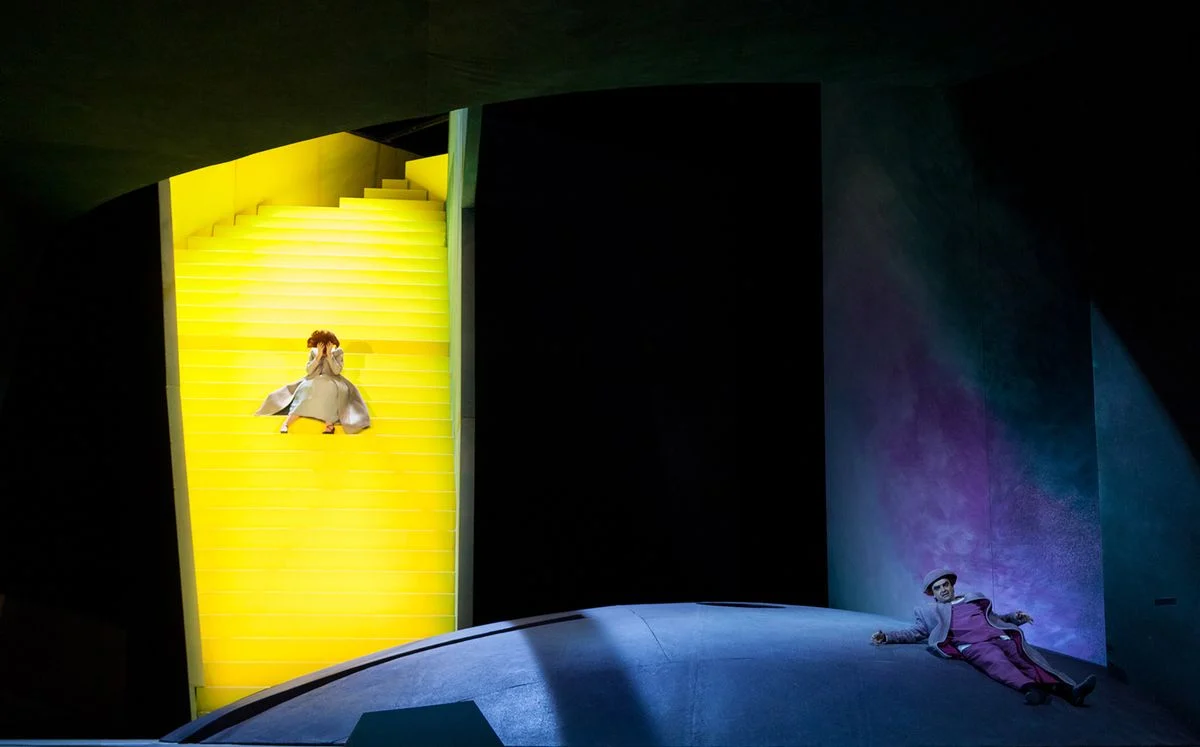
(Credit: Tatjana Daschel)
The Staatsoper Unter den Linden’s venerable production of Claude Debussy’s Pelléas et Mélisande, a cornerstone of its repertoire since 1991, returned to the Berlin stage on July 9th, reaffirming its status as a genuinely great work of theatrical art. More than a mere revival, the performance offered a profound rediscovery, demonstrating that exceptional opera transcends its initial premiere, continuing to exert its potent influence and capacity for surprise across decades. The evening felt like an immersion into operatic history, a testament to a singular theatrical language and aesthetic lineage forged by the late director Ruth Berghaus.
A Visionary Production Endures
The enduring power of this Pelléas et Mélisande is inextricably linked to the visionary genius of Ruth Berghaus. Hailing from Dresden, the East German director, initially rooted in the Brechtian tradition, courageously liberated herself from its theoretical constraints, allowing her unique artistic imagination to flourish. This seminal staging, alongside her celebrated productions of Tristan und Isolde for Hamburg and Il barbiere di Siviglia for Berlin, stands as one of her most significant and enduring achievements, a testament to her innovative approach to opera.
Berghaus’s collaboration with designer Hartmut Meyer resulted in a visual landscape that was both deeply evocative and conceptually rich. Meyer’s costumes, a striking synthesis of Antoine de Saint-Exupéry’s whimsical illustrations for Le Petit Prince and the stylized aesthetic of 1960s Czech animation, transported the audience into a dreamlike, fairytale universe. The voluminous garments and rounded hats altered the perceived proportions of the singers, creating an effect that, in reverse, evoked the elongated figures of Modigliani or Giacometti. This stylistic choice, more readily recognized in the cultural milieu of former East Germany, underscored the opera’s inherent sense of otherworldliness. Equally potent was the design of the stage itself: a vast, spherical floor. This unmistakable allusion to Le Petit Prince served as a powerful metaphor for the precariousness of the characters’ emotional and existential states. The characters’ struggle to maintain their footing, their tendency to slide and crawl rather than stand upright, mirrored the inherent instability and unspoken anxieties that permeate Debussy’s drama.
Berghaus’s commitment to stark minimalism remained a defining characteristic of the production. Hartmut Meyer’s quasi-abstract sets, through subtle yet impactful shifts in light and color, continuously generated new visual tableaux without altering the fundamental structure of the stage. The iconic yellow staircase, ascending dramatically into the upper reaches of the stage, served as a central visual and dramatic anchor. It transformed seamlessly into a tower, a castle, and a site of reckoning, its symbolic resonance deepening with each ascent and descent. The lighting design played an equally crucial role, casting menacing shadows that seemed to materialize the opera’s hidden psychological depths and unspoken fears. The stage presented itself as a series of painterly, endlessly mutable scenes, so captivating that audience members were compelled to capture them photographically.
The dramaturgy employed by Berghaus was equally compelling. The introduction of enlarged letters, passed between characters and pinned to walls like accusations, hinted at a Brechtian legacy, albeit one transmuted through symbolism and poetic expression. The production also brought to the fore a pronounced feminist undercurrent. Golaud’s escalating brutality towards Mélisande and the disturbingly possessive desires of Arkel cast a stark light on Mélisande’s vulnerability within a world dominated by male control and projection. Crucially, Berghaus avoided descending into overt realism, preserving the essential ambiguity and mystery that are the hallmarks of Maurice Maeterlinck’s original drama. This approach maintained the sense of Mélisande as an ethereal being, an inhabitant of another realm who had inadvertently found herself in the human world.
While the production’s overall coherence was remarkable, one directorial choice met with some reservation: the absence of Mélisande’s famously long hair. This omission, particularly in the tower scene where Pelléas describes her hair as a living, enveloping entity, inevitably diminished the sensual and poetic impact of that pivotal moment. Nevertheless, this proved to be a minor point within an otherwise extraordinarily unified and impactful theatrical vision.
Musical Interpretation and Orchestral Performance
Musically, the evening presented a more varied experience. Conductor François-Xavier Roth demonstrated a commendable grasp of the opera’s structural complexities and a keen sensitivity to Debussy’s intricate orchestral colors. The timbral nuances of the score emerged with considerable clarity, and the Staatskapelle Berlin’s profound familiarity with this repertoire was evident. However, the performance took some time to fully ignite. For much of the first act, the orchestra sounded notably restrained, even tentative, and the dramatic tension between scenes occasionally faltered. It was only with Golaud’s discovery of the missing ring that the performance truly began to gain momentum and emotional intensity.
By the third act, both conductor and orchestra had reached their full stride. The scene between Pelléas and Mélisande, particularly its culmination with her flowing hair, was rendered with unbridled intensity. The Staatskapelle Berlin responded with the coloristic richness and dramatic urgency that had been anticipated from the outset. Debussy’s shifting harmonies and elusive sonorities finally achieved their full emotional and structural significance, conjuring a musical landscape of extraordinary beauty and palpable menace.
A Stellar Ensemble Cast
The performance was, above all, elevated by an exceptional ensemble of singers. Magdalena Kožená’s portrayal of Mélisande was profoundly moving, a nuanced interpretation that masterfully blended fragility with an underlying independence, vulnerability with an enigmatic inscrutability. Her vocal delivery at times adopted an almost childlike inflection, suggesting not immaturity but rather the innocent detachment of a creature not entirely of this world. Her intelligent and communicative artistry captured the character’s inherent mystery and profound sadness with affecting subtlety.
Thomas Blondelle delivered a magnificent performance as Pelléas. His interpretation exuded youthful freshness and lyrical beauty, his phrasing richly colored and impeccably controlled. Initially reserved and emotionally guarded, he blossomed dramatically in the opera’s central love scene, where his long-suppressed emotions erupted with tremendous expressive force. Blondelle’s diction, absolutely essential in Debussy’s operatic masterpiece, was flawless, allowing the audience to fully comprehend Mélisande’s attraction to his dreamy, innocent nature.
Simon Keenlyside, who has transitioned from portraying Pelléas to Golaud in his distinguished career, offered a deeply human and multifaceted interpretation of the latter role. While his performance initially may have lacked some of Golaud’s darker authority, he became increasingly compelling as jealousy consumed him. The scene involving Yniold was particularly powerful, starkly exposing Golaud’s desperation, tenderness, and cruelty with painful clarity. His futile attempts to enlist the child as an accomplice in his suspicions revealed not merely a jealous husband but a profoundly damaged and tormented individual.
Anne Sofie von Otter brought her customary intelligence and commanding stage presence to the role of Geneviève. Stephen Milling’s Arkel was sung with sonorous authority and a subtle yet profound dramatic insight. Henrik Brandstetter, a member of the Tölzer Knabenchor, delivered a truly remarkable performance as Yniold, displaying extraordinary assurance and innate dramatic instinct. David Oštrek also made a memorable contribution in the dual roles of the Doctor and the Shepherd, small but significant parts that he imbued with significant impact.
Legacy and Enduring Relevance
By the evening’s conclusion, the performance served as a potent reminder of why Pelléas et Mélisande remains an inexhaustible masterpiece. Debussy’s sole completed opera, often unfairly criticized for monotony or dramatic inertia, emerged on this occasion as a work of profound emotional and psychological complexity. It was the singers, and ultimately the conductor and orchestra, who breathed life into the drama, rendering it deeply human and urgently alive.
More than three decades after its premiere, Ruth Berghaus’s production continues to provoke, disturb, and enchant. Like Mélisande herself, the staging remains ultimately elusive, resisting definitive interpretation and inviting audiences, time and again, into its mysterious and shadowed world. The enduring power of this production underscores the lasting impact of Berghaus’s visionary direction and the profound resonance of Debussy’s unique operatic universe. The continued success of this staging at the Staatsoper Unter den Linden highlights the institution’s commitment to preserving and celebrating groundbreaking operatic interpretations for new generations of audiences. This revival not only honors the legacy of Ruth Berghaus but also solidifies Pelléas et Mélisande‘s place as a perennial masterpiece in the operatic canon. The production’s longevity, spanning over thirty years, speaks volumes about its artistic merit and its ability to connect with contemporary audiences on a deeply emotional and intellectual level. The Staatsoper Unter den Linden’s decision to maintain this production in its repertory for so long is a testament to its enduring quality and its capacity to continually offer fresh insights into Debussy’s complex and enigmatic work. The successful revival further emphasizes the critical role of directorial vision in shaping the reception and lasting impact of operatic works.