 Nayara Elvina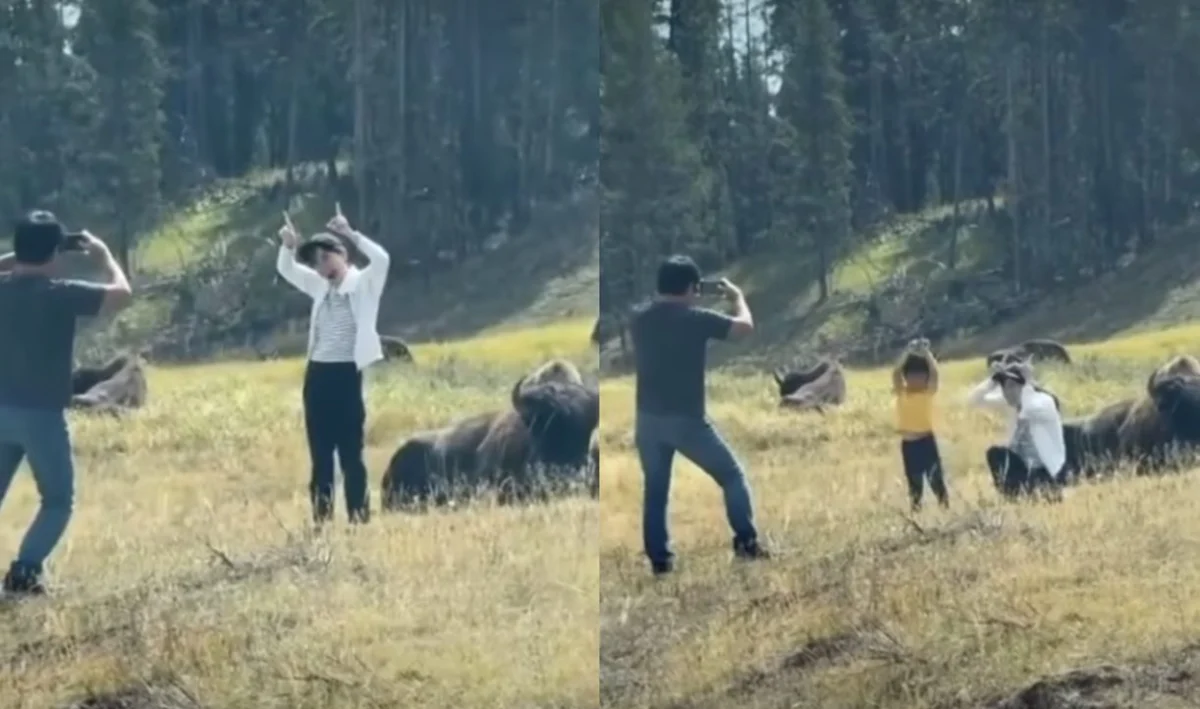
Yellowstone National Park, a cornerstone of the American wilderness spanning Wyoming, Montana, and Idaho, has once again become the site of a high-risk wildlife encounter that has sparked national debate regarding visitor safety and the ethics of wildlife interaction. A recently circulated video captures a woman and her young child approaching a mature American bison at a distance far below the federally mandated safety limit. The incident, which occurred in a high-traffic area of the park, highlights a growing trend of "wildlife tourism" where the desire for social media content appears to supersede personal safety and ecological respect.
The footage, which has been widely shared on platforms dedicated to documenting irresponsible tourist behavior, shows a woman posing for a photograph within a few feet of a resting bison. In a sequence that onlookers described as highly dangerous, the woman is seen turning her back to the animal—a 2,000-pound herbivore capable of explosive speed—and placing her fingers on her head to mimic the animal’s horns. The situation escalated further when the woman gestured for her young child to join her in the immediate vicinity of the animal for a joint photo opportunity.
Chronology of the Incident and Immediate Response
The event took place during the peak summer season, a period when Yellowstone experiences its highest volume of visitors. According to eyewitness accounts and the individual who recorded the footage, the encounter lasted several minutes. Despite the presence of other tourists and visible signage throughout the park warning of the dangers of wild animals, the mother and child remained within the animal’s "flight or fight" zone.
Eyewitnesses reported that several bystanders attempted to verbally warn the mother about the proximity of the bison. The individual filming the encounter can be heard expressing disbelief as the child was encouraged to approach the animal. According to the witness, they were prepared to intervene directly when a National Park Service (NPS) ranger arrived on the scene. The ranger reportedly moved to intercept the family and provide an immediate correction regarding park regulations. Fortunately, the bison remained docile during this specific interaction, and the family was able to retreat without physical injury.
The Biological Reality of the American Bison
The American bison (Bison bison) is the largest land mammal in North America. While often perceived by the public as slow-moving or cattle-like, biological data and park records indicate they are among the most dangerous animals in the National Park System. A mature bull can weigh up to 2,000 pounds and stand six feet tall at the shoulder. Despite their massive size, bison are remarkably agile; they can run at speeds up to 35 miles per hour—three times faster than the average human—and possess the ability to jump over fences and pivot with significant speed.
Biologists at Yellowstone emphasize that bison are unpredictable. Their behavior can change in an instant due to perceived threats, noise, or sudden movements. The National Park Service explicitly states that bison have injured more people in Yellowstone than any other animal, including grizzly bears and wolves. Common injuries resulting from such encounters include gorings, blunt force trauma from being tossed into the air, and secondary injuries from falls.
National Park Service Regulations and Safety Guidelines
The National Park Service maintains strict regulations under the Code of Federal Regulations (36 CFR § 2.2) regarding wildlife protection. These laws are designed to protect both the animals and the visitors. Current Yellowstone safety protocols require visitors to maintain a minimum distance of at least 25 yards (23 meters) from all large animals, including bison, elk, bighorn sheep, deer, moose, and coyotes. For apex predators such as bears and wolves, the mandated distance increases to 100 yards (91 meters).
The "Rule of Thumb" is a common educational tool used by rangers: if a visitor can cover the entire animal with their thumb held at arm’s length, they are likely at a safe distance. In the incident documented in the video, the mother and child were estimated to be less than five yards from the bison, a clear violation of federal guidelines.
Statistical Analysis of Wildlife Encounters in Yellowstone
The recent incident is not an isolated event but part of a documented increase in human-wildlife conflicts. A study of Yellowstone injuries between 1980 and 2015 revealed that bison were responsible for the majority of animal-related injuries to visitors. In 2022 alone, the park reported multiple incidents of visitors being gored or charged after approaching bison too closely.
Data suggests that the primary driver of these encounters is a lack of situational awareness or a deliberate disregard for safety in favor of photography. Between 2010 and 2020, the rise of smartphone technology and social media platforms coincided with a measurable uptick in "close-proximity" interactions. The National Park Service has responded by increasing its digital footprint, using social media to educate the public on the "Yellowstone Pledge," which encourages visitors to act as stewards of the park.
The Influence of Social Media and the "Touron" Phenomenon
The term "touron"—a portmanteau of "tourist" and "moron"—has gained traction in online communities to describe visitors who engage in risky or ecologically damaging behavior. Accounts such as "Tourons of National Parks" serve as a digital archive of these incidents, often drawing millions of views. While these platforms provide a space for public shaming, experts in tourism management argue they also highlight a systemic issue in how modern travelers perceive wild spaces.
Psychological analysis of such behavior suggests a "Disneyfication" of nature, where visitors view national parks as controlled environments or outdoor museums rather than raw, unpredictable ecosystems. The desire for a "perfect" or unique photograph for social media often creates a cognitive bias where the perceived social reward outweighs the physical risk. In the case of the mother and child at Yellowstone, the act of mimicking the animal’s horns for a photo suggests a level of anthropomorphism that ignores the animal’s wild nature.
Legal and Ethical Implications of Wildlife Disturbance
Approaching wildlife in a national park is not merely a safety risk; it is a federal offense. Violating wildlife distance regulations can result in fines ranging from several hundred to several thousand dollars, and in extreme cases, may lead to jail time or a permanent ban from the park. Furthermore, when animals become "habituated" to human presence or are involved in an attack, the animal often pays the ultimate price. While bison are rarely euthanized following an encounter, other animals like bears or elk may be destroyed if they are deemed a recurring threat to public safety due to human-induced habituation.
The ethical implications of the recent video are particularly concerning to child safety advocates. By encouraging a child to approach a 2,000-pound wild animal, the parent is not only violating park law but is also bypassing fundamental safety instincts. This behavior sets a precedent for the child’s future interactions with nature, potentially leading to more dangerous encounters in adulthood.
Long-term Solutions for Visitor Safety and Conservation
In response to the persistent issue of tourists approaching wildlife, the National Park Service has considered various management strategies. These include:
- Enhanced Enforcement: Increasing the presence of law enforcement rangers in known wildlife "hotspots" such as the Hayden and Lamar Valleys.
- Infrastructure Modifications: Installing more physical barriers or designated viewing platforms to separate humans from grazing areas, though this is often criticized for detracting from the park’s natural aesthetic.
- Mandatory Education: Implementing a required safety briefing or video for all visitors upon entry to the park, similar to the protocols in place at some international wildlife reserves.
- Technological Solutions: Utilizing geofencing and mobile alerts to notify visitors when they are entering high-density wildlife zones.
The incident involving the mother and child serves as a stark reminder of the thin line between a memorable vacation and a tragic accident. As Yellowstone National Park continues to see record-breaking attendance numbers, the responsibility for safety remains a dual burden shared by the National Park Service and the visitors themselves. Conservationists argue that the "wild" in wilderness can only be preserved if humans respect the boundaries of the creatures that inhabit it. For the mother and child in the video, the encounter ended without bloodshed, but for the National Park Service, it remains a cautionary tale in the ongoing struggle to manage the intersection of human curiosity and wild nature.