Johan Budi
The international jazz landscape has seen a significant infusion of diverse archival and contemporary recordings, spanning from the historic big band traditions of the Baltic states to the refined small-group aesthetics of New York City and the experimental solo piano works of the modern era. These releases, featuring Latvian icon Raimonds Pauls, the late legendary drummer Jimmy Cobb, and the contemporary composer Tetsuro Hoshii, represent a broad spectrum of the genre’s evolution. While each artist operates within a distinct cultural and chronological framework, their collective contributions highlight the ongoing global dialogue within jazz music, emphasizing technical precision, historical preservation, and the therapeutic potential of improvisation.
The Latvian Big Band Tradition: Raimonds Pauls and the Radio Big Band
Raimonds Pauls, born in 1936, remains a central figure in the cultural history of Eastern Europe, though his work has historically seen limited distribution in the United Kingdom and North America. His latest release, Jazz Suite Moments, issued by Jersika Records, serves as both a tribute to the late trumpeter and arranger Gunārs Rozenbergs and a showcase for the enduring vitality of the Latvian Radio Big Band.
Pauls’ career is inextricably linked with the political and cultural shifts of Latvia. After gaining early experience playing piano in the clubs and restaurants of Riga during the 1940s, he transitioned into formal leadership roles that would define the nation’s musical output. In 1973, he founded the jazz-rock ensemble Modo, and by 1978, he was appointed the music director and conductor of the Latvian Radio and Television Orchestra. His influence extended beyond the stage into the halls of government; from 1988 to 1993, a period covering Latvia’s transition to independence from the Soviet Union, Pauls served as the Latvian Minister of Culture.
The Jazz Suite Moments EP features a 19-piece orchestra conducted by Kārlis Vanags. The recording, captured in Riga in March 2025, utilizes a high-fidelity vinyl format to present a five-part suite. The composition is noted for its adherence to the mid-20th-century American big band aesthetic, drawing stylistic comparisons to the "Atomic" period of the Count Basie Orchestra and the "Herman Herds." Analysts of the work point to Pauls’ piano style as being informed by the technical brilliance of Oscar Peterson and the rhythmic nuance of Erroll Garner.
Technical Specifications and Ensemble Composition
The recording features a standard big band configuration, augmented by a Hammond organ within the rhythm section, a choice that adds a specific tonal weight to the arrangements. The Side A duration is 16:27, encompassing the first three parts of the suite, while Side B concludes the work with two parts totaling 7:44. This release is part of a broader effort by Jersika Records to document the legacy of Latvian jazz, which flourished under complex socio-political conditions during the 20th century.
Preservation of the Hard Bop Legacy: Jimmy Cobb’s Jazz In The Key Of Blue
In a significant move for jazz archivists and audiophiles, Chesky Records has reissued Jazz In The Key Of Blue, a 2008 recording led by the late drummer Jimmy Cobb. Cobb, who passed away in 2020, was famously the last surviving member of the Miles Davis sextet that recorded the 1959 landmark album Kind of Blue. This reissue brings back into focus a session recorded at St. Peter’s Episcopal Church in New York City, a venue renowned for its acoustic properties and its historical "Jazz Vespers" series.
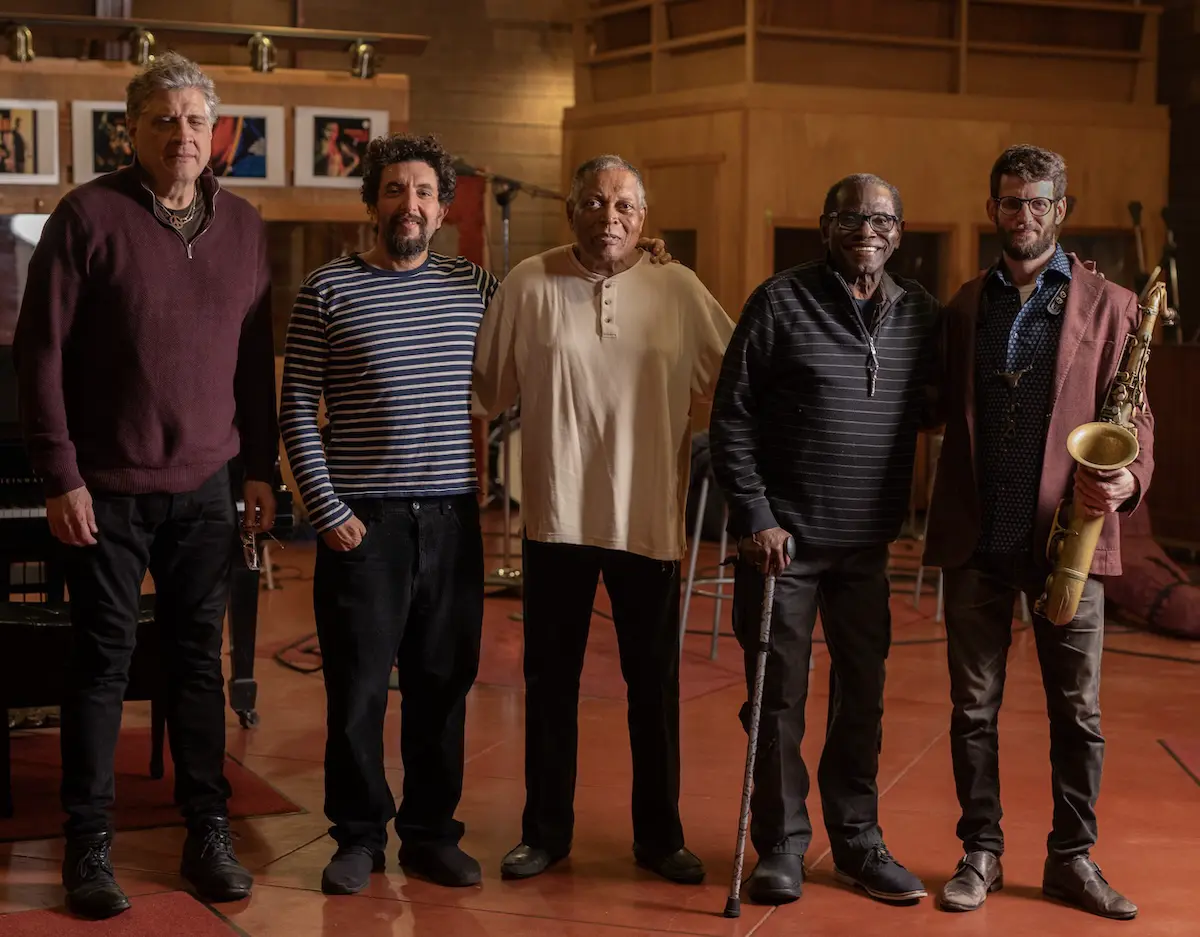
The quartet assembled for this session was notable for its lack of a pianist, a structural choice that allowed for greater harmonic transparency between the lead instruments. The ensemble included trumpeter and flugelhornist Roy Hargrove, guitarist Russell Malone, and bassist John Webber. The session was primarily focused on ballads, a creative direction reportedly suggested by Cobb’s wife, which resulted in a recording defined by restraint and atmospheric depth.
Recording Dynamics and Historical Context
The 2008 session occurred at a time when the members were at the height of their respective careers. Roy Hargrove, a multi-Grammy winner who would pass away in 2018, provided a "serious" and lyrical interpretation of standards such as "Stairway to the Stars." Bassist John Webber later noted that the session was largely unrehearsed, functioning more like a live "gig" where the musicians relied on their collective intuition and shared vocabulary of the Great American Songbook.
The reissue includes new liner notes by Charles Waring, incorporating fresh perspectives from the surviving musicians. The album’s tracklist features a mix of classic standards and modern compositions, including Johnny Mandel’s "Emily" and Billy Preston’s "With You I’m Born Again," both performed in 3/4 time. The recording quality, a hallmark of the Chesky label, emphasizes the subtle brushwork of Cobb, who remained a master of the "quiet" approach to jazz drumming until his final years.
Contemporary Improvisation: Tetsuro Hoshii’s Post-Pandemic Reflections
Representing the modern, globalized state of jazz, Japanese composer and pianist Tetsuro Hoshii has released Everything Is Alive. Based in New York City, Hoshii’s background is a synthesis of formal education and self-taught exploration. A graduate of the Senzoku College of Music in Japan and the Berklee College of Music in Boston, Hoshii was a recipient of the Wayne Shorter Award, an honor reserved for composers demonstrating exceptional original vision.
Everything Is Alive is a solo piano project recorded in a single session in 2022 and mastered in Oslo, Norway, in 2025. The album consists of 20 tracks that blur the lines between contemporary jazz and modern classical music. Hoshii has stated that the album was conceived in the aftermath of the global pandemic as a "healing" project, intended to explore the relationship between silence, resonance, and spontaneous creation.
Structural Analysis of Everything Is Alive
The album is almost entirely improvised, with the exception of two tracks: "Bravery" and "A Fisherman’s Grave." This reliance on spontaneity places the work within the tradition of solo piano innovators like Keith Jarrett, though Hoshii incorporates a modern classical sensibility that suggests influences from film scores and 20th-century minimalism. The recording took place at Big Orange Sheep in Brooklyn, a studio known for its high-end piano captures.
Despite its improvisational nature, the album has been described as a "deeply personal and reflective" body of work. However, some industry observers note that the 20-track duration and the similarity in tone across the pieces challenge the traditional boundaries of the jazz genre, leaning closer to ambient or neoclassical territories.
Chronology of Key Events and Releases
The following timeline illustrates the intersection of these three artists’ careers and the historical context of their latest releases:
- 1936: Raimonds Pauls is born in Riga, Latvia.
- 1959: Jimmy Cobb performs on Miles Davis’s Kind of Blue, establishing his place in jazz history.
- 1973: Pauls founds the group Modo, introducing jazz-rock elements to the Baltic region.
- 1988–1993: Pauls serves as the Latvian Minister of Culture.
- 2008: The Jimmy Cobb Quartet records Jazz In The Key Of Blue at St. Peter’s Episcopal Church, NYC.
- 2015: Tetsuro Hoshii forms The Doggy Cats in New York City.
- 2019: Hoshii’s album Daikon Pizza receives national recognition on NPR’s Fresh Air.
- 2020: Death of Jimmy Cobb at age 91.
- 2022: Tetsuro Hoshii records the solo sessions for Everything Is Alive.
- March 2025: Raimonds Pauls and the Latvian Radio Big Band record Jazz Suite Moments.
- 2025: Reissue of Cobb’s Jazz In The Key Of Blue and the mastering of Hoshii’s solo work are completed.
Broader Impact and Industry Implications
The simultaneous emergence and re-emergence of these works highlight several trends within the global music industry. First, the reissue of Jimmy Cobb’s quartet work underscores the continued demand for high-quality archival recordings from the "Golden Age" of jazz, particularly those featuring late masters like Cobb and Hargrove. Labels like Chesky Records play a vital role in preserving these performances for a new generation of listeners who value both historical significance and audiophile-grade sound.
Second, the release of Raimonds Pauls’ work in the UK and broader European markets signals an increasing interest in "regional" jazz histories. As the jazz canon expands, the contributions of Eastern European musicians—who often worked under the constraints of state-controlled cultural policies—are being re-evaluated for their technical prowess and unique stylistic adaptations.
Finally, Tetsuro Hoshii’s solo work reflects the shifting definition of jazz in the 21st century. As younger musicians move away from strict genre boundaries, the emphasis on "spontaneous solo performance" and "resonance" suggests a future where jazz is as much about psychological and atmospheric exploration as it is about traditional swing or bebop structures.
Collectively, these three releases provide a comprehensive view of the genre’s past, present, and future, proving that jazz remains a resilient and evolving form of artistic expression. Whether through the massive sound of a 19-piece big band, the intimate dialogue of a piano-less quartet, or the solitary reflections of a solo pianist, the commitment to musical excellence remains the common thread.