 Nayara Elvina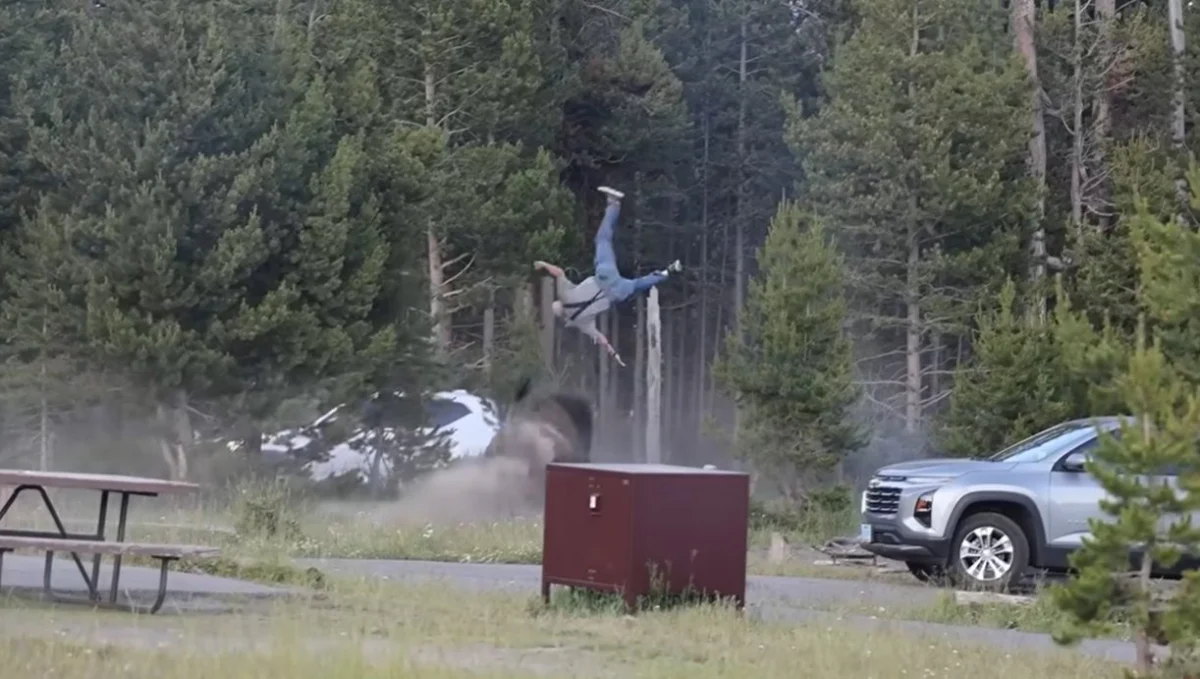
A male visitor to Yellowstone National Park sustained life-threatening injuries on Friday, July 10, 2026, after an agitated bull bison charged and launched him approximately eight to ten feet into the air. The incident, which occurred near the Bridge Bay Campground south of Fishing Bridge, was captured in its entirety by professional wildlife photographer Mike MacLeod. The footage provides a stark illustration of the unpredictable nature of megafauna during the annual mating season, commonly known as the rut. According to witnesses and the photographer, the victim was accompanied by his grandson at the time of the encounter. While the grandson was able to escape the charging animal without physical harm, the older man remains under intensive medical care for significant injuries resulting from the impact and subsequent fall.
Chronology of the Incident
The encounter began in the early evening hours as the man and his grandson observed a bull bison from what appeared to be a standard safety distance. According to MacLeod’s account and the resulting video evidence, the bison was already exhibiting signs of extreme agitation prior to the tourists’ arrival. The animal had been "wallowing"—a behavior where bison roll in the dirt to leave scent and shed fur—and was reportedly charging various objects in the vicinity.
The sequence of events escalated rapidly when a white pickup truck drove past the bison’s location. The bull, apparently perceiving the vehicle as a threat or a rival, charged the truck. As the vehicle accelerated away, the bison immediately redirected its aggression toward the man and his grandson, who were standing nearby. Recognizing the danger, the man attempted to use the natural landscape for protection, weaving between small trees and saplings to create a barrier between himself and the animal.
The bison, weighing an estimated 2,000 pounds, initially focused its rage on a small sapling, headbutting and snapping the wood. However, this distraction lasted only seconds. The bull quickly bypassed the vegetation and closed the gap between itself and the man. Despite the man’s efforts to retreat, the bison struck him with its head and horns, hoisting him into the air with enough force to propel him nearly ten feet above the ground. The victim landed heavily on his side, sustaining what medical responders have characterized as serious traumatic injuries. Park rangers and emergency medical services were dispatched to the Bridge Bay area shortly after the attack to stabilize the victim for transport to a regional trauma center.
Biological Context: The Bison Rut
The severity of this attack is closely linked to the biological cycle of the American bison (Bison bison). The incident occurred during the peak of the rut, which typically spans from late July through August. During this period, male bison experience a significant surge in testosterone, leading to heightened aggression, territoriality, and a near-total loss of tolerance for perceived intruders, whether they be vehicles, other animals, or humans.
During the rut, bulls engage in several distinct behaviors that serve as warning signs to observers. These include:
- Bellowing: A deep, guttural roar used to signal dominance and attract females.
- Wallowing: Rolling in dry pits to coat themselves in dust and urine, which advertises their presence to rivals.
- Horning: Using their massive heads and horns to strike trees, shrubs, or the ground to demonstrate strength.
In the case of the Bridge Bay incident, the bull was observed performing these behaviors shortly before the charge. Wildlife biologists note that during this season, the "flight or fight" threshold of a bison is significantly lowered. An animal that might appear docile in June can become a lethal threat in July with little to no provocation. The physical capabilities of these animals further exacerbate the danger; despite their massive size, bison are capable of sprinting at speeds up to 35 miles per hour and can jump over obstacles six feet high.
National Park Service Safety Regulations
The National Park Service (NPS) maintains strict guidelines regarding wildlife viewing to prevent such tragedies. Current regulations mandate that visitors stay at least 25 yards (75 feet) away from large herbivores, including bison, elk, and deer, and at least 100 yards (300 feet) away from bears and wolves.
Initial reports suggest that the family involved in the Friday incident may have believed they were maintaining a safe distance. However, MacLeod’s testimony indicates that the bison’s agitation was so extreme that the standard 25-yard rule was insufficient for the circumstances. NPS officials frequently emphasize that these distances are minimum requirements and should be increased if an animal shows signs of distress or aggression.
This event marks the second documented bison-related injury in Yellowstone for the 2026 calendar year. Unlike many previous incidents where tourists were injured while attempting to take "selfies" or pet the animals, this specific case appears to be a matter of "wrong place, wrong time," where the victim was caught in the path of an animal already engaged in a territorial display.
Historical and Comparative Data
Yellowstone National Park is the only location in the United States where bison have lived continuously since prehistoric times. The current population fluctuates between 2,300 and 5,500 animals. Because of the high density of both bison and tourists, Yellowstone records more wildlife-related injuries from bison than from any other species, including grizzly bears.
Data from the Journal of the American Medical Association (JAMA) and NPS archives indicate that bison attacks often result in blunt force trauma, puncture wounds from horns, and secondary injuries from being thrown or trampled. A 2019 study of bison-related injuries in the park found that the majority of victims were struck by the bison’s head, leading to internal bleeding and orthopedic fractures. The force of a 2,000-pound animal moving at 30 miles per hour is comparable to being hit by a small vehicle.
Management and Public Reaction
The footage of the attack has sparked a renewed debate regarding visitor safety and wildlife management in national parks. While some social media commentary has been critical of the tourists, professional observers like MacLeod have noted that the situation was uniquely volatile due to the rut.
"The bison was angry, agitated, and charging anything and everything," MacLeod stated in his report to local news outlets. This observation highlights the difficulty the public faces in assessing wildlife behavior. To an untrained eye, a bison standing in a field may look like a domestic cow; to a biologist, a wallowing bull in July is a high-velocity hazard.
The National Park Service has not yet issued a formal statement regarding the specific condition of the victim, citing privacy concerns, but they have reissued a park-wide alert reminding visitors of the dangers of the mating season. "Bison are not aggressive animals by nature, but they are defensive of their space," an NPS spokesperson noted in a general safety briefing. "During the rut, that ‘personal space’ expands significantly."
Analysis of Implications for Park Policy
The 2026 incident may prompt the NPS to consider more aggressive temporary closures of high-traffic areas like Bridge Bay Campground when aggressive bulls are known to be present. Currently, the park relies heavily on education and signage to manage human-wildlife interactions. However, as visitor numbers continue to rise—Yellowstone frequently sees over four million visitors annually—the statistical likelihood of accidental encounters increases.
There is also a growing call for enhanced "wildlife literacy" programs. While signs inform visitors of the 25-yard rule, they often do not explain the nuances of animal behavior, such as how to recognize a "pre-charge" posture. Enrichment of educational materials to include specific rut-season warnings could potentially mitigate future risks.
From a conservation standpoint, the behavior of the bison is viewed as a natural and necessary part of the ecosystem. The rut ensures the continuation of the herd’s genetics and the survival of the species. As such, the NPS rarely takes punitive action against an animal involved in an attack unless the animal is determined to be diseased or is persistently predatory, which is not the case with bison.
Conclusion
The violent encounter at Bridge Bay serves as a somber reminder of the "wild" in wilderness. As the victim continues his recovery, the incident stands as a case study in the power and unpredictability of Yellowstone’s most iconic resident. For visitors planning to travel to the park during the remainder of the summer, the message from officials is clear: the majesty of the bison is best appreciated through a long-range lens, particularly when the biological imperatives of the rut are in play. The physical agility and raw power demonstrated in the MacLeod footage confirm that in a confrontation between a human and a bison, the human is at a permanent and life-threatening disadvantage. Management of these interactions remains one of the greatest challenges for the National Park Service as they balance the mission of preservation with the reality of public access.