Mia Khoirunisa
In an era dominated by polished, subscription-based audio production suites and browser-native modular tools generated by automated software, the digital audio workstation (DAW) landscape has seen the unexpected emergence of Septabee. Developed in secret over an estimated 20,000 hours, Septabee is a free, early-access software application for Linux and Windows platforms created entirely by a single independent developer known as Lost Robot. The software has quickly generated significant discussion among music producers, sound designers, and digital artists for its unorthodox dataflow interface, unconventional development history, and unapologetically raw implementation.
Unlike mainstream digital audio workstations designed for streamlined commercial workflows, Septabee occupies a niche closer to experimental programming environments and generative art tools. Distributed as freeware—often described in software circles as "free as in beer" rather than open-source—the application invites users into a chaotic, node-based workspace that challenges traditional paradigms of music composition, synthesis, and signal routing.
Chronology and Development History
The genesis of Septabee traces back several years through developer logs and archives preserved within community Discord channels. Initially conceived under the working title Woven Music Studio, the project began as a rudimentary audio experimentation framework written in the C++ integrated development environment Code::Blocks using the Simple and Fast Multimedia Library (SFML). According to retrospective developer notes, the project originated at a time when the creator possessed minimal formal experience in digital signal processing (DSP) architecture or professional DAW design.
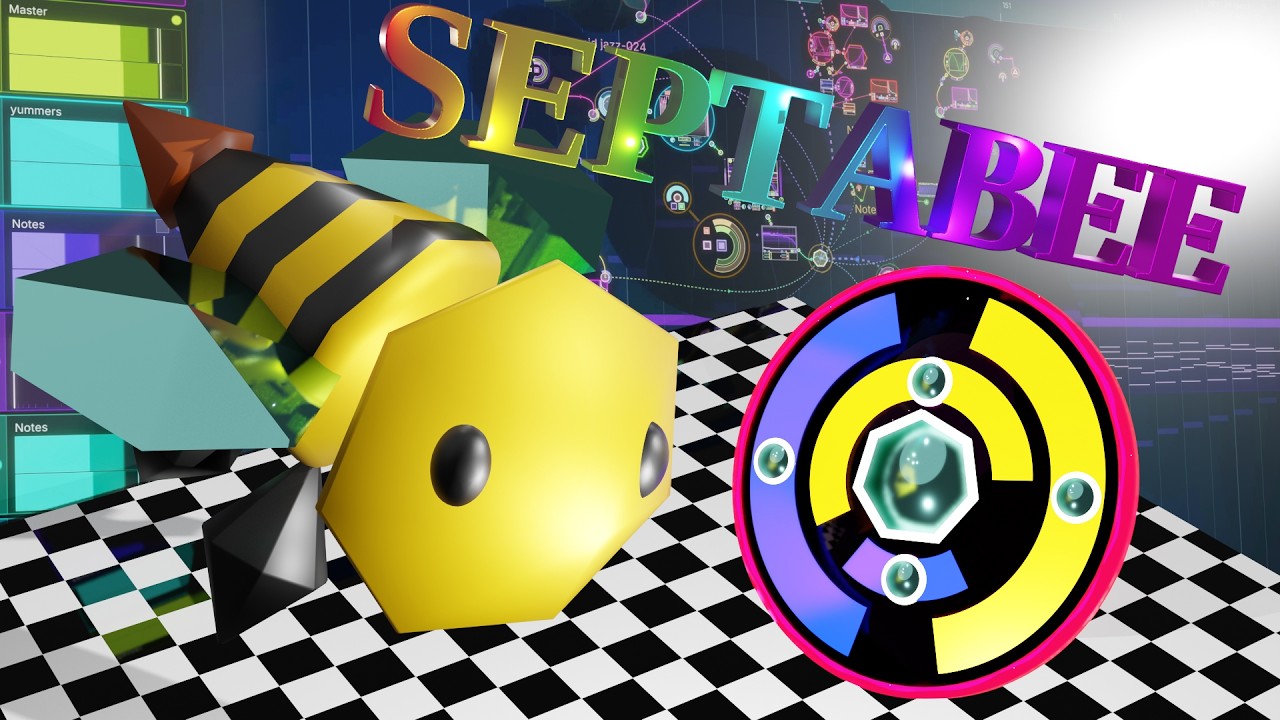
Over the course of its multi-year development cycle, the software underwent numerous structural overhauls. The codebase eventually transitioned to rely on text editors and the Vulkan graphics API for low-level rendering and hardware acceleration. Visual prototypes evolved steadily, moving from basic geometric shapes to the fluid, jiggly node interfaces characteristic of the current release.
The developer has frequently highlighted the iterative nature of the process, noting that writing and discarding entire DAW frameworks from scratch repeatedly was instrumental in refining the software’s core engine. Eventually, this trial-and-error methodology culminated in Septabee, a system jokingly or cryptically referenced by its creator as being written not in standard C++, but in an esoteric language designated as "B++."
Core Architecture and Technical Features
Despite its chaotic aesthetic and deliberately abrasive distribution methods, Septabee incorporates robust technical features that appeal to advanced sound designers and practitioners of microtonal and algorithmic music.
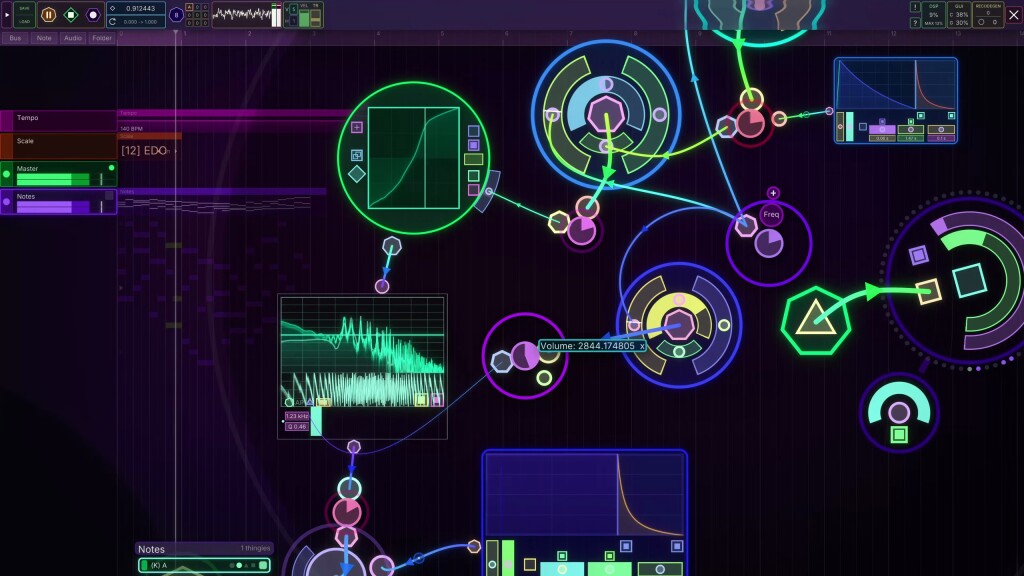
The application utilizes a sample-accurate, node-based dataflow architecture. Users can patch audio, modulation, and control signals freely across a sprawling virtual canvas. Among its more eccentric design choices is a pomegranate-themed metaphor integrated into the modular patching system—where the "P" and "Z" keys serve interchangeable functions—alongside advanced mathematical operators that can be embedded directly into patch cables to manipulate signals in transit.

Key technical specifications and capabilities of Septabee include:
- Node-Based Signal Flow: Real-time, sample-accurate phase modulation allowing users to cross-modulate parameters previously restricted in traditional linear environments.
- Custom Microtuning and Patter Engine: Support for arbitrary tuning systems and programmable pattern generators patched directly into signal paths.
- Instrument and UI Authoring: Tools designed to allow users to construct custom virtual instruments and, in upcoming updates, proprietary graphical user interfaces.
- SoundFont (SF2) Compatibility: Integration capabilities for external sample libraries and classic soundfont formats.
- Cross-Platform Availability: Compiled binaries provided specifically for Linux and Windows operating systems.
The software is distributed via an intentionally retro, early-90s-style website hosted on Nekoweb that automatically plays embedded audio upon loading. This deliberate aesthetic choice mirrors the underground distribution methods of early shareware and demoscene software.
Industry Reception and Community Impact
As Septabee moves through its early-access phase, initial reactions from the electronic music production community have highlighted a growing appetite for software that rejects corporate minimalism in favor of creative friction. While mainstream software developers increasingly rely on artificial intelligence integration, cloud synchronization, and simplified user interfaces to attract broader consumer bases, Septabee appeals to a counter-cultural segment of producers interested in generative composition, black MIDI, and avant-garde sound manipulation.
Early adopters have begun publishing demonstration tracks and technical explorations across platforms like Newgrounds and decentralized social media networks. These early works demonstrate the software’s capability to generate complex polyrhythms, dense microtonal soundscapes, and intricate frequency modulation patches.
Broader Implications for Audio Software Engineering
The release of Septabee underscores a broader shift in independent software development. The barriers to entry for creating complex audio applications have lowered significantly due to advancements in graphics APIs like Vulkan and the availability of robust community knowledge bases. At the same time, the sheer volume of newly released audio tools—ranging from AI-assisted browser utilities to deeply idiosyncratic standalone DAWs—has created an oversaturated market where standing out requires either absolute corporate polish or extreme, deliberate eccentricity.
Because Septabee is proprietary freeware rather than open-source software, the underlying mechanics of its "B++" codebase remain opaque to external developers. This lack of source transparency introduces potential security and stability considerations for users integrating the software into production workflows. However, for a specific demographic of experimental artists, the inherent instability and unpredictable nature of "violently unfinished" software are viewed as artistic advantages rather than technical liabilities.
As the community surrounding Septabee continues to expand through dedicated Discord channels and shared user projects, the software serves as a notable case study in solo application development, demonstrating that highly idiosyncratic, non-commercial software can still capture the imagination of producers seeking alternatives to conventional digital audio workstations.